
ContextLogic Holdings’ Transformation From Wish Platform to Salt Manufacturing Enterprise
ContextLogic has shifted from operating the Wish marketplace to owning and integrating US Salt, marking a strategic overhaul with significant financial and operational implications.
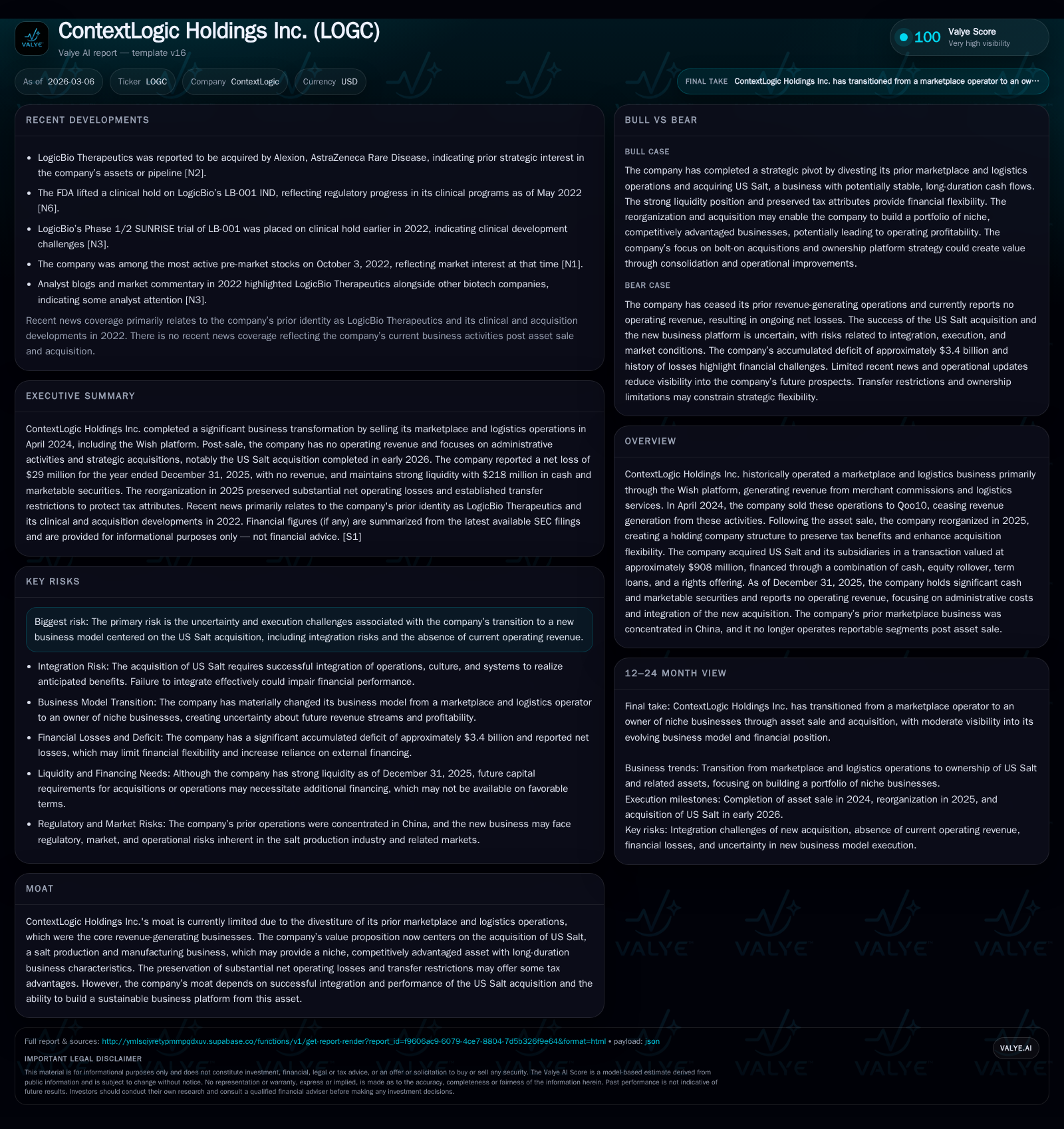
Following the April 2024 divestiture of its Wish marketplace and logistics operations, ContextLogic Holdings restructured into a holding company, acquiring US Salt for approximately $908 million. The acquisition was financed through a combination of cash, equity rollover, term loans, and a rights offering backed by institutional investors. The company reports no current operating revenues and has recorded operating losses while focusing on integrating the industrial salt production business. Its capital structure features significant liquidity supported by marketable securities and debt facilities subordinated only to modest liabilities. Near-term performance hinges on successful post-acquisition integration and capital deployment from a primarily administrative cost base.
From E-Commerce to Manufacturing: The Evolution of ContextLogic’s Business Model
Historical performance (annual)
| FY |
|---|
| 2025 |
Source: SEC companyfacts cache [F1].
ContextLogic Holdings Inc. historically generated revenue primarily through its Wish platform — an e-commerce marketplace that facilitated third-party merchant transactions complemented by logistics services. The company's revenue streams consisted mainly of merchant commissions on sales conducted via the platform and logistics fees for end-to-end shipment services.[S1][S14]
However, this business model was fundamentally altered when ContextLogic divested its core marketplace and logistics operations in April 2024, selling these assets to Qoo10. Post-sale, the company ceased generating operational revenues related to marketplace or logistics activities.[S1] The divestiture marked a strategic exit from digital commerce platforms toward ownership and operation within a physical manufacturing niche.
In 2025, management completed a reorganization establishing ContextLogic Holdings Inc. as a Delaware holding company structure. This move was designed to preserve valuable net operating loss carryforwards for tax purposes and enhance acquisition flexibility. The previous entity, ContextLogic Inc., became a wholly owned limited liability company subsidiary under this new holding framework.[S1][S17]
The company's moat diminished materially with the sale of Wish platform assets but is now repositioned around the newly acquired US Salt business — a salt production and manufacturing operation offering long-duration asset qualities in an industrial commodity sector.[S1]
Financial Recap: Historical Performance and Profitability Challenges
With marketplace revenues terminated post-April 2024 sale, ContextLogic recorded zero top-line revenue for fiscal year ended December 31, 2025.[F1][S1] Operating expenses primarily comprised general & administrative costs alongside stock-based compensation expenses totaling approximately $11 million.[S1]
Operating loss totaled $31 million for full-year 2025; net loss attributable to common stockholders was $23 million.[F1][S1] Interest income earned on cash balances partially offset losses by roughly $8 million.[S1]
At year-end, cash and equivalents stood at $77 million with total current assets reaching $218 million due mainly to the inclusion of marketable securities totaling about $141 million.[F1][S24] Current liabilities were minimal at approximately $7 million resulting in an exceptionally strong current ratio near 31x — underscoring solid short-term liquidity amid no operating revenues.[F1]
The cumulative deficit since inception aggregated to about $3.4 billion reflecting historical investment losses in prior digital operations transitioning into industrial asset ownership.[F1]
| Metric | Value (USD millions) |
|---|---|
| Operating Income | -31 |
| Net Income | -23 |
| Cash & Equivalents | 77 |
| Current Assets | 218 |
| Current Liabilities | ~7 |
| Accumulated Deficit | -3400 |
| Return on Equity (%) | -17.3% |
US Salt Acquisition: Strategic Rationale and Transaction Structure
The transformative event in late 2025 was ContextLogic’s acquisition of US Salt LLC and subsidiaries for approximately $908 million subject to customary adjustments.[S1][S17][S26]
Transaction consideration mixed about $583 million in cash (funded partly by borrowings), approximately $325 million equity rollover from sellers, along with proceeds from institutional rights offering backstops totaling roughly $115 million.[S1][S26] Rights offerings were only partially subscribed directly by shareholders (about $3 million), leading backstop parties—namely BCP Special Opportunities Fund III Originations LP ("BCP") and affiliated entities ACP I/II — to purchase significant portions: BCP acquired around $89 million in Preferred Units priced at $8 per unit; ACP I/II collectively contributed about $23 million of common stock purchases also at $8 per share.[S1][S26]
Additionally, ContextLogic entered into a Credit Agreement providing:
- A term loan facility totalling up to $215 million (Initial Term Loans fully drawn at closing)
- A revolving credit facility capped initially at $25 million with availability for letters of credit[S6][S7]
This multi-instrument financing structure illustrates a complex capital stack suited for a company pivoting from technology-driven commerce toward an industrial asset platform requiring longer investment horizons.[S7]
Liquidity Position and Capital Structure Post-Acquisition
As reported in the latest filings as of December 31, 2025:[F1][S4][S6][S8]
- Cash + marketable securities total nearly $218 million, predominately held in U.S. Treasury bills classified as Level 1/2 fair value assets.
- Current liabilities are low (~$7 million), mainly accounts payable and accrued expenses.
- Strong liquidity is reflected by a current ratio (~31.14), supportive amid zero revenues but expected working capital needs around US Salt integration.
- Debt profile holds term loans ($215M) maturing in February 2033 bearing SOFR plus margin interest ranging between 4.0%-4.5%, alongside revolving loans with covenant restrictions primarily focusing on minimum liquidity thresholds and leverage ratios when revolving borrowings exceed certain levels.
- Importantly, no financial covenants apply to the term loan facility itself; however, revolving credit access contains conditions restricting distributions or further indebtedness beyond specified parameters.[S4][S6][S8]
These attributes underscore an emphasis on preserving financial flexibility during operational recommencement within the salt manufacturing industry.
Operational Outlook: Integration Risks and Revenue Visibility
ContextLogic currently lacks explicit forward-looking guidance concerning revenue initiation or profit timelines following US Salt integration; rather, it anticipates commencing operating profits post-completion of acquisition integration activities.[S1]
Risk disclosures highlight uncertainties tied to execution challenges inherent in transitioning from technology-enabled marketplace operations to industrial manufacturing — including potential delays or cost overruns related to bolt-on acquisitions or operational consolidation within US Salt’s business units.[S15]
Furthermore, the successful realization of tax benefits linked to its substantial NOL packages depends substantially on maintaining ownership structures compatible with IRS regulations concerning change-of-control limitations.[S1]
Industrial clients reliant on salt production generally benefit from steady demand profiles albeit exposed to commodity price volatility; thus US Salt’s niche position offers some moat potential if managed effectively but overall remains nascent for ContextLogic’s capital markets narrative.
Capital Allocation Approach: Assessing Returns, Dividends, and Buybacks
The transition phase precludes meaningful capital return distributions; there are currently no declared dividends or share repurchase programs announced by ContextLogic post-transaction completion.[S27]
Redeemable non-controlling interests represented by Preferred Units issued predominantly to BCP accrue cumulative distributions:
- At an annualized rate of 4% pre-acquisition completion,
- Increasing to 8% per annum thereafter, with accrued amounts either payable in cash or convertible into common units under prescribed formulas.[S16][S27]
Return on equity remains negative at approximately -17.3%, reflecting carrying accumulated deficits paired with recent losses incurred during transition periods without substantive operating income generation yet recorded.[F1]
Capital markets transactions underpin resilience in balance sheet quality but actual returns will depend heavily on post-acquisition performance execution.
What Investors Should Monitor Going Forward
Given that explicit forward guidance is presently unavailable,[N/A] key indicators warranting scrutiny include:
- Timely completion of residual closing metric adjustments related to US Salt purchase price allocations;
- Progress toward first profitable quarters driven by integrated salt production operations;
- Ability to service debt obligations under credit facilities including covenant compliance concerning liquidity levels;
- Any incremental equity issuances or refinancing initiatives that impact shareholder dilution;
- Regulatory updates linked to transfer restrictions impacting tax shield utilization;
- Updates or transparency regarding bolt-on acquisitions consistent with stated strategy targeting complementary long-duration industrial businesses;
- Industry conditions affecting salt demand growth trajectories such as agricultural usage trends or chemical applications.
Careful monitoring of capital deployment efficiency during integration will be imperative given that prior digital platform revenue streams have conclusively ceased.
This analysis is based strictly on information contained within public filings [F1], [S#], and does not incorporate external forecasts or investive opinions. It aims solely to provide detailed context around ContextLogic Holdings’ recent strategic transformation towards industrial asset management following divestiture from e-commerce operations.
Disclaimer: This is research-only, informational analysis and not investment advice. It may include AI-generated interpretation and general industry context. Always verify important details using primary sources.

Comments