
Lineage Cell Therapeutics' Revenue Growth and Elevated Losses Highlight Funding Needs
Increasing collaboration revenues offset by rising operating losses and geopolitical risks shape Lineage's financial profile.
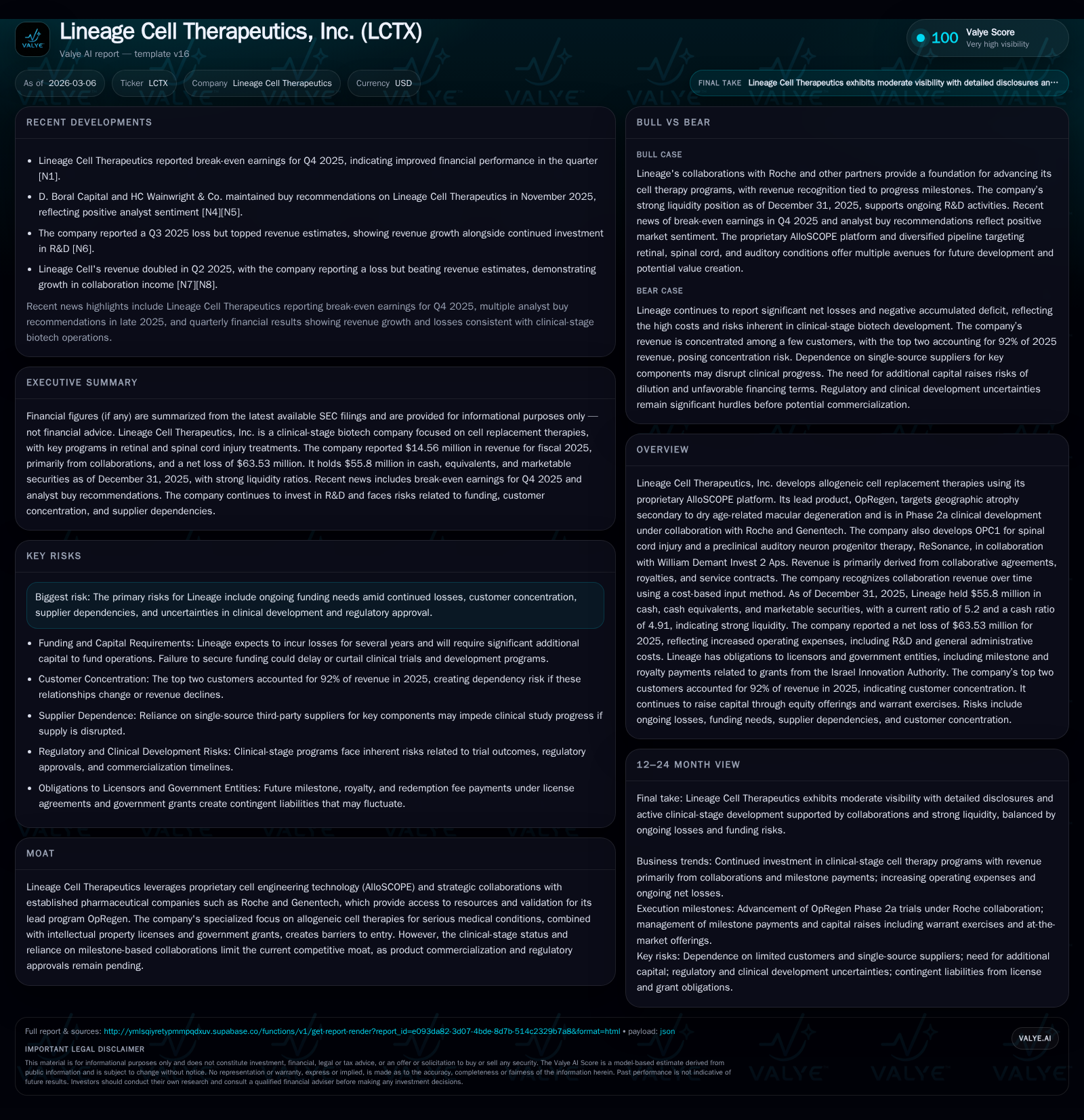
Lineage Cell Therapeutics reported a 53% revenue increase to $14.56 million in 2025 driven by collaboration milestones, notably with Roche/Genentech. Operating losses widened sharply to $36.6 million due to intensified R&D investments in cell therapy development. Net losses expanded to $63.5 million. Liquidity remains solid with $55.8 million in cash and marketable securities, supporting operations for at least the next twelve months, but ongoing capital requirements persist given the pre-commercial stage and milestone-dependent revenue streams.
Historical Financial Performance
Lineage Cell Therapeutics has experienced notable growth in collaboration-driven revenue, reaching $14.56 million in fiscal year 2025, a 53% increase compared to $9.50 million in 2024 [F1]. This growth largely stems from milestone payments under key collaborations, including the Roche/Genentech agreement for the OpRegen program targeting geographic atrophy associated with dry age-related macular degeneration (AMD) currently in Phase 2a trials [S1][N1].
Despite top-line growth, the company's operating results reflect substantial investment in advancing its cell therapy pipeline using the proprietary AlloSCOPE platform. Operating losses increased by over 70% to $36.6 million in 2025 from $21.5 million in 2024 [F1], driven by escalated research and development expenses related to clinical trial progression, regulatory activities, and manufacturing scale-up [S21]. Correspondingly, net loss widened significantly to $63.5 million [F1], consistent with the pre-commercial stage of the business.
The company’s operating cash flows improved modestly but remained negative at approximately $18.9 million compared with $23.1 million cash used in operations during 2024 [F1]. Capital expenditures were limited at $0.52 million, indicating reliance on external partners for manufacturing and clinical services rather than large internal infrastructure investments [F1][S21].
Historical performance (annual)
| FY | Rev ($mm) | Net ($mm) | CFO ($mm) | OpInc ($mm) | Rev YoY | Net YoY |
|---|---|---|---|---|---|---|
| 2025 | 15 | -64 | -19 | -37 | +53.2% | -241.4% |
| 2024 | 9 | -19 | -23 | -21 | +354.9% | -289.7% |
| 2023 | 2 | -5 | -29 | -6 | +9.0% | +24.9% |
| 2022 | 2 | -6 | 1 | -7 |
Source: SEC companyfacts cache [F1].
Capital returns and efficiency (annual)
| FY | FCF ($mm) | ROE% |
|---|---|---|
| 2025 | -19 | -142.6 |
| 2024 | -24 | -23.7 |
| 2023 | -29 | -7.5 |
| 2022 | 1 | -8.7 |
Source: SEC companyfacts cache [F1].
Note: Revenues mainly derive from milestone-based collaborations; losses reflect intensified R&D activity.
Growth Outlook and Pipeline Milestones
The future trajectory of Lineage hinges on successful clinical advancement of its lead asset OpRegen through its Roche/Genentech partnership targeting an unmet medical need in dry AMD patients with geographic atrophy [S1][S25]. Favorable Phase 2a trial results would support progression toward pivotal trials and potential regulatory submissions.
Additionally, Lineage is developing OPC1 cells for spinal cord injury repair and auditory neuron progenitors within the ReSonance preclinical collaboration funded by William Demant Invest up to $12 million over three years [S25][N1]. While these programs diversify the pipeline, they face standard scientific and regulatory challenges inherent in regenerative medicine.
Key risks include clinical trial uncertainties, regulatory review timelines potentially affected by national FDA staffing constraints [S10], geopolitical risks linked to the company's Jerusalem manufacturing facility vulnerable to regional conflicts and employee military service obligations [S1], as well as reliance on single-source suppliers for critical materials which could impact trial timelines [S7].
Given the early development stage without approved commercial products, revenue growth is expected to remain uneven and highly dependent on achievement of milestone events.
Capital Allocation and Funding Position
Lineage reported no dividends or share repurchases consistent with its status as a clinical-stage biotech investing heavily in R&D without commercial product revenues [S27]. The company held $55.8 million in combined cash, cash equivalents, and marketable securities as of December 31, 2025, supporting liquidity with a healthy current ratio of 5.2 [F1][S12].
Recent capital inflows included proceeds from warrant exercises totaling approximately $5 million in early March 2026 alongside funds raised through private placements such as a November 2024 registered direct offering (RDO). The company maintains an active at-the-market equity offering program with roughly $17.4 million capacity available for additional liquidity needs [S13][S27].
Financial obligations encompass contingent sublicense fees, milestone payments tied primarily to licensing agreements including Roche collaborations, royalty payments subject to Israeli Innovation Authority grant terms with an aggregate cap near $96 million plus redemption fees payable upon receipt of milestone or royalty payments [S8][S19]. These contingent liabilities are monitored closely but have not been recognized on the balance sheet due to uncertainty around timing.
Risks and Operational Challenges
Operational risks stem notably from Lineage's centralized manufacturing operations located in Jerusalem which may be disrupted by political instability or military reserve call-ups affecting employees including key executives [S1]. The company has contingency plans but prolonged disruptions could materially impact operations.
Customer concentration risk is elevated as two customers represented approximately 92% of total revenues in fiscal year 2025 including Roche/Genentech collaborations [S7][F1]. Legal proceedings related to intercompany agreements introduce governance uncertainty though management currently does not anticipate material adverse impacts on financials [S15][S18].
Summary
Lineage Cell Therapeutics is navigating typical challenges of a pioneering regenerative medicine developer: expanding milestone-driven revenues alongside escalating operating losses reflecting heavy investment into clinical development amid geopolitical risks tied to its manufacturing base.
Robust liquidity positions provide runway into the near term; however, sustained operational funding will depend on successful clinical progress especially for OpRegen and ability to secure additional capital when needed.
Investors should closely monitor upcoming clinical data readouts and partnership developments while considering inherent execution risks including geopolitical exposure and concentrated customer base.
This report synthesizes publicly available financial information from SEC filings and news sources solely for informational purposes.
Disclaimer: This is research-only, informational analysis and not investment advice. It may include AI-generated interpretation and general industry context. Always verify important details using primary sources.

Comments