
Ranger Energy Services' Revenue Growth Contrasted by Margin Compression and Capital Allocation Dynamics
The company’s expanded rig fleet and integrated service offerings drive top-line gains while profitability dips reflect cost pressures and competitive landscape.
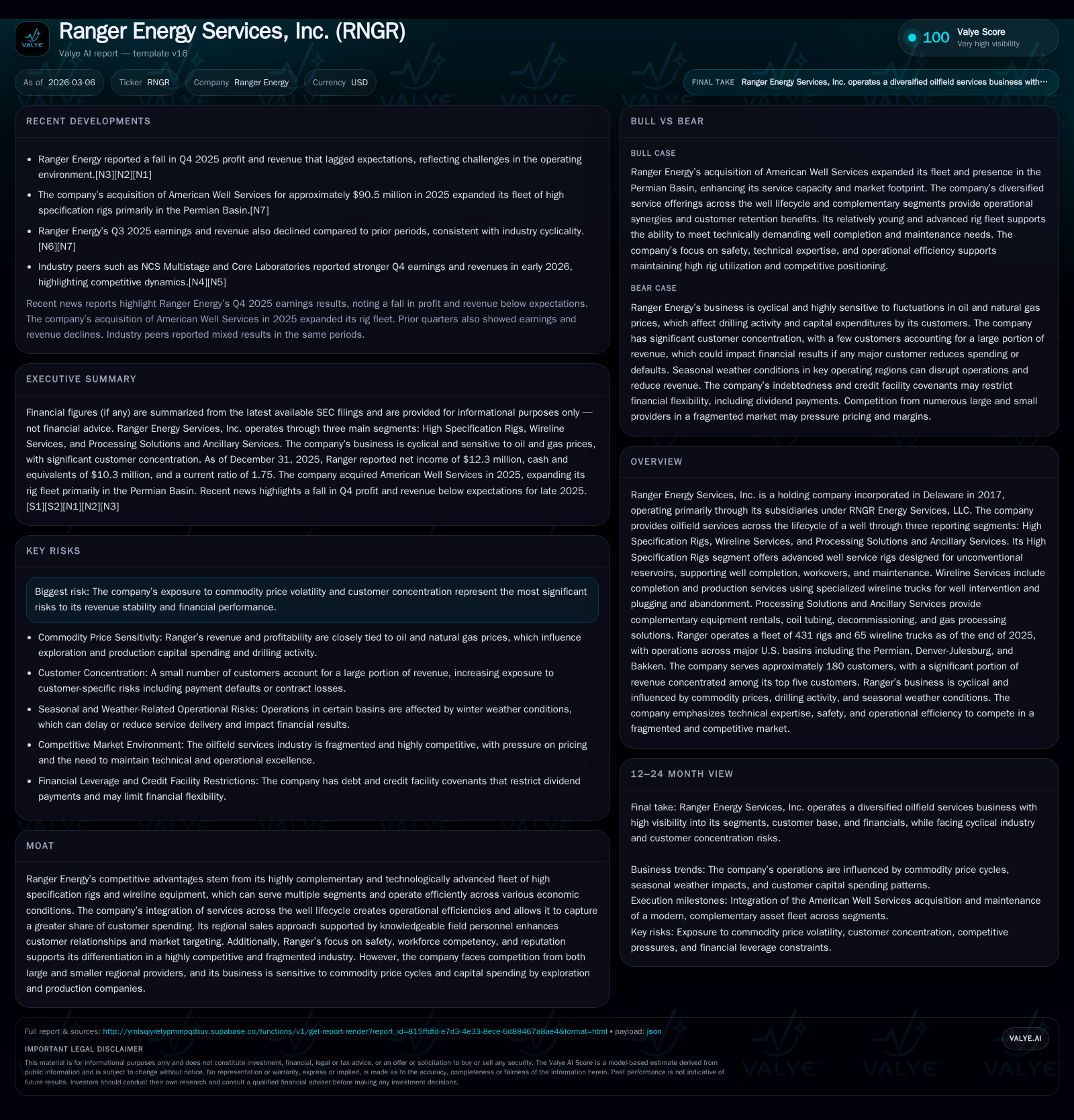
Ranger Energy Services, since its 2017 organization as a holding company, has grown notably through organic expansion and the 2025 acquisition of American Well Services, which bolstered its High Specification Rigs segment particularly in the Permian Basin. In 2025, revenue surged over 70% year-over-year, reaching $85.3 million, yet operating income contracted sharply by 46%, impacted by intensified competition and higher costs. Free cash flow remained positive at $42.9 million, supporting dividends and continued share repurchases. Key risks revolve around commodity price sensitivity, customer concentration, and regional exposure mainly in the Permian Basin. Future growth hinges on sustaining rig utilization amid fluctuating E&P capital spending and effectively integrating acquired assets.
Company Overview
Ranger Energy Services, Inc., established as a Delaware holding company in 2017 concurrently with its IPO, operates through RNGR Energy Services, LLC and its subsidiaries primarily in oilfield service segments including High Specification Rigs, Wireline Services, and Processing Solutions & Ancillary Services [S1][S20]. The firm supports unconventional reservoir drilling and production demands via advanced horizontal rigs designed for completion support, workovers, and maintenance operations.
The company's competitive strength arises from technological capabilities of its rig fleet alongside integrated lifecycle services that enhance operational efficiencies for upstream customers . A pivotal event was the acquisition of American Well Intermediate Holdings LLC (AWS) in 2025—focused within the Permian Basin—which significantly expanded the company's rig fleet and asset base within core growth geographies [S1][S20].
Historical Performance: Growth Drivers and Financial Trends
Between the IPO year (2017) and latest fiscal observations (2025), Ranger Energy executed substantial top-line expansion:
Historical performance (annual)
| FY | Net ($mm) | CFO ($mm) | OpInc ($mm) | Capex ($mm) | Net YoY |
|---|---|---|---|---|---|
| 2025 | 12 | 69 | 15 | 26 | -33.2% |
| 2024 | 18 | 85 | 29 | 34 | -22.7% |
| 2023 | 24 | 91 | 37 | 37 | +57.6% |
| 2022 | 15 | 45 | 20 | 14 |
Source: SEC companyfacts cache [F1].
Capital returns and efficiency (annual)
| FY | Div ($mm) | Buybacks ($mm) | FCF ($mm) |
|---|---|---|---|
| 2025 | 6 | 12 | 43 |
| 2024 | 5 | 16 | 50 |
| 2023 | 2 | 19 | 54 |
| 2022 | 31 |
Source: SEC companyfacts cache [F1].
*Revenue figure for FY2018 also reported as $85M; discrepancy likely reflects segmentation/definition changes over time [F1][S1]
Revenue surged approximately 70% between 2018 and 2025's full year as the company consolidated AWS services into its segments [S1]. This top-line growth manifests successful asset acquisitions but coincides with marked operating margin contraction — operating income declined nearly half from prior-year levels despite robust revenue, reflecting cost inflation pressures, mix shifts toward lower-margin business lines or pricing compression amid competitive intensity noted in recent earnings commentary [N1][N2][F1].
Net income mirrored this softness with a one-third decline relative to the prior year.
Operating cash flow has remained strong albeit decreasing by close to one-fifth from peak levels in early years post-acquisition, consistent with scale effects balanced against increased working capital demands.[F1]
Capex spending pulled back sharply compared to preceding years as Ranger managed investment intensity after fleet expansion.
Capital returns have been a focus: dividends rose steadily from initiation at $0.05 per share annually to quarterly payments of $0.06 entered in early 2026 [S3], supported by healthy free cash flow estimated at nearly $43 million (CFO minus capex). Share repurchases continued actively with over $12 million deployed during the latest fiscal period on top of significant prior authorizations [S13][F1].
Operational Segments and Geographic Concentration
Ranger operates three core reporting segments:
- High Specification Rigs: Delivering well completion support immediately after hydraulic fracturing; complex workovers; routine maintenance—all tailored to unconventional horizontal wells requiring precision equipment.
- Wireline Services: Utilizing specialized trucks for well intervention across completion, production enhancement, pipe recovery, abandonment.
- Processing Solutions & Ancillary Services: Equipment rentals including coil tubing units, decommissioning capabilities, gas processing solutions—integrated closely with primary rig activities [S1][S20].
The purchase of AWS fortifies High Specification Rigs presence specifically within the Permian Basin—a dominant drilling basin where about half of segment revenues derive [S8][S11][S16]. This regional emphasis concentrates exposure but leverages scale advantages there.
Customer concentration remains material: three customers generated about 59% of total consolidated revenue for 2025 (30%,18%,11%). Top five customers accounted cumulatively for roughly 73%, underscoring dependency risks common in oilfield services often linked with major E&P operators’ capital programs [S9][S29].
Risks Highlighted
Key risks include:
- Commodity Price Volatility: Demand for Ranger’s services correlates strongly with oil & gas exploration capital expenditure cycles sensitive to crude price swings.
- Customer Concentration & Creditworthiness: Reduction or default by major clients could materially impact revenue streams; bankruptcy among customers risks contract terminations.
- Regional Exposure: Heavy operational focus on Permian Basin licenses vulnerability to localized factors such as infrastructure bottlenecks or regulatory shifts impacting Texas/New Mexico operations.
- Labor Market: Tightness for skilled operational staff may increase wages or limit fleet utilization rates.
- Operational Hazards: Industry-specific risks including accidents or environmental incidents could impose costs beyond insurance coverage limits or affect reputational standing [S22].
Outlook Considerations (Analysis)
Absent explicit guidance disclosures in available filings or news transcripts [N1][N2], monitoring key indicators is critical:
- Rig utilization rates across segments reflecting activity cadence of upstream operators.
- E&P capital spending trends regionally and nationally given Ranger’s concentrated geography exposure.
- Integration efficiencies from AWS acquisition balancing asset synergies versus incremental operating costs.
- Commodity pricing environment influences propensity for completion work versus routine maintenance.
- Ability to sustain free cash flow generation amid potential margin pressure supports ongoing capital returns.
Capital Structure and Liquidity Position
Liquidity is anchored by a Wells Fargo secured revolving credit line offering up to $75 million capacity maturing May 31, 2028 [S4][S6][S18]. As of end-2025, no borrowings were outstanding though approximately $3.5 million letters of credit were issued under this facility leaving substantial borrowing availability.
Total company debt is modest at about $3.5 million compared to sizable equity figures near $300 million providing solid solvency cushions [F1]. The credit agreement embeds standard covenants including fixed charge coverage minimums preserving financial discipline but may restrict dividend payments if ratios are not met — an important consideration given recent dividend policy adaptations [S14][S15][S28].
Cash and equivalents stood at just over $10 million facilitating working capital needs alongside current assets exceeding current liabilities by a factor of approximately 1.75 times indicating reasonable short-term liquidity buffers [F1].
Returns and Capital Allocation Discipline
While ROE (~4%) is modest reflecting compressed profitability levels relative to equity base expansion post-acquisition [F1], operating cash flow generation remains strong supporting balanced shareholder return policies including dividends augmented progressively in line with board approvals plus opportunistic share repurchases grounded in free cash flow availability[S13][F1].
The deliberate step-down in capital expenditures from previous high investment years signals disciplined fleet management optimizing asset efficiency rather than aggressive growth capex currently.[F1]
Summary Thoughts
Ranger Energy Services encapsulates a mid-sized oilfield technical services provider that has strategically scaled through acquisition complementing organically grown rig assets while expanding its suite of lifecycle well solutions across horizontal plays—predominantly the Permian Basin.
Its financials reflect the paradox common among such companies navigating cyclical E&P spend environments: robust revenue growth eclipsed by margin compression due largely to competitive pricing pressures and integration costs post-acquisition.
Healthy operating cash flows underpin a shareholder-friendly approach with dividends tempered by leverage covenants yet sustained buybacks emphasizing management’s confidence in capital allocation discipline.
Going forward, balancing rig utilization amid evolving commodity price cycles coupled with maintaining customer relationships amidst concentration risks will be paramount along with vigilant management of regulatory complexities linked chiefly to regional operations.
This analysis is based solely on publicly available information as of March 2026 without incorporation of any non-public insights or forward-looking statements beyond those explicitly cited herefrom sources listed below.
Disclaimer: This is research-only, informational analysis and not investment advice. It may include AI-generated interpretation and general industry context. Always verify important details using primary sources.

Comments