
MONROE CAPITAL Corp’s Lower Middle-Market Debt Focus Drives Portfolio Growth Amid Pending Merger Uncertainty
MONROE CAPITAL Corp (MRCC) leverages specialized lending and disciplined underwriting for value creation, while navigating significant transaction-related risks.
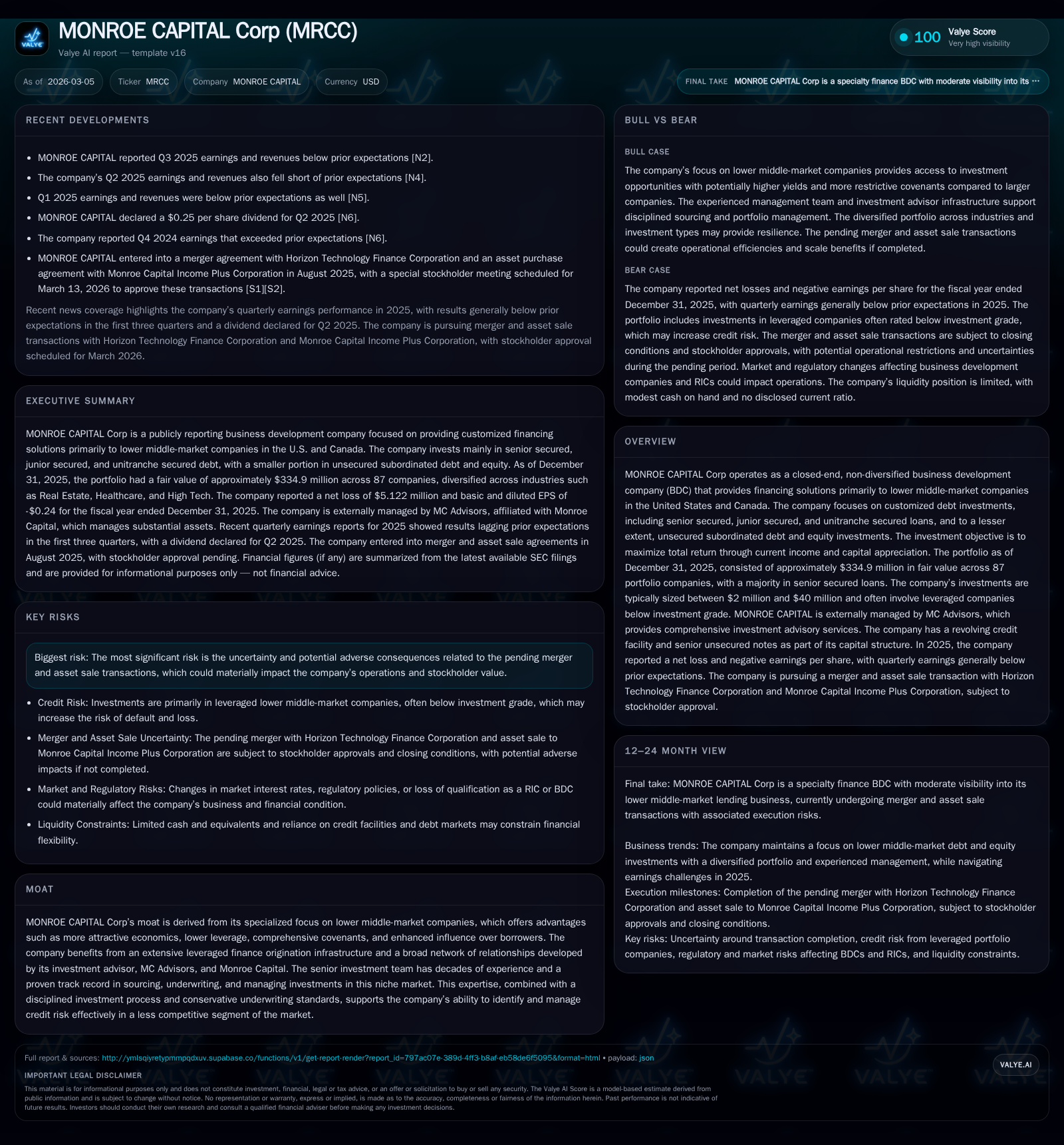
MONROE CAPITAL Corp operates as a closed-end, non-diversified BDC, concentrating on customized debt financing to lower middle-market companies primarily in the US and Canada. The company has grown its portfolio to $334.9 million fair value over 87 portfolio companies with senior secured loans dominating. Despite a challenging net income decline in 2025, operating cash flows surged significantly, reflecting strong underlying portfolio cash generation. MRCC’s future growth hinges on its superior origination capabilities and conservative underwriting but faces uncertainties from pending merger and asset sale transactions. Capital allocation focuses on sustaining distributions under regulatory constraints, with leverage managed prudently via revolving credit and notes.
Company Overview and Investment Focus
MONROE CAPITAL Corp (ticker MRCC) is an externally managed closed-end Business Development Company (BDC) specializing in providing tailored debt financing solutions predominantly to lower middle-market enterprises in the United States and Canada [S1]. Since its IPO in October 2012, MRCC has cultivated a portfolio emphasizing senior secured loans but also includes junior secured, unitranche secured debt, unsecured subordinated debt, and selective equity co-investments [S6]. The strategic focus targets investments sized between $2 million and $40 million in leveraged companies generally rated below investment grade if rated, aiming for total return through current income plus capital appreciation.
Historical Growth and Performance
Since inception, MONROE CAPITAL has expanded its portfolio substantially to a fair value of $334.9 million as of December 31, 2025 spread across 87 portfolio companies [S6]. The diversification is balanced but weighted toward senior secured loans which account for roughly 78.6% of the portfolio's fair value—a defensive positioning that reflects the company’s preference for collateral-backed lending structures [S6]. Junior secured loans stand at approximately 10.5%, unitranche loans at under 1%, and equity investments at about 10.2%.
Financially, MRCC demonstrated uneven profitability over recent years. Net income registered positive figures from FY2022 through FY2024 but dipped sharply into a loss of approximately -$5.1 million in FY2025 [F1]. This represents a year-over-year net income decline of around -152.8%. However, despite this net loss environment, operating cash flow surged by over 222% year-over-year in the same period to approximately $115.9 million, signifying robust cash receipts accrued from interest payments and loan repayments within the portfolio [F1]. Such divergence between net income and cash flow suggests timing or non-cash valuation adjustments impacting earnings but underscores underlying asset quality enabling strong realized cash returns.
Historical performance (annual)
| FY | Net ($mm) | CFO ($mm) | Net YoY |
|---|---|---|---|
| 2025 | -5 | 116 | -152.8% |
| 2024 | 10 | 36 | +2515.6% |
| 2023 | 0 | 52 | -91.7% |
| 2022 | 4 | 14 |
Source: SEC companyfacts cache [F1].
Capital returns and efficiency (annual)
| FY | ROE% |
|---|---|
| 2025 | -3.1 |
| 2024 | 5.1 |
| 2023 | 0.2 |
| 2022 | 2.0 |
Source: SEC companyfacts cache [F1].
Equity contracting to $166.5 million at end-2025 from $191.8 million a year earlier contributed to an approximate return on equity (ROE) of negative 3.1% for the full year [F1]. The pattern reflects challenges possibly linked to marked-to-market valuation adjustments or direct losses on select credits.
Investment Strategy and Underwriting Discipline
MONROE CAPITAL's moat derives from its deep expertise and infrastructure focused exclusively on lower middle-market borrowers—a segment offering less competition compared to larger corporate credits along with more favorable lending economics including tighter covenants, more stringent default provisions, and lower leverage multiples [S1]. The company’s advisor MC Advisors administers comprehensive origination capabilities spanning twelve offices globally, enhancing sourcing access across multiple industries [S10].
The company's credit process prioritizes detailed due diligence weighing issuer fundamentals such as market position, financial performance track record, projections stress-tested for downside scenarios, management quality checks, and industry dynamics analysis [S10]. Investments receive risk grading internally from Grade 1 (least risk) to Grade 5 (high risk), monitored systematically quarterly with adjustments as warranted by evolving borrower performance [S17].
Investment structures typically feature first-lien security interests backed by assets for senior secured loans; unitranche holdings combine first and second liens with syndication strategies offering asymmetric repayment priorities; junior secured loans possess subordinate liens; preferred equity combines equity upside potential with fixed dividend features; while warrants or equity co-investments provide incremental return enhancements tied to portfolio company appreciation [S16],[S21].
Capital Structure and Liquidity Position
MRCC maintains prudent leverage usage aligned with BDC regulatory mandates requiring at least a 150% asset coverage ratio after borrowings [S19]. As of December 31, 2025, MRCC’s asset coverage was robust at approximately 187%, comfortably exceeding minimum thresholds [S4],[S7].
Borrowing facilities include a revolving credit line currently sized at $175 million with ING Capital LLC as agent; this facility contains various covenants targeting minimum net assets maintenance ($150 million plus specified increments), ratio floors such as total assets to total indebtedness not less than 1.5:1, and senior debt coverage ratios above two times [S4],[S7],[S8]. The facility also features customary negative covenants including restrictions on new indebtedness beyond prescribed limits, asset transfer controls, and distribution caps which affect dividend policies [S5],[S7].
In addition to revolving borrowings totaling $62 million as of end-2025, MRCC holds approximately $130 million in senior unsecured notes maturing in mid-2026 ("2026 Notes") which have prompted amendments designed to facilitate refinancing flexibility including temporary easing of borrowing base calculations known as "Borrowing Base Flex Period" arrangements [S4],[S11].
Dividend Policy and Capital Allocation
As a regulated investment company for US tax purposes (RIC), MONROE CAPITAL aims to distribute substantially all taxable income annually to maintain pass-through taxation benefits [S1]. Dividend policy adheres strictly to regulatory provisions that cap distributions based on net investment income calculated per quarter.
Given debt covenant restrictions linked to revolving credit agreements limiting distributions based on asset coverage tests and borrowing covenants—especially crucial during refinancing negotiations around the upcoming maturity of the notes—MRCC's capital allocation decisions must balance steady payout expectations against liquidity preservation [S5],[S15],[S25]. The company has also benefited from SEC exemptive orders facilitating co-investment activities alongside affiliated funds under MC Advisors auspices thereby expanding capital deployment opportunities while managing conflicts through Board oversight [S15].
Share repurchases have historically been limited relative to dividend payments due to regulatory limitations inherent under the Investment Company Act coupled with balance sheet considerations.
Future Growth Prospects and Risks
Growth catalysts rest heavily on MRCC's capability to continue leveraging its origination infrastructure supplemented by proactive portfolio risk management that guards against credit deterioration through early interventions—including covenants enforcing board rights or change-of-control protections—and restructuring negotiations where needed [S14],[S16],[S17].
Growth may come from:
- Expansion into new sectors or geographies within North America leveraging existing origination teams.
- Opportunistic investments including distressed debt or other alternative lending niches adding incremental yield.
- Incremental scale via follow-on financings inside existing portfolio companies.
- Potential benefits from improved macroeconomic conditions supporting borrower performance and reduced defaults.
Conversely, growth could be capped or hurt by:
- Macroeconomic headwinds causing borrower distress especially given non-investment grade profile.
- Interest rate volatility affecting cost of funding versus loan yields given most are floating-rate loans with indexed rates resetting frequently but subject to floors limiting downside rate risk [S1].
- Regulatory or compliance complexities inherent in maintaining BDC qualification while negotiating amendments on credit facilities.
- Most notably the pending merger transactions pose significant uncertainties regarding timing, valuation impact upon stockholders receiving shares of HRZN post-merger consideration plus related asset sales which collectively might disrupt operational continuity or depress equity valuations temporarily or longer term [N#],[S2],[S3],[S12],[S20].
What To Watch Going Forward (Analysis)
Investors should monitor:
- Completion status of the pending merger with HRZN including timing of shareholder votes originally scheduled for March 13, 2026 [N#],[S3],[S12].
- Refinancing outcomes or paydown progress related to the $130 million senior notes due later in calendar year 2026.
- Credit quality trends reflected via internal risk grading migrations particularly inflows into Grades 3–5 categories signaling elevated distress levels.
- Changes in dividend payout ratios aligned with net investment income metrics influenced by interest rate movements or realized gains/losses.
- Evolution of borrowing base conditions under revolving credit amendments reflecting underlying collateral valuations amid market adjustments.
Conclusion
MONROE CAPITAL Corp presents a niche-focused platform delivering customized finance solutions primarily targeting lower middle-market borrowers via structurally protective senior secured instruments supported by deep sector expertise. While recent earnings volatility highlighted by a net loss in FY2025 raises near-term performance questions, robust operating cash flow generation reinforces resilience underlying core lending operations. Ongoing capital structure management including progressive refinements around revolving credit structures coupled with strict adherence to underwriting discipline support favorable long term prospects within its specialized marketplace segment. Pending transformative merger-related events add complexity creating execution risks warranting close attention as these strategic corporate developments unfold.
This analysis does not constitute investment advice but seeks to present an objective financial evaluation grounded exclusively on publicly available disclosures from SEC filings dated March 5th 2026 unless otherwise noted.
Disclaimer: This is research-only, informational analysis and not investment advice. It may include AI-generated interpretation and general industry context. Always verify important details using primary sources.

Comments