
SandRidge Energy’s Mid-Continent Focus Underpins Operational Gains but Limits Growth Leverage
The company’s concentrated asset base and capital discipline drive recent profitability amid exposure to commodity price volatility and regional risks.
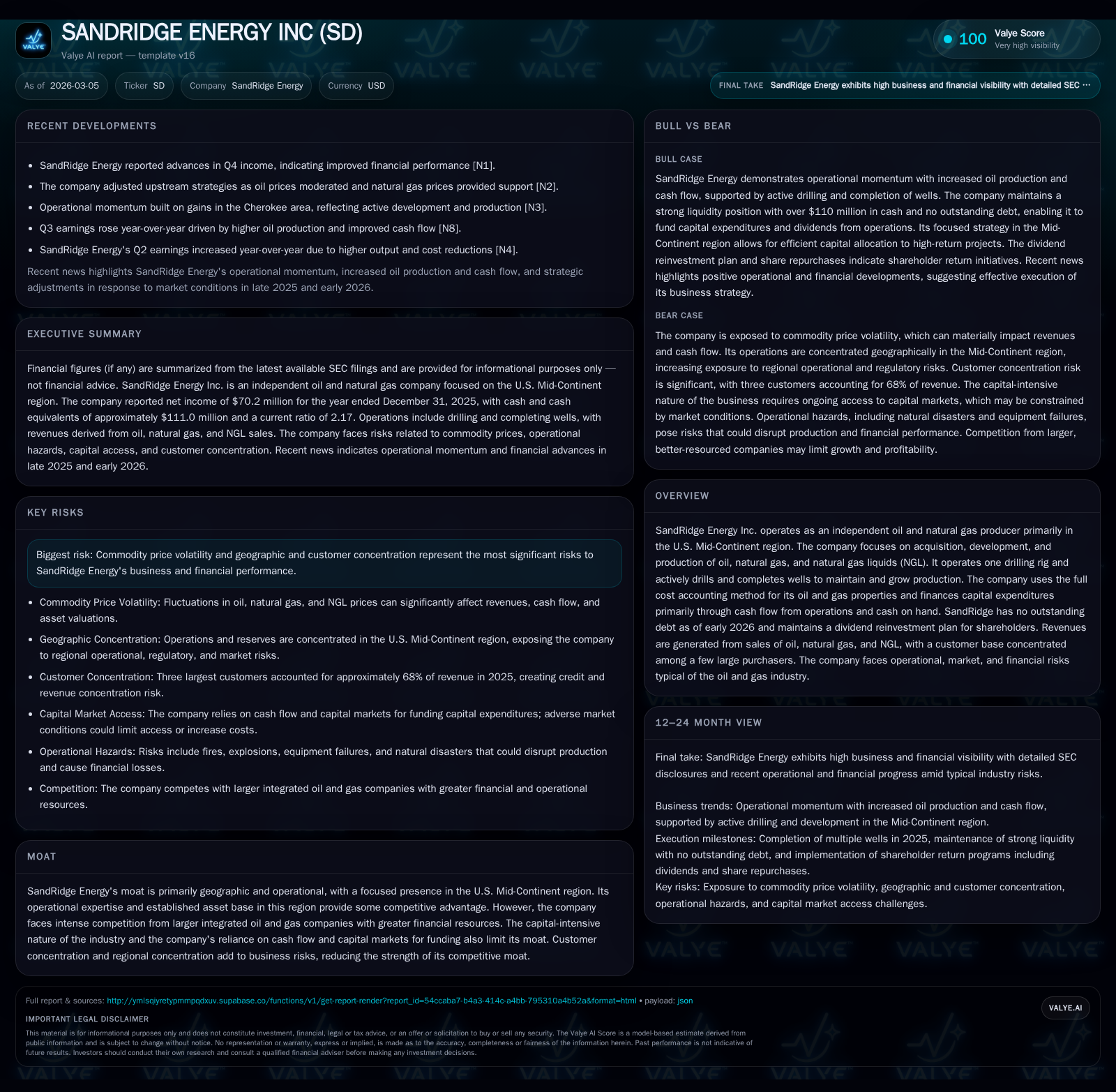
SandRidge Energy Inc., an independent oil and gas producer centered in the U.S. Mid-Continent, delivered substantial operating income growth in 2025 supported by increased production and robust operational cash flows. The company operated one drilling rig focused on incremental well development, financing expansion primarily through internally generated funds. While its no-debt balance sheet and share repurchases reflect prudent capital allocation, risks from commodity price swings, customer concentration, and geographic focus persist. Future growth depends on balancing capital expenditures with cash flow amid industry cyclicality.
Company Overview
SandRidge Energy Inc. operates as an independent oil and natural gas producer primarily focused on the U.S. Mid-Continent region. The company's portfolio centers around exploration, development, and production activities of oil, natural gas, and natural gas liquids (NGL). SandRidge employs the full cost accounting method for capitalizing its oil and gas property costs and has elected to finance capital expenditures mainly from operational cash flow complemented by existing liquidity reserves [S1][N1].
The firm actively manages its asset base with a single drilling rig operation dedicated to maintaining production levels through targeted well completions notably in the Cherokee Play within the Mid-Continent [S21]. The geographic concentration provides operational advantages grounded in localized expertise but inherently increases vulnerability to regional risks including weather disruptions, regulatory changes, and infrastructure constraints [S7][S25].
Historical Financial Performance
SandRidge's revenue trajectory has contracted significantly from historical highs but stabilized relative to recent years. Revenue stood at $59.9 million as of FY2019 compared with earlier peaks exceeding $346 million in FY2014; this reflects strategic divestitures and market pressures impacting volumes and pricing over time [F1].
Operating income surged by approximately 83% year-over-year to reach $60.9 million for FY2025 from $33.2 million the previous year, signaling improved operational efficiency and possibly higher commodity realizations given rising energy prices during the period [F1]. Net income also increased moderately by nearly 12% to $70.2 million in FY2025 versus FY2024.
Operational cash flows expanded by over a third reaching $100.1 million at year-end 2025 which enabled the company to fund capital projects internally while supporting shareholder returns through dividends and modest buybacks [F1][S19]. Capital expenditures grew sharply by over 120% year-over-year from $26.4 million in FY2024 to $58.6 million in FY2025 reflecting renewed investment into organic resource development [F1][S21].
Historical performance (annual)
| FY | Net ($mm) | CFO ($mm) | OpInc ($mm) | Capex ($mm) | Net YoY |
|---|---|---|---|---|---|
| 2025 | 70 | 100 | 61 | 59 | +11.5% |
| 2024 | 63 | 74 | 33 | 26 | +3.5% |
| 2023 | 61 | 116 | 64 | 26 | -74.9% |
| 2022 | 242 | 165 | 175 |
Source: SEC companyfacts cache [F1].
Capital returns and efficiency (annual)
| FY | Div ($mm) | Buybacks ($mm) | FCF ($mm) |
|---|---|---|---|
| 2025 | 16 | 6 | 42 |
| 2024 | 72 | 0 | 48 |
| 2023 | 82 | 89 | |
| 2022 |
Source: SEC companyfacts cache [F1].
Note: Revenue data is public through fiscal year ending December 31, 2019; subsequent metrics based on available disclosures.
Capital Allocation & Returns
SandRidge maintained a conservative balance sheet as of end-2025 with no outstanding debt reported [S16], which enhances its financial flexibility relative to industry peers more leveraged amid cyclical headwinds.
Shareholder returns are balanced between dividends and repurchases; dividends paid totaled about $15.9 million in FY2025 compared with a significantly larger distribution of over $72 million paid out in FY2024—an adjustment likely aligned with earnings variability —while share repurchases accelerated to $6.4 million from minimal activity previously under an authorized program capped at $75 million that commenced mid-2023 [F1][S5][S6].
This suggests preference for maintaining liquidity despite opportunistic buybacks driven by share price attractiveness or excess cash beyond operational needs.
The company's approximate return on equity stood at nearly 14% by end-2025 using net income divided by equity measure ($70m / $511m), indicating moderate profitability consistent with industry norms for exploration-focused independents sustaining disciplined reinvestment cycles [F1].
Industry Positioning & Moat Dynamics
SandRidge's competitive moat derives largely from concentrated regional expertise within the U.S Mid-Continent—a prolific hydrocarbon basin that offers access to established infrastructure including processing plants and pipelines—as well as operational know-how exploiting this complex geological area effectively [S7]. However, this same geographic focus equates to concentration risk across physical operations subject to weather disruptions or capacity bottlenecks.
Unlike larger integrated oil companies with diversified production portfolios spanning upstream-to-downstream segments globally, SandRidge navigates capital-intensive exploration challenges relying on tightly controlled budgets funded internally rather than levering significant external financing sources or scale economies [S8].
Furthermore, customer concentration intensifies credit risk: three largest buyers comprised almost seventy percent of revenues during FY2025—with significant dependencies on entities like Targa Pipeline Mid-Continent West OK LLC accounting for roughly one-third of total sales volume—exposing it also to counterparty performance risks amidst fluctuating commodity prices or demand environments [S7][S10].
Growth Outlook & Operational Considerations
Looking forward, SandRidge plans capital expenditures between approximately $76 million and $97 million for calendar year 2026 aimed at sustaining production growth primarily via incremental drilling activities within core properties funded predominantly through cash flow generation supplemented by existing liquidity reserves [S24]. This prudent budgeting approach reflects caution given prevailing industry cyclicality characterized by commodity price volatility impacting realized prices received for oil, natural gas, and NGL products which remain critical cash flow drivers across all upstream operators.
Success hinges significantly on efficiently managing natural production declines inherent in mature fields while identifying economically recoverable reserves within existing acreage or opportunistic acquisitions supported by active seismic evaluation methodologies—although lacking leverage afforded by diversified multi-basin portfolios limits upside scalability without meaningful capital market access or debt leverage platforms [S25].[S21]
Cybersecurity is also a growing focus area for governance; SandRidge’s board has entrusted oversight responsibilities predominantly to its Audit Committee supported by experienced internal audit leadership addressing cybersecurity programs—an increasingly important factor given digitization trends across industry operations—from exploration data systems through production monitoring platforms outlining potential vulnerability exposures requiring vigilant controls implementation going forward [S1][S11].
Key Risks Summary
Several material risks contextualize SandRidge’s corporate outlook:
- Commodity Price Volatility: Fluctuations affect both revenues directly linked to market prices as well as reserve valuations under full cost accounting potentially leading to impairment losses during prolonged low price cycles affecting reported earnings and borrowing capacity.[S1][S9]
- Geographic Concentration: Single basin exposure subjects operations to localized weather events, regulatory changes or infrastructure pipeline disruptions disproportionately compared with diversified competitors.[S7]
- Customer Concentration: Heavy revenue reliance on limited purchasers concentrates credit exposure amidst variable financial health trajectories for these counterparties.[S10]
- Capital Market Access: Dependence primarily on internal cash flows constrains ability to pursue significant acquisitions or rapid reserve replacements especially if market financing environments tighten unexpectedly.[S24]
- Cybersecurity Threats: As operations increasingly integrate IT systems controlling physical assets, risk of cyber incidents carries potential business interruptions or reputational damage requiring sustained vigilance.[S1][S11]
What To Watch Next (Analysis)
Whilst explicit guidance beyond planned capital budgets is limited,[N1] investors should monitor:
- Quarterly operating metrics including realized commodity prices net of deductions given their direct influence on profit margins.
- Development success rates alongside operating expense trends reflecting efficiency improvements or inflationary pressures notably labor or utility costs affecting unit economics.[S21]
- Changes in customer mix or contract terms signaling shifts in counterparty risk profiles.
- Any material revisions in the share repurchase program intensity which could indicate management’s assessment of valuation opportunities relative to reinvestment priorities.[S19]
- Updates regarding litigation or regulatory matters which can impose contingent liabilities impacting financial flexibility.[S9]
- Potential impacts from evolving federal tax regulations influencing deferred tax assets utilization given prior establishment of a Tax Benefits Preservation Plan designed to protect critical NOL assets.[S13]
Conclusion
SandRidge Energy presents as a fiscally disciplined mid-sized independent E&P operator leveraging its Mid-Continent stronghold with a lean operational footprint marked by significant recent profitability improvement fueled by active capital deployment within manageable risk constraints. The combination of no debt at year-end fiscal reporting coupled with enhanced operating cash flow allowed measured shareholder distributions alongside continued reinvestment supports reasonable near-term sustainability.
Nevertheless, inherent risks posed by commodity price fluctuations coupled with significant geographic and purchaser dependencies inject uncertainty into long-term reserve growth trajectories absent material new discoveries or acquisition opportunities executed under favorable financing conditions.
Maintaining strict vigilance around capital allocation efficiency matched with robust risk mitigation across cybersecurity exposures will be pivotal amid ongoing sector volatility.
Disclosure: This analysis is based solely on information publicly available as of the report date without providing investment advice.
Disclaimer: This is research-only, informational analysis and not investment advice. It may include AI-generated interpretation and general industry context. Always verify important details using primary sources.

Comments