
Atea Pharmaceuticals’ Strategic Bet on Pan-Genotypic HCV Treatment Amid Clinical and Capital Challenges
Atea advances its differentiated hepatitis C regimen through pivotal Phase 3 milestones while grappling with sustained losses and commercialization hurdles.
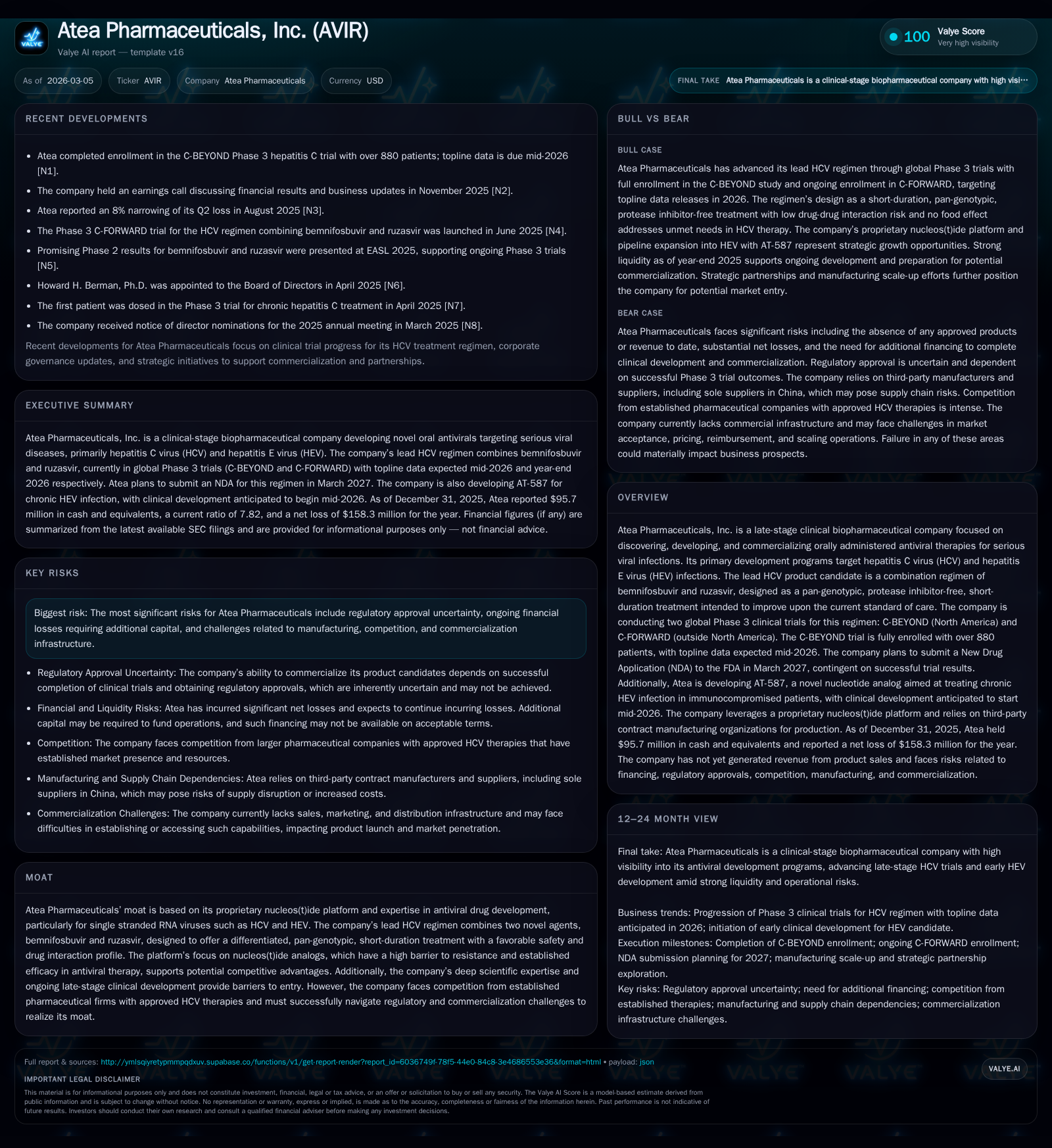
Atea Pharmaceuticals is transitioning from development to potential commercialization with its lead hepatitis C virus (HCV) regimen combining bemnifosbuvir and ruzasvir. The company has completed enrollment in the C-BEYOND Phase 3 trial and anticipates topline data in mid-2026, aiming for an NDA submission in early 2027. However, Atea continues to operate at significant losses with no approved products or revenues to date, relying heavily on cash reserves and capital management to sustain ongoing R&D and prepare for market launch. The company faces regulatory complexity, competitive pressures, and challenges building commercial infrastructure as key risks shaping its near-term trajectory.
Clinical Program Evolution: From Early Promise to Phase 3 Completion
Atea Pharmaceuticals has positioned its lead hepatitis C virus (HCV) regimen—bemnifosbuvir combined with ruzasvir—as a distinct entrant in antiviral therapeutics through several differentiators. The regimen is designed as a pan-genotypic treatment that avoids protease inhibitors, targeting an unmet need for an eight-week nucleotide inhibitor-based option that could improve convenience and safety relative to existing therapies [S1].
The global Phase 3 program consists of two randomized open-label trials: C-BEYOND conducted in North America, now fully enrolled with over 880 patients, and C-FORWARD enrolling outside North America with a similar patient target. Both trials compare Atea’s combination against the active comparator sofosbuvir/velpatasvir across diverse genotypes [S1]. Topline results from C-BEYOND are expected by mid-2026 followed by C-FORWARD at year-end 2026, which underpin the company's plan for an NDA filing with the FDA scheduled for March 2027 contingent on positive trial outcomes [N1][S1].
Earlier Phase 2 data involving 275 patients demonstrated good tolerability, high potency, a low risk of drug-drug interactions (DDIs), including compatibility with proton pump inhibitors, and flexibility regarding food intake—attributes designed to enhance patient adherence [S1]. This profile aims to address shortcomings in the current standard of care by offering a safe, short-duration therapy without protease inhibitors.
Financial Trajectory and Operating Performance: Trends Through 2025
Atea’s financial history underscores the typical pre-commercial profile of late-stage biopharmaceutical companies heavily invested in R&D without product revenues. The company reported operating losses that have widened over recent years but showed moderate improvement year-over-year at -$180.9 million for FY2025 versus -$193 million in FY2024—reflecting a roughly 6.3% relative improvement [F1]. Net losses similarly narrowed slightly from -$168.4 million to -$158.3 million. Operating cash flow was negative $132 million for FY25 but improved marginally compared to prior-year figures.
Historical performance (annual)
| FY | Net ($mm) | CFO ($mm) | OpInc ($mm) | Capex ($) | Net YoY |
|---|---|---|---|---|---|
| 2025 | -158 | -132 | -181 | +6.0% | |
| 2024 | -168 | -135 | -193 | -23.9% | |
| 2023 | -136 | -85 | -164 | 1943000 | -17.3% |
| 2022 | -116 | -121 | -131 | 1943000 |
Source: SEC companyfacts cache [F1].
Capital returns and efficiency (annual)
| FY | FCF ($mm) | ROE% |
|---|---|---|
| 2025 | -57.5 | |
| 2024 | -38.4 | |
| 2023 | -87 | -24.5 |
| 2022 | -123 | -18.1 |
Source: SEC companyfacts cache [F1].
Atea maintains limited capital expenditures aligned primarily with clinical trial support rather than operational infrastructure expansion.
The accumulated deficit stood at approximately $522.6 million as of December 31, 2025 [S1]. Equity declined along with losses but remained sufficient relative to liabilities; notably the company had a current ratio near 7.82 at year-end due to sizeable cash and equivalents ($95.7 million) relative to current liabilities ($39.8 million). Return on equity remains deeply negative (~-57.5%), consistent with the absence of commercial revenues at this stage [F1]. No dividends or buybacks have been indicated given the capital-intensive status.
Navigating Regulatory Pathways and Key Milestones Ahead
Key upcoming value inflection points hinge on successful completion and reporting of Phase 3 clinical data.
Topline results from fully enrolled North American C-BEYOND are anticipated mid-2026 and will be closely scrutinized by regulators given comparison against an established standard-of-care active regimen [N1][S1]. Equally important is data from C-FORWARD later in the year encompassing broader geographic diversity.
Should these trials meet primary endpoints demonstrating non-inferiority or superiority on sustained virologic response rates alongside safety advantages, Atea targets submission of an NDA to the FDA in March 2027 [N1][S1]. Concurrently the company is advancing a focused Chemistry Manufacturing and Controls (CMC) strategy aimed both at supporting final trial material production—in fixed dose combination forms—and priming supply chain readiness for potential commercialization [S1].
This pathway underscores inherent risks typical of biopharma late-stage assets: regulatory review complexity coupled with post-approval manufacturing validation requirements could delay market entry or necessitate further studies.
Capital Structure, Cash Position, and Capital Allocation Considerations
As of December 31, 2025 Atea held $95.7 million of cash and equivalents alongside $311 million in current assets against modest current liabilities totaling $39.8 million—a liquidity posture viewed as conservative within biopharma but limited given projected further spending [F1].
Despite solid current ratios exceeding 7x indicating short-term solvency strength, persistent negative free cash flow approximated $134 million for FY25 signals ongoing capital absorption tied almost exclusively to clinical development activities absent revenue streams [F1]. Management has not declared any dividends or initiated share repurchases; capital allocation evidently prioritizes development progression above returns.
Looking forward there will be material needs for financing cycles unless regulatory approvals unlock commercial revenues or partnerships reduce funding burdens—a crucial watch point as trial readouts approach.
Commercialization Readiness: Infrastructure and Market Access Challenges
Transitioning from R&D orientation toward commercialization entails significant operational challenges highlighted by management commentary [N1][S1]. Building sales forces specialized in HCV therapeutic marketing requires strategic hiring amid an increasingly complex payor landscape characterized by varied US federal/state policies plus global reimbursement systems.
Regulatory approval alone is insufficient; achieving adequate coverage by insurance payors requires nuanced negotiations supported by health economic data—a lengthy process particularly pressured by growing payer cost containment initiatives documented in regulatory risk disclosures [S4][S5]. Fragmented coverage decisions among private insurers complicate uniform uptake.
Operational scale-up must also navigate manufacturing controls aligned with cGMP compliance under FDA scrutiny while maintaining cost discipline within constrained cash flows.
Competitive Landscape and Platform Differentiators in Antiviral Therapeutics
Atea operates in a crowded antiviral space dominated by legacy pharmaceutical firms marketing broad-spectrum DAA regimens such as sofosbuvir/velpatasvir—currently benchmark therapies for HCV [S1]. Despite this competitive intensity, Atea’s reliance on its proprietary nucleos(t)ide analog platform offers certain moats: these agents tend to exhibit high barriers to resistance relative to protease inhibitors plus reduced risk of DDIs enhancing prescribing confidence.
Clinically the pan-genotypic coverage coupled with omission of protease inhibitors enables potential appeal for patients seeking short-duration regimes minimizing side effects or interactions—a segment possibly underserved by existing drugs whose durations often extend beyond eight weeks.
However these advantages hinge entirely on successful clinical demonstration versus entrenched incumbents who benefit from extensive real-world use histories.
Risk Factors: Financial, Regulatory, and Market Execution Risks
Atea acknowledges broad risks summarized prominently in its latest filings emphasizing:
- Uncertainty around FDA approval despite promising Phase 2/early Phase 3 data congruent with historical unpredictability of regulatory decisions;
- Persistent financial losses requiring fresh capital raises given extensive negative operating cash flows statewide through trial completion;
- Complexities scaling manufacturing processes compliant with stringent quality standards necessary for commercial release;
- Competitive pressure from established brands limiting market share capture;
- Healthcare laws related to pricing transparency plus anti-kickback statutes imposing compliance overheads;
- Challenges securing payer coverage consistently across fragmented healthcare payor systems potentially delaying patient access post-launch [S1,S4,S5].
This array translates into heightened execution risk extending well beyond clinical proofing into regulatory authorization and market access success critical for commercially meaningful returns.
This analysis synthesizes publicly available information from Atea Pharmaceuticals’ SEC disclosures including their Form 10-K as filed on March 5th, 2026 ([S1]), recent earnings call transcripts ([N1]), along with quantitative financial metrics extracted from structured company facts ([F1]). It reflects current known facts without speculative extrapolation.
Readers should consider ongoing developments including upcoming clinical readouts as pivotal junctures that may materially update company prospects assessed herein.
Disclaimer: This is research-only, informational analysis and not investment advice. It may include AI-generated interpretation and general industry context. Always verify important details using primary sources.

Comments