
CIMG Inc.'s Financial Struggles and Strategic Moves in the Maca Product Market
CIMG Inc. confronts intensified supplier and customer concentration risks while pursuing growth through product innovation and acquisitions amid ongoing losses.
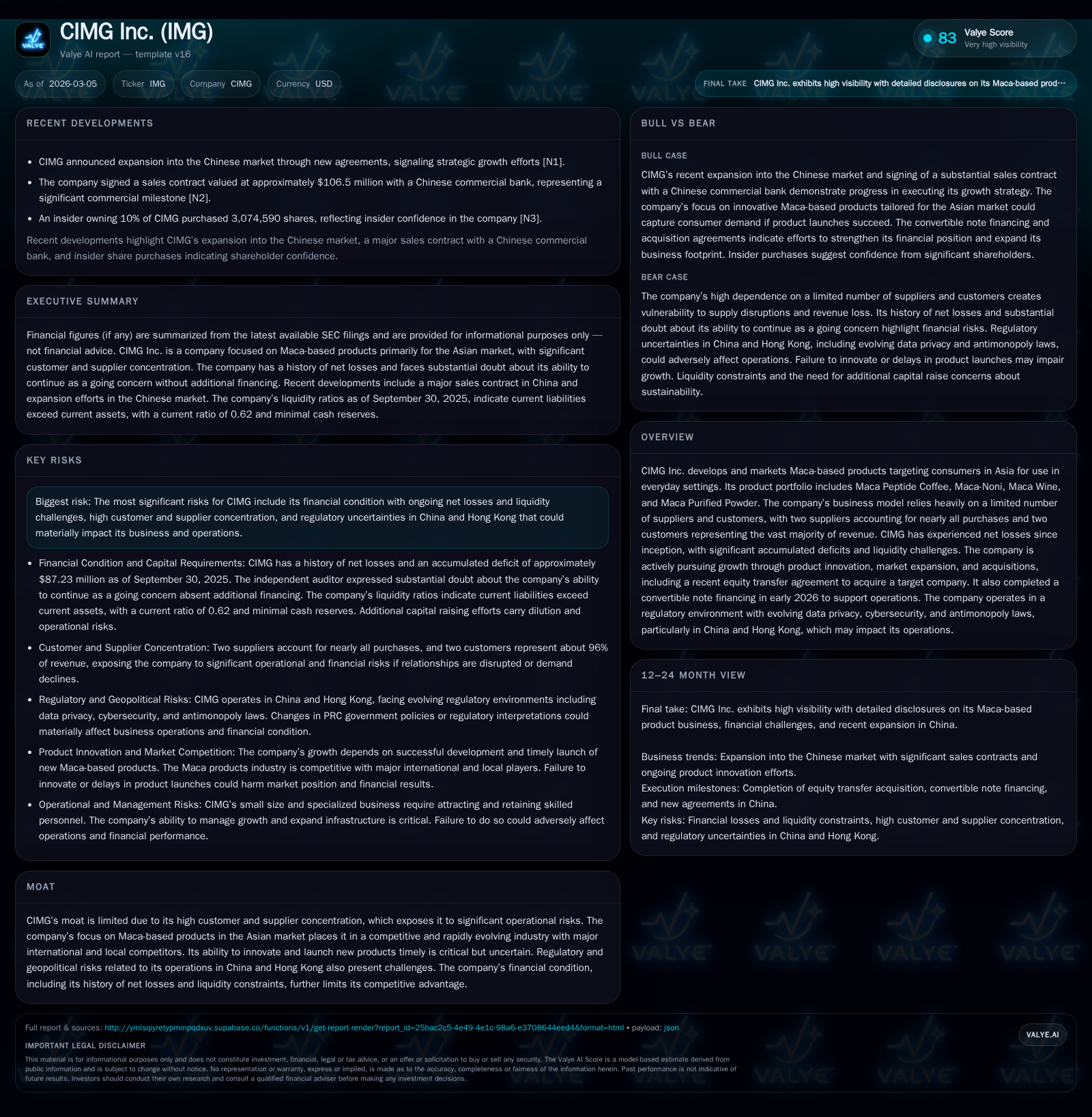
CIMG Inc. specializes in Maca-based consumer products primarily marketed in Asia but faces significant operational risks due to its heavy reliance on just two suppliers and two customers, which together dominate its purchase and revenue profiles. Despite a 29% revenue increase in the latest fiscal year, the company continues to report substantial net losses and negative cash flows, driven by high operating expenses and liquidity constraints. Recent strategic maneuvers include expanding into the Chinese market under new agreements, pursuing acquisitions via equity transfer agreements, and securing convertible note financing to support ongoing operations. Regulatory risks, particularly around data privacy and cybersecurity in China, coupled with active litigation, compound the company’s challenges. Monitoring the successful integration of acquisitions, stabilization of supply chains, and capital sufficiency will be critical as CIMG seeks to improve its financial footing.
Historic Financial Performance: The Trajectory of Revenues and Deepening Losses
CIMG Inc. has experienced a notable rise in revenue over recent years coinciding with escalating operating losses that reflect ongoing challenges in achieving profitability. From fiscal year (FY) 2016 through FY2019, revenues increased sharply from $455K to approximately $1.79 million [F1]. Despite this revenue growth trajectory translating into a 29.1% year-over-year expansion from FY2024 to FY2025, operating income remained negative at about -$5.2 million for FY2025 compared with a much larger loss of -$10.8 million the prior year [F1].
Net losses also narrowed somewhat from nearly -$9 million to -$4.9 million during this period but still represent a deep deficit demonstrating persistent margin pressures (Table below). The company’s operating cash flow contrasts starkly with its top line growth, reaching a negative nearly -$17.6 million in FY2025, suggesting that revenue gains have not translated into positive operational liquidity.
Capital expenditures have remained relatively modest by comparison but steady between FY2024 and FY2025 at around $320K annually [F1]. Equity transitioned to positive territory by FY2025 at $45.7 million after being negative or near zero previously [F1], due largely to capital raises but further highlighting the scale of accumulated deficits carried forward.
Historical performance (annual)
| FY | Net ($mm) | CFO ($mm) | OpInc ($mm) | Capex ($) | Net YoY |
|---|---|---|---|---|---|
| 2025 | -5 | -18 | -5 | 319843 | +45.6% |
| 2024 | -9 | -10 | -11 | 319843 | -2.6% |
| 2023 | -9 | -7 | -9 | 16241 | +25.8% |
| 2022 | -12 | -7 | -11 | 191765 |
Source: SEC companyfacts cache [F1].
Capital returns and efficiency (annual)
| FY | FCF ($mm) | ROE% |
|---|---|---|
| 2025 | -18 | -10.7 |
| 2024 | -10 | 1379.0 |
| 2023 | -7 | -522.6 |
| 2022 | -8 | -121.1 |
Source: SEC companyfacts cache [F1].
Note: Revenue values available through FY2019; later years reflect income and cash flow data illustrating broad financial trends.
Concentration Risks: Supplier and Customer Dependencies in Focus
One of the defining vulnerabilities for CIMG is its extreme dependency on a very small base of suppliers and customers. For FY2025 two suppliers accounted for approximately 96.76% of all purchases [S5], creating pronounced inventory sourcing risk that could disrupt production if relations sour or terms worsen.
Mirroring this concentration on the cost side is an equally risky flow on the revenue side: two customers contributed around 96% of total sales revenue—with one representing roughly 60% and another about 36% [S5]. Such reliance exposes the company acutely to demand shocks or contractual renegotiations that could materially impair cash flows.
Given this operational leverage inherent in supply chain dependencies plus limited geographic diversification beyond Asia [N1], managing these relationships effectively remains critical but challenging amid competitive pressures.
Product Innovation and Market Expansion as Future Growth Engines
To mitigate industry headwinds and capitalize on evolving consumer trends towards functional health beverages within Asia's lucrative macroscale markets [S19], CIMG has bolstered its product portfolio featuring Maca Peptide Coffee and Maca-Noni among others [N1]. These products tap into growing wellness segments yet require rapid innovation cadence against large international competitors.
In February 2026 CIMG announced expansion into China through new distribution agreements alongside executing an Amended & Restated Equity Transfer Agreement targeting acquisition closing anticipated before March-end [N1][S3][S24]. This move suggests strategic intent to diversify channels beyond existing concentrated clients while leveraging acquisitions to scale presence.
However—innovation timing amid competitive fragmentation remains uncertain [S19]—putting pressure on product development alignment with consumer tastes.
Capital Structure & Recent Financing: Convertible Notes Amid Liquidity Pressures
Reflecting tight liquidity conditions flagged repeatedly by auditors ([S1]), CIMG closed a $5 million convertible note offering at annual interest of 7%, structured in tranches beginning early February 2026 [S6][S8][S9]. Warrants exercisable upon shareholder approval complimented this debt issuance reflecting efforts at shoring up capital structure.
Nonetheless balance sheet strains remain evident; current assets totaled approximately $17.1 million against liabilities near $27.6 million at September-end FY2025 yielding a current ratio around just 0.62 indicating potential short-term funding gaps [F1]. A net loss relative to sizable equity ($45.7 million) yields an approximate ROE near -10.7%, underscoring impaired returns from ongoing deficits [F1].
Operating cash outflows intensified sharply with CFO plunging nearly -76% year-over-year to almost -$18 million free cash burn after capex adjustment [F1], compelling additional financing reliance absent clear path toward sustained positive free cash generation.
There have been no dividend distributions or share repurchase announcements recently consistent with prudent capital preservation policies under distress conditions [S15][S17].
Regulatory Environment and Litigation Impact on Business Stability
CIMG operates amidst increasing regulatory complexities particularly across China/Hong Kong jurisdictions involving evolving cybersecurity laws governing platform operators handling substantial user data as well as antimonopoly oversight [S27][S29]. While currently exempt from mandatory cybersecurity reviews due to user account thresholds not yet met [S27], future regulatory interpretations can impose significant compliance costs or restrict market access.
Additionally litigation risks are non-trivial; ongoing lawsuits include disputes over convertible note purchase arrangements filed by investors alleging breach events plus claims by former directors for unpaid fees stretching back multiple quarters [S1][S22][S28]. Outcomes could entail material adverse cash impacts or reputational damage complicating stakeholder relations.
Failure to comply fully with foreign corrupt practices laws alongside transfer pricing tax regimes further layers risk exposure within cross-border operations [S7].
Strategic Risks from Market Dynamics and Supply Chain Vulnerabilities
Aside from concentration concerns described earlier affecting supply sourcing flexibility (operational leverage), inflationary pressures have elevated input costs which price adjustments cannot reliably offset without volume erosion risking margin compression [S16][S21]. Forecasting consumer demand accurately poses difficulty given fast-evolving preferences especially relevant for niche Maca wellness variants where novel entrants abound.
Intellectual property protections remain imperfect; competitors can replicate similar formulations potentially eroding product differentiation while creating exposure through infringement claims that may be costly both financially and operationally [S16].
Limited geographic diversification—with primary focus confined within Asian regions despite recent Chinese expansion deals—also restricts market risk spread complicating long-term scalability under shifting geopolitical tensions or trade policies that affect cross-border commerce.[N1][S5]
Outlook: Milestones to Monitor in CIMG’s Growth Trajectory
While explicit management guidance is silent or sparse regarding financial forecasts following latest filings,[N1] key metrics warrant attention:
- Timely completion and integration of acquisition(s) tied to equity transfer agreements scheduled around Q1–Q2 calendar year ending,
- Stabilization or reduction of supplier/customer concentration risk notably via onboarding alternate vendors/clients,
- Evidence of improved operating margins driven by successful product launches resonating well with target demographics,
- Enhanced liquidity profile signaled through narrowing negative free cash flow trends post convertible notes inflow,
- Navigating regulatory headwinds without incurring penalties or operational curtailments,
- Progression toward Nasdaq listing compliance amid continued monitoring conditions.
These milestones will collectively elucidate whether CIMG can convert growth aspirations manifested through recent strategic initiatives into tangible financial improvements without exacerbating structural vulnerabilities.
This analysis is based solely on information extracted from SEC filings and publicly available disclosures as cited without forecasting unsupported estimates or investment recommendations. Given CIMG’s history of net losses combined with sector-specific operational risks tied to concentration and regulatory factors within Asian markets focused on health supplement products derived from Maca root extracts; cautious observation remains warranted before inferring durable profitability trajectories.
Disclaimer: This is research-only, informational analysis and not investment advice. It may include AI-generated interpretation and general industry context. Always verify important details using primary sources.

Comments