
Stabilis Solutions Pursues Capacity Expansion Despite Mixed Profitability and Capital Challenges
Stabilis Solutions leverages its leading small-scale LNG capabilities to target high-value markets while managing financial pressures and expansion risks.
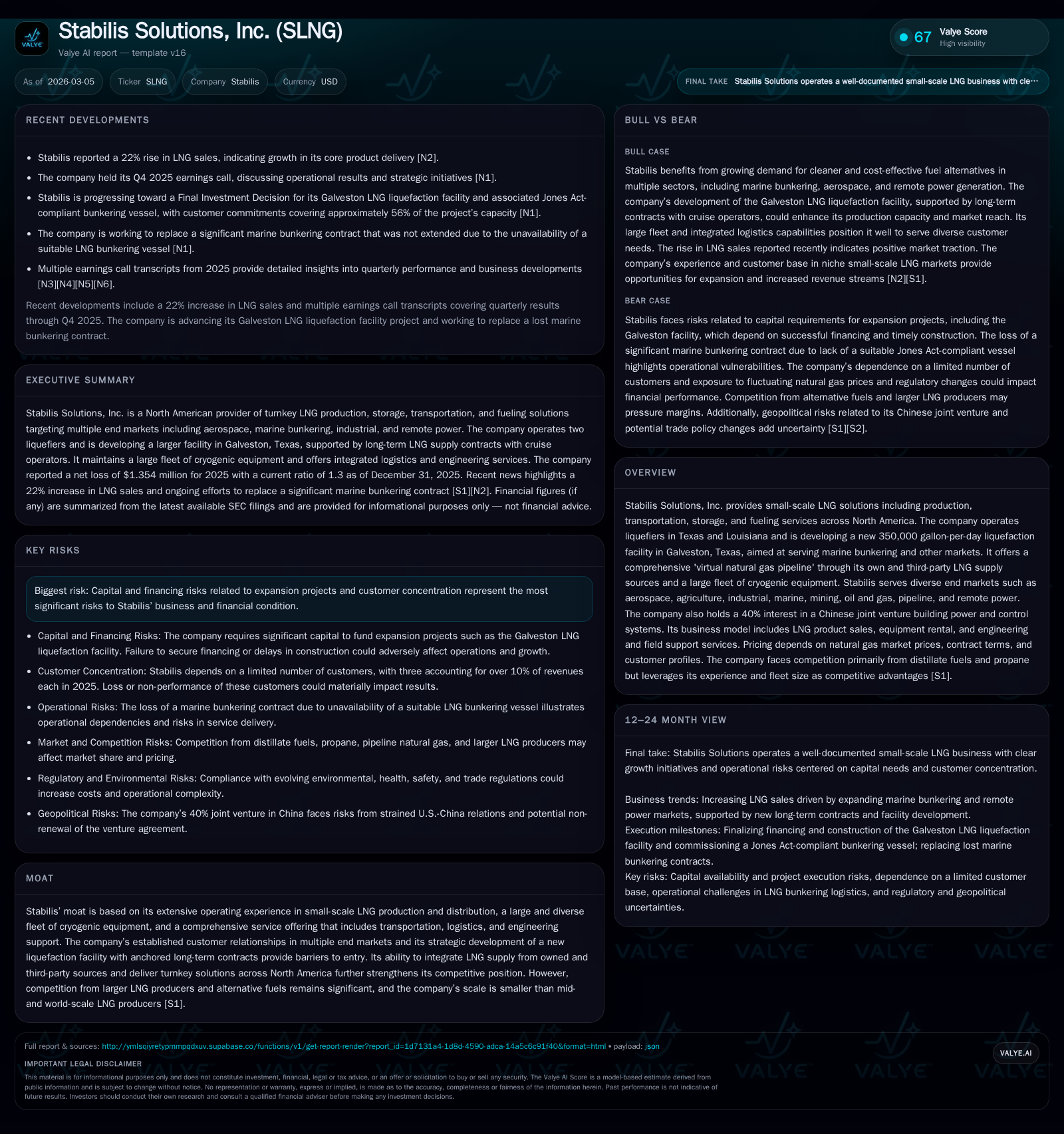
Stabilis Solutions, a North American leader in small-scale LNG production and distribution, has grown through a diversified portfolio spanning marine bunkering, remote power, and aerospace sectors. The company reported fluctuating profitability, highlighted by a net loss in 2025 despite positive operating cash flow. Its upcoming Galveston liquefaction facility signals strategic growth focus with anchored long-term contracts. However, capital needs and competitive pressures from larger LNG producers and alternative fuels remain key challenges to monitor.
Company Overview
Stabilis Solutions, Inc. stands out as a prominent provider of small-scale liquefied natural gas (LNG) solutions across North America. Over its 22-year history, the firm has distributed over 580 million gallons of LNG via more than 60,000 truck deliveries, positioning it among the most experienced operators in this niche [S1]. Their operations encompass LNG production through liquefiers located in Texas (George West) and Louisiana (Port Allen), complemented by transportation, storage, fueling services, equipment rental, and field support.
The company defines its "small-scale" scope as liquefaction capacities below approximately 1.7 million gallons per day (~1 MTPA), addressing end markets unsuited for the mid- or world-scale LNG providers that dominate large export volumes [S4]. Stabilis uniquely serves diverse verticals including aerospace for rocket propulsion fuel, remote power generation (notably data centers), oil & gas operations using dual-fuel engines, marine bunkering for vessels requiring cleaner fuels, pipeline maintenance bridging interruptions in natural gas supply, agriculture, mining operations off grid, and various industrial applications seeking alternatives to distillate fuels.
Additionally, Stabilis holds a 40% stake in BOMAY Electric Industries in China, contributing power and control system expertise within Asian energy markets [S1][S8].
Historical Financial Performance
Available historical financials indicate steady revenue growth punctuated by operational challenges:
Historical performance (annual)
| FY | Net ($mm) | CFO ($mm) | Capex ($mm) | Net YoY |
|---|---|---|---|---|
| 2025 | -1 | 9 | 8 | -129.4% |
| 2024 | 5 | 14 | 9 | +3579.2% |
| 2023 | 0 | 7 | 10 | +103.9% |
| 2022 | -3 | 15 | 4 |
Source: SEC companyfacts cache [F1].
Capital returns and efficiency (annual)
| FY | FCF ($mm) | ROE% |
|---|---|---|
| 2025 | 0 | -2.0 |
| 2024 | 5 | 6.9 |
| 2023 | -4 | 0.2 |
| 2022 | 11 | -5.3 |
Source: SEC companyfacts cache [F1].
[F1] reveals that although earlier years featured operating losses reflecting investment phase challenges (for example operating losses near $4-7 million during mid-2010s), recent years showed improving cash flow generation. Net income turned positive in some years but swung back to a minor loss in calendar year ending December 2025 [F1].
Operating cash flows remain robust relative to net income volatility—a signal of underlying operating business health but also indicative of non-cash charges or working capital fluxes common in commodity-linked logistics businesses.
Capital expenditure remains a significant outflow due to ongoing facility upgrades and capacity expansion initiatives such as the Galveston liquefier project.
Future Growth Prospects
Strategically, Stabilis aims to ramp up liquefaction capacity by nearly fourfold with the Galveston waterfront facility (350,000 gallons/day capacity), targeting burgeoning marine bunkering demand from cruise ships and other Gulf Coast port users [S7][S20]. This facility benefits from anchor tenancies via multiple ten-year take-or-pay contracts signed with cruise vessel operators commencing deliveries in 2027 [N6][S20]. These long-term contracts reduce execution risk compared to spot-market reliance.
Further market diversification into remote power generation is illustrated by a $200 million multi-year LNG supply contract starting early 2027 at a prominent data center site [S21]. This initiative aligns with growing market demand for resilient behind-the-meter clean energy solutions where grid access is constrained or peaks are significant.
Aerospace remains another promising niche where LNG’s safety profile and energetic efficiency drive adoption for reusable rocket fuel systems; two new customers joined in this vertical during 2025 [S24].
However, risks persist: capital requirements for new infrastructure necessitate external financing rounds or debt issuances due to limited internal liquidity reserves relative to capex forecast [S11][S22]. Additionally, tariff uncertainties related to US-China trade dynamics could introduce margin pressure despite mainly domestic sales [S2].
Growing competition from larger scale LNG suppliers equipped for global exports imposes scale disadvantages for Stabilis in pricing leverage though these competitors do not currently service the small-scale truck loading segment which remains Stabilis’ domain [S10]. Alternative fuels like distillate oils and propane maintain entrenched positions across many end uses complicating market share gains.
Key Milestones / What To Watch
- Completion and commissioning of the Galveston LNG liquefaction facility expected by late-2026/early-2027.
- Commencement of multi-year LNG deliveries under the data center contract starting Q1 of 2027.
- Replacement or renewal of marine bunkering contracts after recent non-renewal due to Jones Act vessel availability limitations [S20].
- Progress on securing financing arrangements to cover remaining capex requirements.
- Regulatory developments affecting environmental compliance costs or permitting outcomes for expansion projects.
While explicit guidance is limited beyond noted contract milestones [N6][S3], these markers define near-term operational catalysts.
Returns & Capital Allocation
Reported net losses in recent periods (-$1.35 million in FY2025) signpost ongoing profitability challenges despite positive operating cash flows ($8.6 million CFO vs $8.1 million capex in FY2025 yielding modest free cash flow ~$0.46 million) [F1]. Equity capital stands at nearly $67 million indicating an approximate ROE of about -2% given negative net income results [F1].
The company has historically engaged in nominal share repurchases at modest scale relative to its size signaling prioritization of reinvestment over capital return programs [F1]. Dividend policy is not emphasized given earnings volatility and growth-stage investments.
Working capital trends reveal moderate current ratio (~1.3) but underline liquidity sensitivity stemming from payment timing mismatches with suppliers versus customers compounded by natural gas price volatility risk exposure [S11][S12]. Debt terms have been structured cautiously with ongoing efforts required to secure financing for major capital expenditures including Galveston construction costs estimated at $400 million [S24].
Industry Context & Competitive Positioning Analysis
Small-scale LNG occupies a unique energy niche between pipelined natural gas infrastructure limitations and large-scale global LNG export terminals which focus on massive volumes unsuitable for local or portable uses [S4][S10]. Stabilis’ fleet of cryogenic transport trailers coupled with turnkey supply solutions create a "virtual pipeline" effect catering to mobile or temporary deployments unavailable from traditional suppliers.
Its experience over two decades navigating regulatory environments across states and cross-border regions builds operational barriers versus new entrants lacking proven execution history or asset bases of similar breadth.
However, its smaller size relative to utility-backed or multinational LNG exporters restricts cost competitiveness on bulk sales while competing fuels remain entrenched especially where switching costs or infrastructure investments are deterrents.
In sum, the value proposition leans heavily on flexibility encompassing engineering support services bundled with product offerings plus targeted customers sensitive to emissions regulations who benefit from cleaner combustion relative to diesel or propane alternatives.
Risks Overview
Beyond capital constraints enumerated earlier [S11][S22], material risks feature:
- Regulatory shifts imposing higher compliance costs or emission restrictions impacting fuel demand elasticity [S6][S26]
- Supply chain shocks affecting LNG feedstock availability or pricing fluctuations unhedged effectively provoking margin compression [S15]
- Customer concentration risks given heavy revenue contribution from select multi-year contracts with limited counterparty diversification that influence earnings volatility [S19]
- Potential labor market tightness increasing personnel costs as construction ramps up alongside operational staffing needs [S15]
- Trade uncertainties including tariffs triggering indirect cost inflation despite domestic focus constraining margin predictability further [S2]
- Technological advances in alternative energy sources possibly diminishing LNG market penetration prospects over medium term horizons [S14]
Conclusion
Stabilis Solutions embodies a specialized operator leveraging domain expertise in small-scale LNG delivery that interfaces complex logistics with evolving customer needs across multiple industrial verticals poised for growth amid decarbonization trends.
Its strategic investments emphasize scaling capacity into high-value marine bunkering and innovative remote power domains that align well with regulatory drivers favoring cleaner-burning fuels.
Financially constrained yet operationally robust based on cash flow generation patterns observed recently, the firm’s future trajectory hinges critically on successful commissioning of the Galveston facility along with prudent capital management amidst intense macroeconomic headwinds inherent to energy commodity businesses.
Investors should monitor execution on backlog contracts alongside tightening liquidity conditions caused by working capital dynamics inherent in its business model before drawing conclusions about sustainable profitability potential.
This analysis is intended solely for informational purposes reflecting facts derived exclusively from verified company filings and reputable news transcripts dated through March 2026 without any investment recommendation or price forecasting intention.
Disclaimer: This is research-only, informational analysis and not investment advice. It may include AI-generated interpretation and general industry context. Always verify important details using primary sources.

Comments