
South Plains Financial Advances Growth with Strategic Acquisitions and Robust Capital Management
SPFI leverages expansion across Texas and New Mexico through acquisitions and disciplined credit culture to enhance regional banking strength.
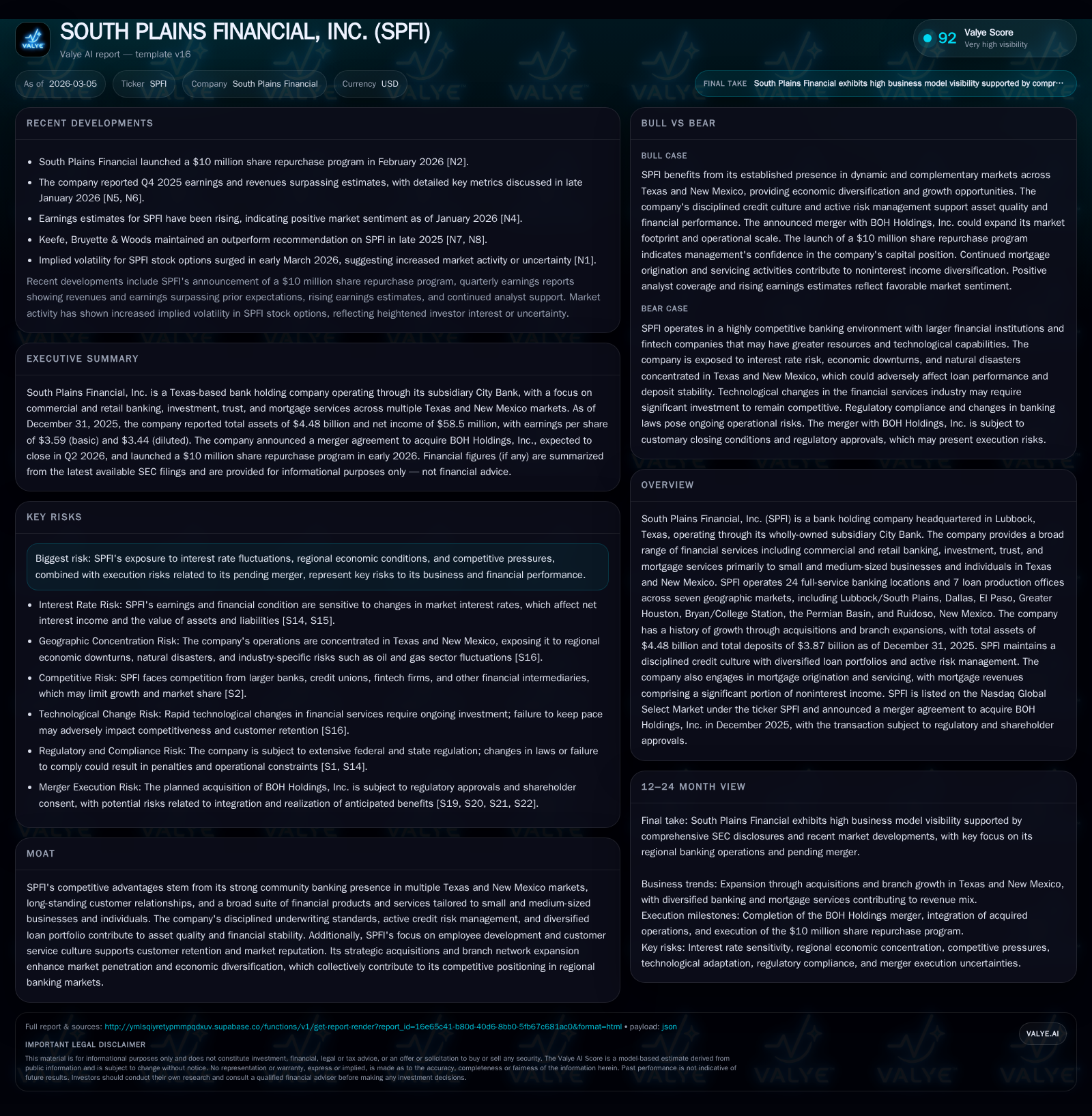
South Plains Financial, Inc. (SPFI) has demonstrated steady growth driven by strategic acquisitions and branch expansions across key markets in Texas and New Mexico. With $4.48 billion in total assets and a diversified loan portfolio emphasizing small to medium-sized businesses, SPFI maintains asset quality supported by active risk management. The company’s capital allocation strategy includes a modest dividend yield and a renewed $10 million share repurchase program, reflecting confidence in its future prospects amid interest rate and regional economic risks. Investors should monitor the closing of the BOH Holdings merger expected in mid-2026 as a key catalyst for market penetration.
Company Overview
Established over 80 years ago, South Plains Financial, Inc. (SPFI) is a Texas-based bank holding company centered on community banking through its wholly-owned subsidiary City Bank [S1]. SPFI focuses on commercial and retail banking tailored to small and medium-sized businesses alongside individual consumers primarily within Texas and New Mexico. At December 31, 2025, SPFI reported total assets of $4.48 billion and deposits of $3.87 billion — reflecting substantive size for a regional community bank competing in diverse local markets including Lubbock/South Plains, Dallas-Fort Worth metroplex, El Paso, Greater Houston, Bryan/College Station, Permian Basin, and Ruidoso NM [S1][S7].
Historical Performance and Drivers
SPFI's growth trajectory has been marked by a steady combination of organic expansion complemented by accretive acquisitions such as West Texas State Bank in 2019 and the pending acquisition of BOH Holdings expected to close in mid-2026 [S7]. Net income rose from approximately $49.7 million in 2024 to $58.5 million in 2025 — an increase of nearly 18%, highlighting operational leverage and effective cost management during an inflationary environment [F1]. Operating cash flow expanded sharply by over 30% year-over-year to $77.5 million alongside moderate capex increase driven by branch upgrades and technology investments [F1].
The multi-market presence contributed to deposit growth—with the Lubbock/South Plains market alone accounting for about $2.5 billion in deposits at year-end—a critical funding source underpinning loan growth and margin stability [S7]. Loan portfolio diversification across all major business lines coupled with disciplined underwriting standards has preserved asset quality despite elevated commercial real estate lending concentration risks typical for regional banks serving energy-dependent geographies like West Texas [S10][S17].
Historical performance (annual)
| FY | Net ($mm) | CFO ($mm) | Capex ($mm) | Net YoY |
|---|---|---|---|---|
| 2025 | 58 | 77 | 6 | +17.6% |
| 2024 | 50 | 59 | 3 | -20.8% |
| 2023 | 63 | 59 | 5 | +7.7% |
| 2022 | 58 | 124 | 4 |
Source: SEC companyfacts cache [F1].
Capital returns and efficiency (annual)
| FY | Div ($mm) | Buybacks ($mm) | FCF ($mm) |
|---|---|---|---|
| 2025 | 10 | 9 | 72 |
| 2024 | 9 | 1 | 56 |
| 2023 | 9 | 18 | 54 |
| 2022 | 8 | 23 | 119 |
Source: SEC companyfacts cache [F1].
Net income figures presented as revenue proxy given lack of explicit top-line disclosure; operating cash flow shows rising internal liquidity metrics.
Future Growth Prospects
Strategic expansion remains core to SPFI's playbook with six acquisitions or de novo establishments since inception contributing to its branch network breadth [S7]. The approved merger agreement with BOH Holdings stands out as a significant step bolstering presence in Texas urban-suburban corridors potentially enhancing deposit base quality and commercial lending capacity [S7].
Growth will also hinge on continued penetration into underserved regions supported by trusted community banking approaches fostering long-term customer relationships—a moat partially reinforced by employee retention where approximately one-third have tenure exceeding ten years [S8].
However, headwinds persist given current elevated interest rates which may dampen loan originations particularly mortgage demand impacting noninterest income streams from mortgage activities [S1]. Regional economic cyclicality tied closely to oil & gas production could also constrain credit performance given local concentration risk despite efforts toward diversification within the loan book [S16][S17]. Regulatory compliance costs related to consumer protection laws remain an ongoing burden but are factored prudently into operating expense forecasts.
Forecasts and Milestones
While the company has not provided explicit forward guidance beyond regulatory filings up to early March 2026 [S1], important near-term milestones include completion of the BOH Holdings merger anticipated in Q2-2026 that will materially impact deposit share concentration profiles and presumably drive operational synergies over subsequent quarters [S7][N6]. Market observers should watch quarterly earnings reports for integration-related cost metrics as well as any revised capital distribution policies post-merger closure.
Returns and Capital Allocation
SPFI maintains a measured capital allocation policy balancing shareholder returns against prudent capital buffer requirements dictated by Basel III mandates applying to bank holding companies of its scale (> $3 billion assets) [S12][S26]. In fiscal year 2025: dividends paid totaled just over $10 million representing a steady payout ratio consistent with Federal Reserve guidance encouraging earnings retention aligned with future capital needs [F1][S12]. Meanwhile a $10 million share repurchase program initiated February 2026 highlights management’s confidence in intrinsic value while offering flexibility in capital usage amid ongoing expansion efforts [N6][S12]. Estimated return on equity for FY2025 stood near 11.8%, signaling reasonable profitability relative to equity employed under prevailing macroeconomic conditions [F1].
Cash flows remain robust providing ample free cash flow (operating cash flow minus capex) approximating $71.8 million—strengthening financial flexibility for future opportunities or contingencies [F1].
Competitive Positioning and Risk Considerations
SPFI operates amidst competition from larger regional institutions often boasting broader product suites and technological investment capacity; however SPFI’s differentiation emerges through entrenched local relationships established over decades alongside targeted service models tailored for SMEs—an area often underserved by larger players prioritizing mass-market clients [S9]. This relationship focus is coupled with rigorous internal credit risk governance incorporating external audit overlays ensuring portfolio quality amid fluctuating economic cycles particularly affecting real estate sector loans common within their balance sheet positioning.
Key risks flagged include material sensitivity to interest rate volatility due to reliance on net interest margins (gap between asset yields & liability costs), concentrated deposit relationships which form over one-fifth of total deposits potentially amplifying liquidity pressures if large withdrawals occur unexpectedly; regulatory compliance cost escalation especially relating to consumer protection laws enacted post-financial crisis; as well as macroeconomic headwinds exacerbated by potential downturns impacting oil & natural resource-rich markets where SPFI holds meaningful deposit and lending exposure [S1][S16][S19].
Summary
South Plains Financial stands out among regional banks through disciplined credit culture combined with steady geographic expansion via strategic acquisitions culminating soon with BOH Holdings integration. The bank benefits from entrenched market positions delivering diversified financial solutions deeply aligned with small-medium business needs throughout Texas-New Mexico corridor.
Management’s commitment toward judicious capital allocation balancing dividends alongside share repurchases within strong free cash generation showcases financial stewardship designed to support sustainable growth trajectories while addressing evolving competitive dynamics.
Although risks—chiefly funding concentration risk coupled with sensitive interest rate exposure—remain noteworthy challenges requiring continual vigilance by executive teams and the board’s Credit Risk Committee oversight function.
Prospective developments will be shaped prominently by regulatory approvals around merger execution timelines plus integration efficacy influencing long-run profitability margins.
This analysis relies exclusively on available public disclosures up to early March 2026 without extrapolating financial data or issuing forward-looking investment advice.
Disclaimer: This is research-only, informational analysis and not investment advice. It may include AI-generated interpretation and general industry context. Always verify important details using primary sources.

Comments