
TaskUs Expands AI-Enabled Digital Outsourcing Amid Client Concentration Risks
TaskUs leverages human expertise and proprietary AI tools to fuel growth, while managing revenue risks from key client dependence.
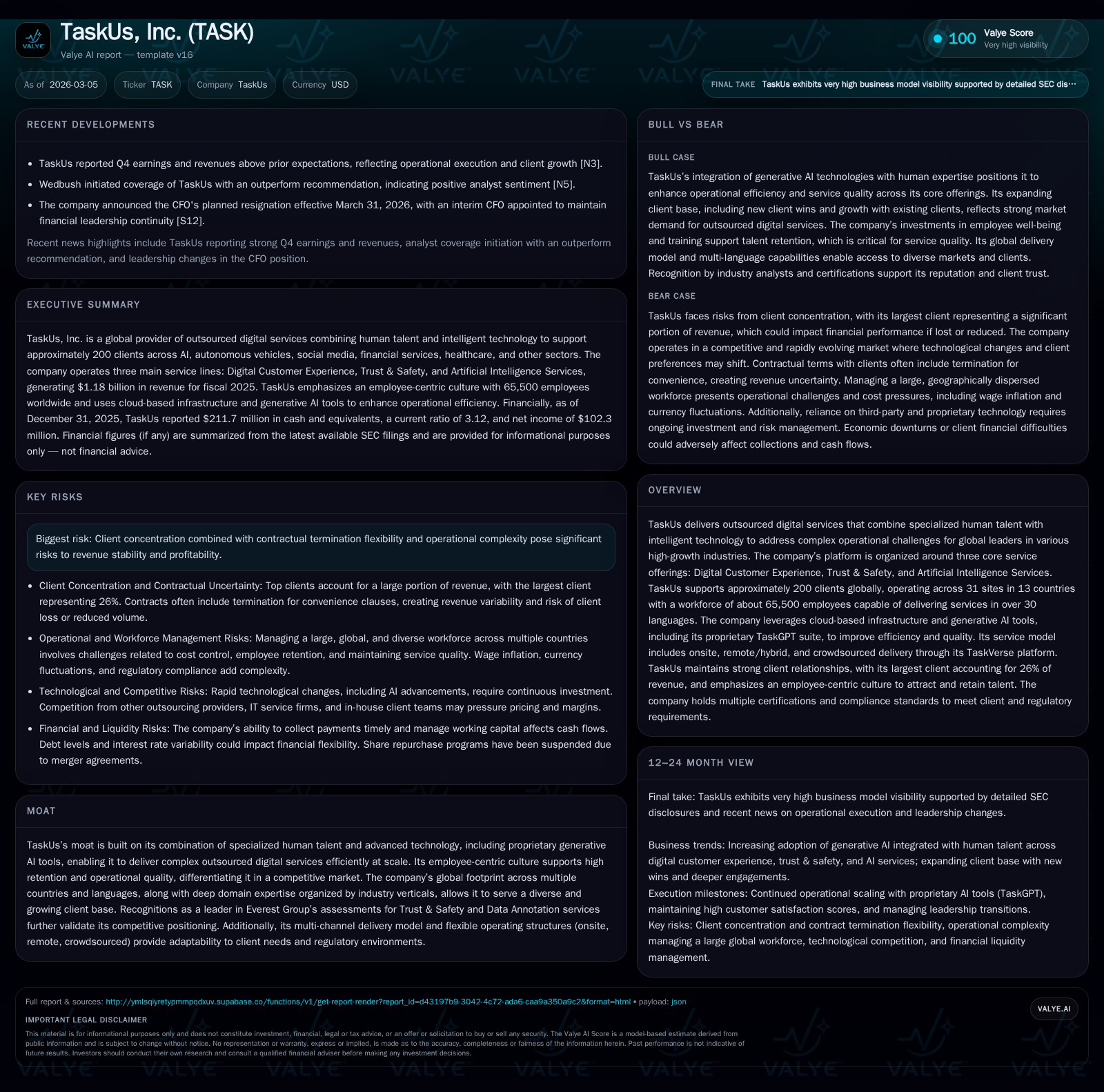
TaskUs, a leading provider of outsourced digital services, delivers growth through a combination of specialized human talent and advanced technology including its proprietary TaskGPT AI suite. The firm's service portfolio—centered on Digital Customer Experience, Trust & Safety, and AI Services—has expanded alongside strong client wins and industry recognition. Despite robust operating income growth and solid cash flow generation in 2025, concentrated revenue from a few large clients exposes TaskUs to potential termination and pricing risks. Future prospects hinge on AI integration, geographic expansion, and diversification of the client base amid an evolving regulatory landscape.
Company Overview
TaskUs operates at the crossroads of outsourced digital services powered by a hybrid model combining skilled human agents with intelligent technology solutions. Its core service lines—Digital Customer Experience (Digital CX), Trust & Safety, and Artificial Intelligence Services—cater primarily to high-growth technology-forward clients spanning social media, e-commerce, gaming, streaming media, financial services, healthcare, autonomous vehicles and robotics [S16].
Supporting roughly 200 clients with about 65,500 employees distributed over 31 global sites in 13 countries enables TaskUs to deliver offerings in over 30 languages [S16]. The company’s robust cloud-based infrastructure supports flexible delivery modes including onsite workspaces optimized for retention; remote/hybrid models leveraging TaskUs’ internally developed Cirrus platform; and crowdsourcing via TaskVerse which taps freelance "Taskers" globally for supplemental work [S9][S20].
Historical Financial Performance
The company has demonstrated consistent growth over recent years with expanding service penetration and operational efficiencies contributing to stronger profitability:
Historical performance (annual)
| FY | Net ($mm) | CFO ($mm) | OpInc ($mm) | Capex ($mm) | Net YoY |
|---|---|---|---|---|---|
| 2025 | 102 | 137 | 141 | 64 | +123.0% |
| 2024 | 46 | 139 | 92 | 39 | +0.4% |
| 2023 | 46 | 144 | 95 | 31 | +13.0% |
| 2022 | 40 | 147 | 84 | 44 |
Source: SEC companyfacts cache [F1].
Capital returns and efficiency (annual)
| FY | Div | Buybacks ($mm) | FCF ($mm) |
|---|---|---|---|
| 2025 | 28 | 74 | |
| 2024 | 19 | 100 | |
| 2023 | 0 | 112 | 113 |
| 2022 | 0 | 31 | 103 |
Source: SEC companyfacts cache [F1].
*Revenue figures sourced from SEC narrative sections due to absence of XBRL device; operating income onward refer directly to XBRL values [F1][S10]
Operating income grew robustly by over half from the prior year due to both higher revenues and margin improvement driven by scale and technology incorporation. Net income more than doubled compared with the prior year indicating effective expense control alongside improved operating performance. Cash flows from operations have remained solidly positive ranging between $137 million-$147 million annually despite rising capital expenditures necessary for technology infrastructure expansion—capex reached $63.5 million in FY2025 from $39 million in FY2024 (a nearly two-thirds increase), indicating upfront investments fueling future growth platforms [F1].
Capital Allocation
Alongside reinvestment into technology and operational capacity expansion as evidenced by increased capex spend, TaskUs returned capital via share repurchases amounting to $27.8 million for FY2025 after variable buyback levels in prior years [$111.9M in FY23 to lower levels in FY24-25] [F1]. Dividends were not resumed post-2021’s $50 million payout indicating focus on balance sheet flexibility amid growth initiatives. Equity rose steadily reflecting retained earnings generation plus likely moderate equity issuances as part of compensation or financing activities.
Return on equity approximated at around ~17% for FY2025 showcases respectable capital efficiency given the company’s reinvestment phase plus competitive market dynamics.
Growth Drivers & Future Prospects
Technology-Led Service Differentiation
TaskUs continues scaling its proprietary generative AI toolset branded TaskGPT alongside process automation and analytics capabilities embedded throughout its delivery platform. This investment aims at augmenting employee productivity while maintaining service quality standards crucial for customer experience-centric engagements [S9][S10].
The company is also integrating experimental Agentic AI system design consulting coupled with training programs—an innovation viewed favorably amid surging client demand for turnkey AI governance solutions.
Expansion Across Industry Verticals & Geography
Its diversified clientele includes high-growth tech disruptors but increasingly spans regulated industries such as healthcare & financial services where risk mitigation services (Trust & Safety) are critical. The growing breadth allows cross-selling opportunities within existing accounts while serving new enterprise-class customers internationally including Europe and Asia where expansion plans focus on language capabilities + specialized vertical expertise [S11][S16].
Client Wins & Retention Strategy
In calendar year 2025 alone TaskUs secured agreements with 34 new clients while reinforcing relationships through addendum statements of work with two-thirds of current clients [S11], suggesting healthy funnel development coupled with tactical account management.
Operational Model Flexibility
Adapting delivery structures from centralized on-site hubs focused on workforce engagement programs (e.g., free daycare services) to scalable remote/hybrid teams addresses shifting client preferences post-pandemic while ensuring compliance with local labor regulations adds resilience versus competitors relying solely on offshore labor arbitrage models [S9][S20].
Constraints & Risks
A prominent structural risk emerges from pronounced client concentration: five largest clients account for nearly half of total revenue with one client alone contributing over one quarter ($308M+ range estimate for Meta) [S1], exposing TaskUs to downside if key contracts are terminated or volume commitments revised downward.
Further complicating revenue visibility is contract flexibility permitting termination at convenience often without significant penalties; many agreements feature automatic renewals but no exclusive arrangements which impairs long-term revenue predictability [S1][S15].
Intense market competition features legacy BPO providers moving aggressively into higher-tech digital services alongside emerging players adopting newer AI-enabled workflows threatens margin compression risks especially where price leverage is limited by significant buyer concentration.
Compliance burdens related to data privacy laws (GDPR/CCPA), content regulation varying across geographies particularly impacting Trust & Safety operations along with intellectual property protection challenges remain persistent cost anchors that require constant vigilance and investment [S6][S8][S14][S21].
Technology obsolescence risk is non-trivial as evolving generative AI models and automation frameworks may rapidly commoditize portions of TaskUs' offerings absent continuous R&D investment.
What To Watch / Analyst Considerations (Analysis)
- Monitoring evolution of client mix will be critical given current concentration: a meaningful diversification away from top accounts would materially reduce earnings volatility.
- Adoption pace and scalability of the TaskGPT suite as measured by client deployment breadth will provide insight into sustainable margin uplift potential.
- Capital investment trends beyond FY25 especially relating to software platform development vis-à-vis facility expansion could signal strategic shifts toward higher-value-capability delivery.
- New contract signings coupled with renewal rates offer leading signals toward near-term revenue stability against backdrop of flexible termination terms.
- The regulatory environment’s impact on Trust & Safety business line margins particularly if compliance costs accelerate or stringent local regime barriers arise.
- Technology partnerships or acquisitions aimed at expanding Agentic AI or sector-specific functional capabilities should be assessed for synergistic value accretion.
Conclusion
TaskUs stands out within the digital outsourcing space by embedding generative AI technologies alongside its core human talent base to address complex customer experience and trust requirements for innovative global enterprises. Its solid financial trajectory evidenced by healthy top-line gains, margin expansion, strong net income progression paired with meaningful free cash flow generation underpin capability to fund growth investments sustainably without excessive dilution or leverage build-up.
However, elevated dependency on a handful of large clients intensifies earnings sensitivity particular amidst contractual flexibility allowing early termination or renegotiation pressures. Navigating this sector’s relentless pace requires continued innovation leadership particularly around generative AI integration alongside rigorous risk management addressing regulatory complexity and competitive threats.
Investors should monitor client concentration metrics closely along with effectiveness of evolving technology platforms (including TaskGPT) as proxies for durable competitive moat reinforcement supporting valuation multiples in this digitally transforming outsourcing landscape.
Disclaimer: This report is provided for informational purposes only and does not constitute investment advice or recommendations. It is based on publicly available information as of early March 2026 and is subject to change without notice.
Disclaimer: This is research-only, informational analysis and not investment advice. It may include AI-generated interpretation and general industry context. Always verify important details using primary sources.

Comments