
Preformed Line Products' Moderate Growth Faces Tariff and Supply Chain Pressures
PLPC's stable product mix and R&D focus underpin steady earnings despite tariff-driven cost pressures.
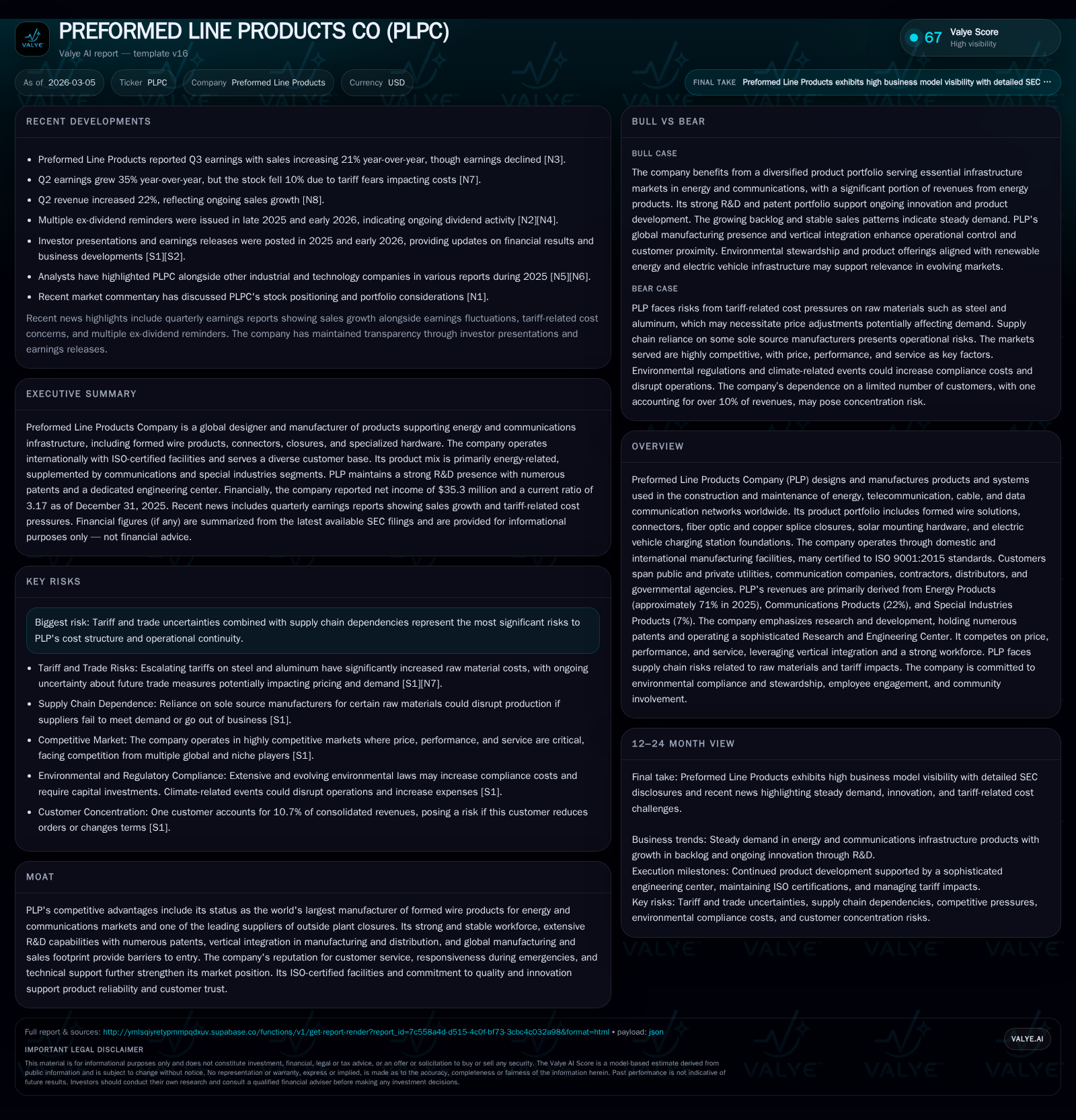
Preformed Line Products Company (PLPC) operates as a global leader in formed wire and cable support products, primarily serving energy and communication markets. Over recent years, it has demonstrated moderate growth with operating income increases but a slight net income decline in 2025 amid rising input costs due to tariffs. The company maintains solid cash flow generation and capital discipline, highlighted by its first dividend increase since 2001 and modest buybacks. Future growth hinges on infrastructure upgrades, fiber optic communication expansions, and special industries innovations, although trade uncertainties and raw material sourcing remain significant risks.
Business Overview
Preformed Line Products Company (PLPC) specializes in designing and manufacturing formed wire solutions, connectors, splice closures for fiber optic and copper cables, solar mounting hardware, and EV charging station foundations. Serving primarily the energy (approximately 71% of revenues) and communications markets (circa 22%), the company also caters to special industries such as solar framing and inspection services. Its worldwide manufacturing operations benefit from ISO 9001:2015 certification that facilitates consistent quality standards across geographies [S1][S4][S11].
Historical Performance
Financial results over recent years reveal a relatively steady revenue base with variations impacted by market conditions, raw material pricing, and competitive pressures. Operating income increased from $50.8 million in FY2024 to $55.1 million in FY2025 representing an 8.6% rise. However, net income slipped from $37.1 million to $35.3 million over the same period (-4.9%), indicating rising cost pressures likely due to input price inflation influenced by tariffs on steel and aluminum imports [F1][S6].
Operating cash flow also improved by about 8.9%, reaching nearly $73.5 million in FY2025, bolstered by healthy working capital management despite increased capex expense which jumped markedly to $40.1 million from $14.7 million a year prior—a roughly +174% increase reflecting investments into manufacturing capacity or technology enhancements [F1][S8][S29].
The company maintained a strong balance sheet with total equity rising to $475.5 million at fiscal year-end versus $422.3 million prior year-end; coupled with current assets comfortably exceeding current liabilities yielding a strong current ratio above 3x [F1].
Historical performance (annual)
| FY | Net ($mm) | CFO ($mm) | OpInc ($mm) | Capex ($mm) | Net YoY |
|---|---|---|---|---|---|
| 2025 | 35 | 73 | 55 | 40 | -4.9% |
| 2024 | 37 | 67 | 51 | 15 | -41.4% |
| 2023 | 63 | 108 | 84 | 35 | +16.4% |
| 2022 | 54 | 26 | 69 | 41 |
Source: SEC companyfacts cache [F1].
Capital returns and efficiency (annual)
| FY | Div ($mm) | Buybacks ($) | FCF ($mm) |
|---|---|---|---|
| 2025 | 4 | 1049000 | 33 |
| 2024 | 4 | 226000 | 53 |
| 2023 | 4 | 728000 | 72 |
| 2022 | 4 | 158000 | -14 |
Source: SEC companyfacts cache [F1].
Note: Revenue figures are not disclosed.
Product Segment Analysis
Energy Products: This segment forms the largest revenue contributor at approximately 71% in FY2025. It includes formed wire products used for supporting transmission lines, bolted/welded connectors for substations, polymer insulators, wildlife protection hardware, and specialized motion control devices like spacer dampers [S11]. Formed wire products leverage helical shaping technology that offers cost-effective yet reliable solutions widely accepted by utilities.
Communications Products: Making up about 22% of revenues in FY2025, this category features rugged outside plant closures designed for protecting fiber optic or copper networks against environmental damage—vital for modern FTTH deployments supporting broadband growth initiatives [S11]. The communication segment faces stiffer competition but benefits from PLPC's reputation as one of the top four OSP closure suppliers globally.
Special Industries: Approximately 7% of revenues derive from niche markets including solar panel mounting hardware for commercial/residential applications and electric vehicle charging station foundations, alongside inspection services using drone technologies for infrastructure monitoring [S4][S11]. These segments offer growth potential as renewable energy adoption accelerates.
Competitive Positioning and Moat
PLPC is the world's largest manufacturer of formed wire products for energy and communications markets, supported by extensive vertical integration allowing control over manufacturing and distribution processes [S5]. Its sizable patent portfolio — roughly 75 U.S. patents plus over a hundred international patents — underscores continuous innovation efforts driven out of a large Research and Engineering Center that conducts sophisticated vibration testing and environmental simulations [S8][S14].
The company's global footprint extends close proximate support to customers worldwide via strategically located plants delivering ISO certifications that instill confidence through strict quality controls [S6][S9]. Customer service excellence during emergencies such as natural disasters further builds loyalty among utilities that require timely repair solutions [S10]. This combination creates high entry barriers for competitors.
Risks and Challenges
Several macroeconomic uncertainties cloud PLPC's outlook. Rising tariffs on raw materials—primarily steel and aluminum—have materially escalated input costs leading to margin pressure despite selective price adjustments [S6][S18]. The evolving geopolitical tariff landscape injects unpredictability in supply chain costs requiring vigilant managed pass-through pricing strategies.
Moreover, sole-source suppliers for some raw materials pose risks if disruptions occur; though PLPC mitigates this via multiple sources or the ability to relocate tooling if necessary [S5][S6]. Climate-related regulatory requirements could also impose compliance costs or operational constraints over time [S12][S16]. Cybersecurity remains a focus as breaches could impact operational continuity; however recent organizational restructuring aims at strengthening IT governance [S15][S17].
Growth Prospects
Future revenue expansion could be driven by accelerating grid modernization initiatives embracing renewable energy integration where PLP’s products enhance reliability and resilience against climate events [S10][S12]. Regulatory mandates expanding fiber optic network rollouts particularly FTTH deployments present sustained demand for communications closures.
Special industries leveraging solar PV hardware adoption amid decarbonization policies alongside EV charger foundation products represent emerging markets ripe for innovation-led penetration [S4][S11]. Continual investment into advanced materials development through internal R&D will support product differentiation with patented technologies maintaining industry leadership [S14].
Order backlog growth to $232.8 million at year-end signals robust near-term demand visibility going into calendar year 2026 [S6]. Close monitoring is warranted on tariff evolutions which could compress margins if raw material prices spike without commensurate price recovery.
Capital Allocation & Returns
In December 2025, PLPC announced a rare dividend increase of roughly 5%, raising quarterly payouts from $0.20 to $0.21 per share—the first raise since listing on NASDAQ in 2001—highlighting management’s confidence in cash flow stability [S21]. Dividend payments were around $4.1 million annually.
Buyback activity has been modest but accelerating with around $1 million repurchased shares in FY2025 versus less than $250k the year before, signaling some shareholder return initiatives balanced against capital expenditure needs [F1][S24]. Free cash flow approximated at $33.3 million after subtracting capex from operating cash flow provides discretionary spending capacity while supporting ongoing investments into manufacturing modernization.
Return on equity was roughly estimated at about 7.4% for FY2025 based on net income relative to ending equity balances reflecting moderate profitability consistent with industry peers facing cost inflationary environments but benefiting from operational leverage effects within core product lines [F1].
What to Watch Going Forward (Analysis)
- Impact of evolving U.S./international tariffs: Any relaxation may ease cost pressures, whereas further escalation would necessitate additional pricing actions or sourcing changes.
- Order backlog fulfillment pace: Execution efficiency on backlog can indicate resilience amid supply chain challenges.
- R&D breakthroughs or new patent filings: Could open avenues into adjacent markets or improve competitive standing.
- Expansion of special industries segment including solar/EV related sales: Would add incremental revenue streams beyond traditional energy/communication base.
- Dividend policy evolution amid capex requirements: Further hikes or pacing of buybacks may signal management’s risk appetite toward shareholder returns vs reinvestment.
- Any impact from regulatory/compliance shifts particularly climate-related requirements affecting operating costs or facility investments.
- Cybersecurity incident management effectiveness given rising global IT threats; the formation of the new Director of Global IT Infrastructure & Security role may mitigate future risk.
Conclusion
Preformed Line Products Company presents a profile of consistent mid-single-digit operating income growth powered by leadership positions in specialized formed wire applications across critical infrastructure sectors globally. The company’s differentiated technology portfolio backed by strong R&D capabilities offsets competitive commodity pressures somewhat but not fully amid inflating tariff-related raw material costs.
Robust liquidity metrics combined with prudent capital allocations including capex ramp-up to sustain production capacity make PLP well-positioned to serve ongoing infrastructure modernization trends especially in energy transition domains like renewables plus broadband connectivity expansions through fiber optics. Nonetheless uncertain trade policies remain near-term headwinds while the gradual recovery trajectory post pandemic-induced disruptions requires monitoring for any shifts impacting customer budgets or supplier relations.
Disclaimer: This analysis is based solely on information available as of early March 2026 without provision of investment recommendations.
Disclaimer: This is research-only, informational analysis and not investment advice. It may include AI-generated interpretation and general industry context. Always verify important details using primary sources.

Comments