
Via Renewables’ Volatile Growth and Capital Challenges Spotlight Industry Risks
Via Renewables shows robust top-line expansion shadowed by eroding margins, regulatory pressures, and leverage constraints.
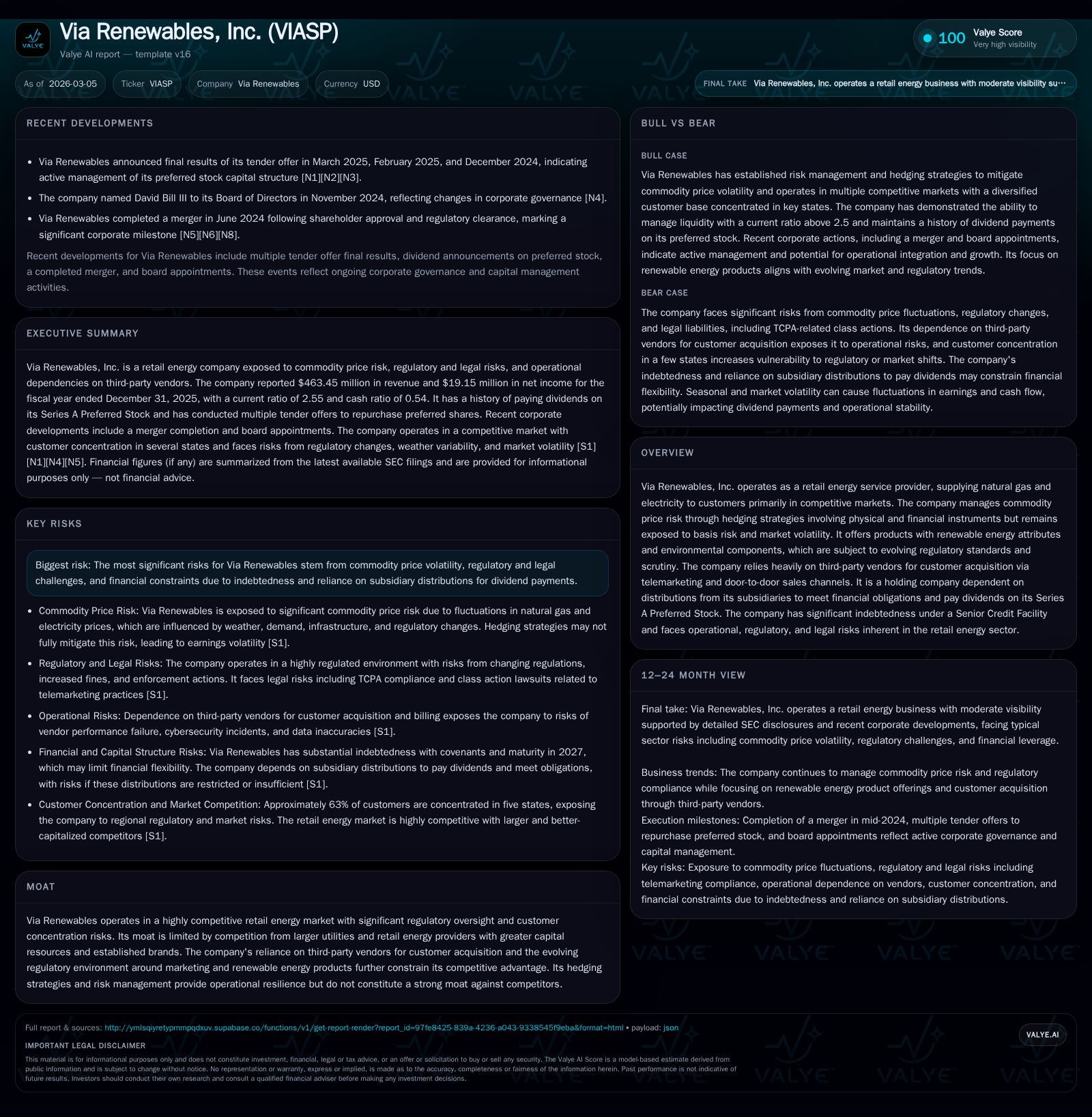
Via Renewables, Inc. has exhibited notable revenue growth over recent years, increasing its top-line by over 16% in fiscal 2025 despite mounting margin pressure reflected in a sharp decline in operating income. This volatility is accentuated by exposure to commodity price fluctuations, reliance on third-party vendors for customer acquisition amid stringent telemarketing regulations, and ongoing class action litigations. The company's significant indebtedness under its Senior Credit Facility limits strategic flexibility and heightens refinancing risks as maturity approaches mid-2027. While operational cash flows remain positive with moderate free cash flow generation and a respectable return on equity, dividend payments to Series A Preferred Stockholders and regulatory compliance demand careful capital allocation. Future growth hinges on navigating regulatory headwinds, sustaining vendor relationships, and managing legal exposures within an intensely competitive retail energy marketplace.
Revenue Growth Trends and Fluctuating Profitability in Recent Years
Via Renewables, Inc.’s financial trajectory over the past four fiscal years illustrates a dynamic yet volatile performance. In FY2025, revenue surged to approximately $463.5 million—a 16.2% increase compared with $398.9 million in FY2024—demonstrating the firm’s capability to expand sales amid competitive pressures [F1]. This growth trend followed a contraction in FY2024 versus FY2023 but rebounded strongly from FY2023’s $435.2 million level.
However, this top-line strength contrasts sharply with profitability metrics that reveal significant margin compression. Operating income declined steeply by 36.4% year-over-year to $53.5 million in FY2025 from $84.2 million the previous year [F1]. Similarly, net income was down by 32.2%, settling at $19.1 million after reaching $28.3 million in FY2024.
Such divergence between revenue progression and profitability loss indicates increasing cost pressures or lower incremental margins despite expanding customer base or volumes. Notably, operating cash flow decreased by about 16.6% in FY2025 compared with the prior year ($42.1M vs $50.5M), even as capital expenditures nearly doubled from $1.58 million to $2.96 million year-over-year [F1]. This suggests rising investments possibly for operational scalability or compliance enhancements but also strains free cash flow potential.
Historical performance (annual)
| FY | Rev ($mm) | Net ($mm) | CFO ($mm) | OpInc ($mm) | Rev YoY | Net YoY |
|---|---|---|---|---|---|---|
| 2025 | 463 | 19 | 42 | 54 | +16.2% | -32.2% |
| 2024 | 399 | 28 | 50 | 84 | -8.3% | +88.7% |
| 2023 | 435 | 15 | 49 | 46 | -5.5% | +97.6% |
| 2022 | 460 | 8 | 16 | 25 |
Source: SEC companyfacts cache [F1].
Capital returns and efficiency (annual)
| FY | FCF ($mm) | ROE% |
|---|---|---|
| 2025 | 39 | 28.3 |
| 2024 | 49 | 42.3 |
| 2023 | 48 | 32.1 |
| 2022 | 14 | 17.8 |
Source: SEC companyfacts cache [F1].
Note: Growth percentages computed where applicable using reported values [F1].
Impact of Commodity Price Volatility and Customer Acquisition Model on Margins
The retail energy business is inherently tied to volatile commodity markets for natural gas and electricity that Via Renewables navigates through an active hedging program using physical and financial instruments intended to mitigate price exposure on forecasted volumes [S1],[S15]. Nevertheless, hedging introduces basis risk resulting from mismatches between the delivery points of purchased commodities under hedge contracts versus where actual supply occurs—such as differences between regional hubs used in Chicago or Houston pricing versus local market delivery points—creating residual unhedged exposures that threaten margins [S23].
Price swings driven by weather fluctuations—colder winters boosting natural gas demand or hotter summers elevating electricity use—can unexpectedly alter consumption patterns against hedge assumptions causing over- or under-hedging consequences with financial impacts [S21]. Extreme weather events exacerbated by climate change intensify these seasonal swings.
Operationally, Via Renewables depends heavily on third-party vendors primarily delivering customer acquisition through telemarketing and door-to-door sales channels [S7],[S19]. This vendor reliance introduces layers of regulatory complexity amid increasingly stringent rules such as the December 2023 FCC restrictions limiting outbound calls via lead generators and amplified risks under the Telephone Consumer Protection Act (TCPA). Liability can extend vicariously to Via Renewables even if their vendors’ actions breach compliance—a notable industry challenge leading to costly class action suits [S4],[S7]. Vendor-driven sales efficiency has already seen pressure from declining landline penetration prompting shifts towards door-to-door strategies that themselves are under regulator scrutiny for deceptive tactics.
These factors jointly compress incremental margins as selling costs rise concurrently with unpredictable commodity procurement expenses.
The Burden of Regulatory Compliance Risks and Legal Challenges
Regulatory oversight presents significant hurdles for Via Renewables beyond mere commodity market exposure: the company faces ongoing class action litigations tied principally to alleged inappropriate sales practices executed by third-party vendors including TCPA violations or misleading marketing representations [S4],[S7]. These actions threaten multi-million dollar penalties, adverse judgments, increased bond postings required for licensing, or outright license revocations which could bar operation within critical states.
The company’s licenses are essential operational permits; losing or having licenses adversely conditioned—as witnessed in other ESCO bans with multi-year suspensions—would materially disrupt customer access and revenue generation capabilities [S4]. Since about two-thirds of Via’s customers concentrate within five states (PA, CO, TX, NY, OH), any adverse state regulatory moves disproportionately amplify business risk exposure to those jurisdictions’ policy shifts [S10],[S20].
Compliance cost escalation also stems from data privacy requirements around customer communications plus cyber-security risks related to third-party billing platforms integral to operations [S11],[S19]. Emerging regulatory scrutiny over artificial intelligence tools used for marketing amplifies uncertainty.
How Debt Levels and Credit Facility Terms Limit Strategic Flexibility
Via Renewables' capital structure features significant indebtedness comprising approximately $156.7 million outstanding under its Senior Credit Facility as of December 31, 2025, supplemented by letters of credit totaling $36.7 million supporting collateral needs for supply contracts; no subordinated debt is currently drawn [F1],[S8]. The facility matures mid-2027 and contains restrictive covenants limiting distributions upstream from subsidiaries (e.g., Spark HoldCo) essential for funding holding company obligations such as Series A Preferred Stock dividends and corporate-wide investments [S5],[S27].
The leverage compresses financial agility notably because:
- Adherence to covenant ratios constrains discretionary dividend increases or stock repurchases.
- Rising interest rates impact borrowing costs given floating rate terms.
- Refinancing risks approach as maturity nears amidst uncertain capital markets.
- Current economic conditions heighten challenges in sourcing additional liquidity without dilutive or expensive alternatives.
This leverage profile interlocks tightly with operational cash flows which must cover interest service ahead of equity distributions restricting growth capital deployment flexibility [F1].[note: Operating cash minus capex capped ~39M USD free cash flow]
Insights into Capital Allocation: Dividends, Buybacks, and Cash Flow Management
In financial stewardship terms, Via Renewables generated $42 million in operating cash flow during FY2025 but invested nearly $3 million into capital expenditures marking an upward trend due perhaps to compliance upgrades or system expansion projects; this yielded near $39 million in free cash flow still adequate to fund partial preferred stock redemptions announced early CY26 targeting ~232K shares at $25 plus accrued dividends indicating management’s prioritization of stabilizing preferred distributions amidst earnings headwinds [F1],[S3],[S24].
While share repurchases have historically been minimal—virtually nil since FY2019—the company maintains dividend commitments on its cumulative Series A Preferred Stock at a stated rate of approximately 8.75%, subordinated below senior debt obligations complicating capital return policies under tight liquidity conditions [F1],[S24],[S27].
Return on equity stands at an estimated robust level of ~28%, reflective of deployed equity totaling nearly $67 million against net earnings of $19 million albeit shrinking profits indicate caution ahead should operational hurdles persist reducing shareholder value creation scope absent margin recovery strategies.
Evaluating Future Growth Opportunities Against Market and Operational Constraints
Future outlook is clouded given absence of explicit forward guidance but can be analyzed through qualitative factors:
- Organic expansion resides heavily on sustaining vendor effectiveness amid regulatory clamps on telemarketing lead generation reducing available prospects forcing costlier outreach modes like door-to-door which themselves face growing state-level restrictions raising compliance expenditures.
- Acquisition strategies exist per corporate disclosures but integration execution risk plus financing constraints due to credit facility covenants limit maneuverability.
- Evolving renewable product standards create necessity for greater due diligence around Renewable Energy Credits procurement risking volatility in product pricing competitiveness if pass-throughs falter impacting consumer retention.
- Customer concentration adds geographic vulnerability particularly toward states susceptible to abrupt policy reversals undermining revenue stability.
- External factors such as climate effects unpredictably skew demand-supply dynamics affecting hedging effectiveness.
Key Milestones to Monitor for Potential Upside or Setbacks
Several pivotal developments merit close observation:
- Successful refinancing negotiations or covenant amendments ahead of June 30, 2027 Senior Credit Facility maturity affecting liquidity and operational freedom is critical [S5],[S13].
- Legal resolutions favoring or burdening operations via outcomes from TCPA-related lawsuits and vendor liability claims influencing cost structures or license statuses warrant tracking [S4],[S7].
- Regulatory rulings reshaping telemarketing compliance frameworks or renewable product validation could recalibrate growth pathways substantially especially post-FCC rule adaptations effective late-2023 onward [S7],[S29].
- Commodity price cycle shifts impacting basis risk intensity hand-in-hand with management’s hedging effectiveness determine margin viability going forward.
- Customer churn metrics reflecting real-time competitive positioning within key states provide operational insight into retention success amid aggressive marketplace competition.
This analysis relies exclusively upon company filings up through March 5, 2026 including detailed SEC disclosures and reported financial statements without conjecture beyond documented facts or reasonable sector-specific assessment grounded firmly within presented information sources noted herein.
This report is intended solely for informational purposes without constituting investment advice or endorsement.
Disclaimer: This is research-only, informational analysis and not investment advice. It may include AI-generated interpretation and general industry context. Always verify important details using primary sources.

Comments