
CarParts.com Weighs Growth Opportunities Against Structural Profitability and Capital Constraints
The aftermarket auto parts e-commerce company faces challenges balancing operational losses, supply chain dynamics, and liquidity risks.
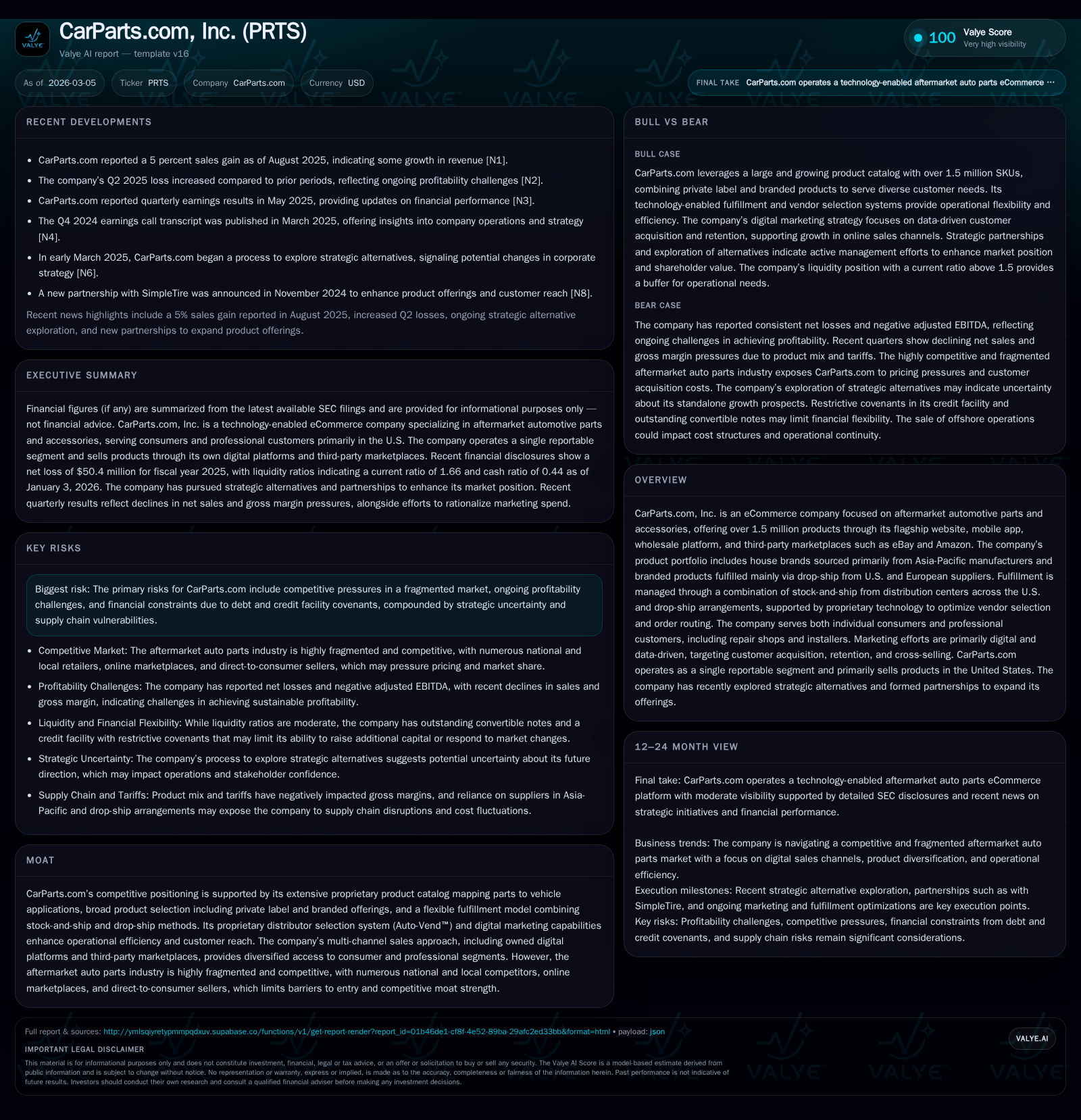
CarParts.com, Inc. operates a broad online platform for aftermarket automotive parts with a mix of house brands and third-party offerings, utilizing hybrid fulfillment models to serve retail and professional customers. Although revenue has largely stagnated over recent years, the company faces increasing losses driven by gross margin compression and elevated operating expenses. Liquidity stands constrained by amended credit agreements limiting borrowing capacity amid significant debt levels and covenant restrictions. Future growth hinges on digital marketing optimization, product catalog expansion, and operational scalability but is capped by competitive pressures and capital structure limitations.
Company Overview
CarParts.com, Inc. operates primarily as an e-commerce platform specializing in aftermarket automotive parts and accessories. The company offers over 1.5 million SKUs through its flagship website, mobile app, wholesale web portal, as well as third-party marketplaces such as eBay and Amazon [S1], [S5]. Its product portfolio is divided between proprietary house brands sourced mainly from Asia-Pacific manufacturers (such as JC Whitney®, Evan Fischer®, Garage-Pro®) and third-party branded products fulfilled predominantly via drop-ship from partners in the United States and Europe [S5], [S15].
The business employs a hybrid fulfillment structure combining stock-and-ship — involving four U.S. distribution centers — with drop-ship arrangements facilitated by a proprietary Auto-Vend™ distributor selection system that prioritizes delivery vendor based on location, cost, service history, and contractual terms [S10]. This dual-model optimizes inventory management while aiming to meet customer demands across individual consumers (DIY segment) and professional installers or repair shops (DIFM segment).
Historical Performance & Growth Drivers
From available historical data spanning FY2019 through FY2025, CarParts.com’s revenue has remained relatively flat near the $69 million mark reported at the end of FY2019 ([F1]). The company’s operating income has deteriorated markedly over this period: shifting from positive territory with slight operating income of approximately $0.65 million in FY2022 to a substantial operating loss reaching nearly $49 million by FY2025 ([F1]). Net losses echo this trend, deepening from under $1 million loss in FY2022 to more than $50 million in FY2025 ([F1]).
Historical performance (annual)
| FY | Net ($mm) | CFO ($mm) | OpInc ($mm) | Capex ($mm) | Net YoY |
|---|---|---|---|---|---|
| 2025 | -50 | -34 | -49 | 8 | -24.2% |
| 2024 | -41 | 10 | -41 | 21 | -393.7% |
| 2023 | -8 | 50 | -10 | 12 | -764.7% |
| 2022 | -1 | 15 | 1 | 13 |
Source: SEC companyfacts cache [F1].
Capital returns and efficiency (annual)
| FY | Buybacks ($mm) | FCF ($mm) | ROE% |
|---|---|---|---|
| 2025 | -42 | -94.3 | |
| 2024 | 4 | -10 | -47.7 |
| 2023 | 4 | 38 | -7.3 |
| 2022 | 1 | 3 | -0.9 |
Source: SEC companyfacts cache [F1].
Financials reflect increased losses disproportionate to revenue changes indicating margin compression and higher cost base [F1].
The decline in operating income was principally driven by factors including tariff impacts on imports primarily from China/Taiwan in addition to product mix shifts favoring lower-margin items, which together squeezed gross margins [S15]. Marketing rationalization efforts aimed at improving profitability inadvertently depressed sales volume contributing to topline softness (~11% sales decrease during Q3-2025 YoY noted) [S24].
Business Model & Operational Structure
CarParts.com leverages an extensive proprietary catalog that maps parts to specific vehicle applications — a critical competitive factor ensuring customers find correct parts despite the complexity of auto part specifications . House-brand products are stocked in company-owned warehouses facilitating stock-and-ship shipping while branded products often flow through drop-ship vendors linked with real-time APIs enabling inventory visibility and direct shipment [S5], [S10]. Approximately three drop-ship vendors represented about 12% of all product purchases during fiscal 2025 illustrating reliance on a concentrated supplier set for these offerings [S15].
Marketing employs diversified digital channels including paid search, SEO, social advertising, affiliate partnerships plus marketplace-specific tools on Amazon/eBay enhancing product visibility reservation [S15]. Customer acquisition and retention strategies utilize data-backed lifecycle engagement via email/SMS/mobile notifications with personalized promotions tied to vehicle ownership data [S15]. This multi-pronged approach generates cross-selling opportunities across the large product SKU array.
Though strategic partnerships such as that with ZongTeng Group aim to boost logistics efficiency via improved distribution positioning and delivery speed optimization initiatives [S10], operational complexity remains significant while cost pressures persist.
Competitive Environment & Industry Dynamics
CarParts.com operates within a fragmented aftermarket auto parts industry characterized by intense competition comprising national chains (Advance Auto Parts, AutoZone), local retailers, specialized online platforms plus dominant marketplaces like Amazon [S13]. Competitive factors include part catalog breadth/depth accuracy, ease of finding right-fit components online amidst legacy complexities of vehicle specs, pricing competitiveness especially vis-à-vis OEM vs aftermarket options along with customer service quality [S13].
Limited barriers to entry due to low switching costs encourage aggressive price competition constraining margin expansion opportunities despite CarParts.com’s proprietary cataloging technology system providing some differentiation . Market trends also reveal evolving consumer shopping behavior trending towards mobile devices which demands continued platform optimization for user experience underpinned by fast response times — failure of which could impair customer retention [S26].
Capital Structure & Liquidity Constraints
CarParts.com’s liquidity profile exhibits notable stress due primarily to ongoing net losses coupled with heavy working capital requirements inherent in inventory-intensive e-commerce operations [F1], [S4], [S6], [S7]. The company’s credit facility was materially amended in September 2025 reducing revolving commitment from $75 million to $25 million with additional sublimits pertaining to letters of credit plus an option for uncommitted increases up to $125 million under certain conditions; maturity was accelerated to September 8, 2026 from June 2027 previously [S4], [S12]. These amendments reflect lender conservatism aligned with CarParts.com’s deteriorating financial metrics.
Restrictive covenants embedded within the amended credit agreement impose constraints on incurring further indebtedness or engaging in asset sales or dividend payouts limiting strategic flexibility [S4], [S7]. The company had no outstanding revolver debt as of early FY2026 end but may draw borrowings subject to borrowing base tests tied to receivables/inventory/PP&E valuations; any deterioration here could trigger liquidity challenges requiring asset disposals or cash conservation measures [S6], [S7]. Convertible notes totaling approximately $25 million further complicate capital structure dynamics [S12], contributing interest expenses amidst negative cash flows.
Historically worsening cash flows are evident in CFO turning negative $34 million in FY2025 versus positive inflows previously highlighting ongoing cash burn pressure; capital expenditures were scaled back materially last year but still persist near $8 million annually indicating investment needs continuing despite financial strain ([F1]).
Equity base has shrunk materially reflecting accumulated deficits nearing half a century USD billions; approximate ROE based on recent net losses suggests substantial negative returns around negative ninety percent range signaling poor capital efficiency ([F1]). No dividend distributions or stock buybacks were reported recently consistent with preserving limited liquidity.
Future Prospects & Risks Analysis
Future growth for CarParts.com depends heavily on several interrelated factors:
- Improved operational profitability driven partly by refining marketing spends without compromising customer acquisition,
- Further development of proprietary catalog systems facilitating easier vehicle-part matching,
- Expansion into complementary wholesale channels serving professional installers,
- Enhancing fulfillment efficiency via tech-enabled vendor selection algorithms optimizing speed versus cost tradeoffs,
- Navigating competitive tactics from giant marketplaces offering similar products,
- Adapting digital experiences specifically for rising mobile usage among consumers,
- Mitigating supply chain risks arising from geopolitical tensions affecting Asia-Pacific suppliers,
- Compliance with evolving regulations especially those affecting aftermarket parts usage disclosures or restrictions in collision repairs.
Key risk vectors include:
- Intensifying pricing wars potentially eroding margins beyond recovery,
- Supplier concentration risks especially if key drop-ship vendors curtail credit lines or inventory allocations,
- Fulfillment disruptions caused by reliance on third-party logistics or failure to scale warehouse infrastructure timely,
- Debt covenant breaches triggering accelerated repayments or liquidity crises,
- Ongoing net losses impairing investor confidence restricting access to new capital sources.
No explicit future guidance was disclosed; stakeholders should monitor upcoming quarterly earnings announcements for updates relating to margin trends, customer acquisition metrics versus marketing spend efficiency, debt covenant compliance status as well any potential refinancing plans given upcoming credit facility maturity in September 2026.
Summary Table: Key Financial Metrics ($ thousands)
| Metric | FY2022 | FY2023 | FY2024 | FY2025 |
|---|---|---|---|---|
| Revenue | N/A | N/A | N/A | N/A |
| Operating Income | +651 | -9,881 | -40,635 | -48,875 |
| Net Income | -951 | -8,223 | -40,601 | -50,443 |
| Operating Cash Flow | +15,368 | +50,001 | +10,338 | -34,076 |
| Capital Expenditures | 12,585 | 11,879 | 20,573 | 7,961 |
| Equity | 110,072 | 112,831 | 85,175 | 53,476 |
Note: Revenue listed only for early years due to data scope limitations; losses reflect accelerating negative trends becoming pronounced post-FY2022; cash flow reflects growing strain despite capex reduction.
Closing Remarks
CarParts.com finds itself at a critical inflection point balancing ambitious multi-channel platform scaling against challenging structural profitability dynamics intensified by heightened competitive pressures within auto parts ecommerce. Its proprietary catalog technology coupled with hybrid fulfillment models offers some differentiation yet is not enough alone to overcome weak financial results demonstrating substantial operating losses amplified over recent years. Liquidity constraints imposed by trimmed-down credit facilities combined with restrictive covenants reduce financial flexibility substantially ahead of major maturities slated for late next year. Management will have to skillfully realign marketing investments while navigating supplier relationships and fulfillment expansions amid evolving consumer expectations notably around mobile commerce experiences. Though considerable headwinds persist throughout its operational ecosystem—the company’s scale alongside digital reach does provide avenues for incremental improvements if appropriately executed. Investors should continue monitoring cash flow developments closely alongside creditor relationship dynamics given their integral influence on corporate viability moving forward. This analysis is intended solely for informational purposes without investment advice or recommendations regarding CarParts.com securities.
Disclaimer: This is research-only, informational analysis and not investment advice. It may include AI-generated interpretation and general industry context. Always verify important details using primary sources.

Comments