
Ambiq Micro’s Strategic Pivot Boosts Margins and Expands Edge AI Reach
Ambiq Micro’s geographic shift and proprietary SPOT® platform are key drivers behind its 2025 margin recovery and positioning in edge AI markets.
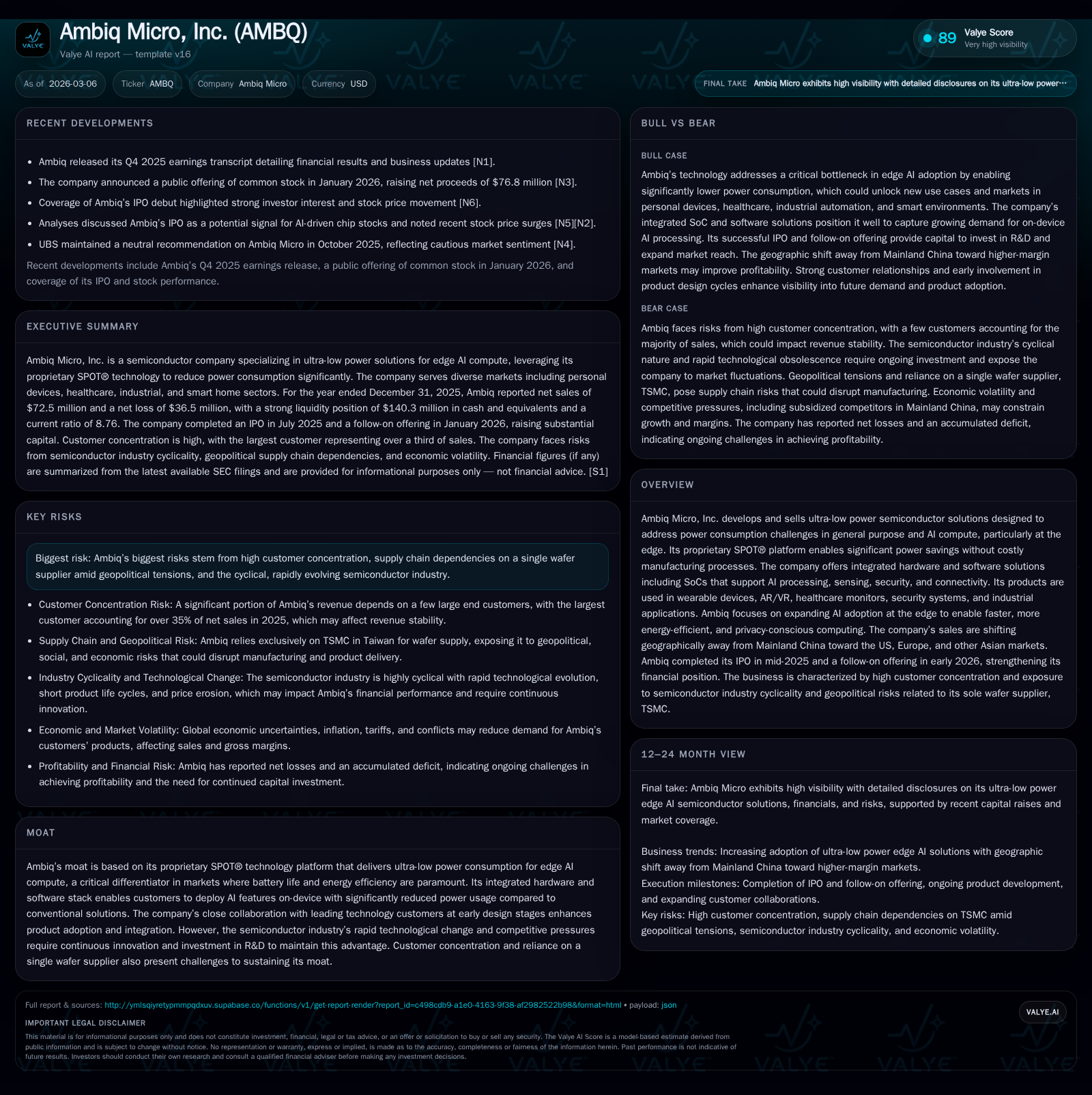
In 2025, Ambiq Micro executed a strategic realignment of its sales footprint away from Mainland China toward higher-margin markets such as the US and Europe, catalyzing a substantial gross margin improvement of 1,240 basis points to 44.3%. The company’s proprietary SPOT® technology continues to differentiate its ultra-low power AI semiconductor solutions, critical in device power envelopes for edge computing applications. While revenue slightly declined 4.7%, the pivot reflects a deliberate focus on profitability over volume amid geopolitical pressures. Ample liquidity from mid-2025 IPO and early 2026 follow-on offerings support ongoing R&D investments. Key risks include reliance on TSMC wafer supply and customer concentration, warranting close monitoring as Ambiq seeks further AI edge adoption.
Track Record: Growth Drivers and Margin Recovery in 2025
Ambiq Micro’s full-year performance in calendar 2025 illustrates a pivotal shift reflecting strategic prioritization of profitability over pure top-line growth. While reported revenue declined modestly by $3.6 million or 4.7% year-over-year to $72.5 million [F1], the underlying story is one of portfolio realignment and geographic diversification away from Mainland China — historically a dominant but lower-margin market.
The gross margin increase was dramatic with a rise of 1,240 basis points to reach 44.3% in 2025 compared to just under 32% the prior year [F1][S6]. This jump was driven principally by the shift towards end customers outside Mainland China where ASPs are higher and the product mix carries greater value-add linked to edge AI functionalities [S4][S5]. Ambiq attributes this margin improvement also to improved manufacturing yield despite rising silicon wafer and assembly costs — a testament to optimized production cycle management alongside its patented technology advantages [S4][S29].
However, this transition came at a cost: net income remained negative at -$36.5 million with operating losses standing at -$39.5 million [F1], signaling that while revenue quality improved, investments in R&D ramp-up for new product lines and increased public company expenses weighed on near-term profitability.
Historical performance (annual)
| FY |
|---|
| 2025 |
Source: SEC companyfacts cache [F1].
Note: Operating income and net income for 2024 not explicitly disclosed.
Leveraging SPOT® Technology to Solve Edge AI Power Challenges
At Ambiq's core lies its proprietary SPOT® technology platform, engineered to significantly compress the power consumption envelope essential for wearable devices, industrial sensors, healthcare monitors, AR/VR gadgets, and smart security systems operating at the edge [S4]. The integrated hardware-software stack not only addresses thermal constraints but enables on-device AI inference enabling privacy-conscious processing with lower latency.
Critically, SPOT® avoids costly advanced node manufacturing processes which typically hike fabrication expenses or reduce yield—a notable advantage when sourcing silicon wafers from third-party foundries such as TSMC's established PV fabs [S4][S29]. This cost-effective approach helps maintain competitive gross margins even amidst inflationary pressures on packaging and testing.
Ambiq’s close collaboration with top-tier OEMs early in design cycles helps embed power efficiency deep into system architecture—an increasingly vital differentiator as device form factors shrink and battery budgets tighten across IoT verticals.
Geographic Realignment: From Mainland China to Diversified Markets
In a deliberate strategic recalibration prompted by escalating geopolitical tensions and intense price competition fueled by subsidized mainland Chinese rivals, Ambiq drastically reduced Mainland China's contribution from approximately half its revenue (50%) in 2024 down to only about 8.6% in 2025 [S4][S5]. Instead, it expanded sales notably into the United States, Taiwan, Singapore, the Netherlands, and other Asia-Pacific markets [N1][S25].
This shift has enhanced margins due to higher ASPs aligned with sophisticated medical/healthcare devices and industrial edge applications requiring ultra-low power intelligence rather than commoditized volume sales [S4][S5]. It also mitigates concentrated political risk while positioning Ambiq closer to customers driving innovation at the AI edge.
However, this geographic pivot remains challenging operationally due to demand volatility amid macroeconomic uncertainty along with longer sales cycles common outside highly transactional Chinese OEM relationships.
Operational and Financial Metrics: Profitability, Cash Position, and Capital Structure
Despite improved gross margins, Ambiq remains unprofitable on an operating (-$39.5 million) and net (-$36.5 million) basis for full year 2025 [F1], owing largely to continued high R&D investment plus incremental public company costs post-IPO [S7][N1]. Its current ratio stands robustly at approximately 8.76x given current assets of $168 million against liabilities near $19 million—a strong liquidity buffer supporting operational scalability [F1][S7].
Importantly, Ambiq carries essentially zero long-term debt risk with no significant interest burdens reported—a notable strength given capital-intensive semiconductor cycles—and relies mainly on equity financing for growth capital [S7]. Cash flow from operations remains negative but improving compared with prior periods indicating ongoing burn aligned with development phase investment pacing typical among semiconductor startups transitioning into commercial maturity [F1].
Capital Allocation: IPO Proceeds, R&D Investment, and Shareholder Returns
The IPO in July 2025 generated approximately $102.7 million net proceeds followed swiftly by an additional $76.8 million raise via a secondary offering early in January 2026 [S7][N3]. These infusions have been earmarked primarily for R&D ramp-up focused on products like Atomiq which have incurred elevated development costs including engineering headcount increases and contract labor spikes [S6].
R&D expense grew moderately (~+3.5%) year-over-year reaching $38.5 million reflecting both incremental projects and staffing expansions without dramatic scale-up yet fully realized revenue offsets [S6]. Conversely SG&A expenses rose nearly +20%, largely due to one-time IPO transaction costs plus recurring public company compliance overheads including audit fees, D&O insurance hikes, investor relations activities—and some increased stock-based compensation charges tied to RSUs granted during transition [S6].
No dividends or share repurchases were declared or planned as capital allocation focuses squarely on reinvestment for growth rather than shareholder returns [N3][S7].
Market Risks: Supply Chain Dependencies and Customer Concentration
Ambiq’s dependence on a sole supplier for its wafer needs—TSMC—is a critical vulnerability accentuated amid heightened geopolitical strife around Taiwan status quo preservation concerns [S8][S9]. Any disruption could necessitate costly transfer of manufacturing or sourcing shifts impacting timelines and margins.
Customer concentration also poses material risk; the top three customers collectively generated roughly 85% of net revenues in fiscal year 2025—the largest customer alone constituting approximately one-third of sales—potentially exposing Ambiq to significant fluctuations based on contract renewals or market dynamics impacting these accounts [S9][S11]. Mitigation efforts have included broadening end markets beyond traditional consumer segments toward healthcare and industrial nodes less susceptible to cyclicality but challenges remain.
Moreover semiconductor industry cyclicalities—including rapid technological obsolescence pressure requiring constant fresh IP development—and pricing erosion pressures intensified by subsidized competitors especially within Mainland China add systemic uncertainty governing sustainable margin maintenance going forward [S4].
Outlook: What to Watch in Ambiq’s Path Forward
Looking ahead through an analytical lens derived from recent earnings commentary [N1] and market reaction narratives [N2], several operational milestones merit close observation:
- Continued displacement of Chinese exposure balanced against sustained pipeline penetration within US/EU/Taiwan geographies.
- Successful scaling of SPOT-powered product families alongside new launches such as Atomiq sustaining margin leverage amidst competitive pricing environment.
- Supplier capacity availability particularly TSMC wafer fab scheduling accommodating increasing demand without bottleneck-induced shipment delays.
- Efficient absorption of public company expense structure post-IPO transition without negating bottom-line improvements.
- Potential extension into adjacent IoT verticals exploiting ultra-low power credentials tailored for privacy-sensitive AI use cases.
Investor interest should track quarterly cadence data on bookings growth outside China plus supply chain metrics sensitive to macrotrade developments involving key semiconductor ecosystem participants.
Disclaimer: This analysis is based solely on disclosed data points from SEC filings, official news releases and transcripts referenced herein; it does not constitute investment advice or forecasts beyond cited sources' explicit statements or direct extrapolations thereof.
Disclaimer: This is research-only, informational analysis and not investment advice. It may include AI-generated interpretation and general industry context. Always verify important details using primary sources.

Comments