
Orion Properties Shrinks Portfolio and Faces Refinancing Challenges Despite Strategic Asset Shift
The REIT confronts operational headwinds and liquidity risks amid a transition from traditional office assets to specialized dedicated-use properties.
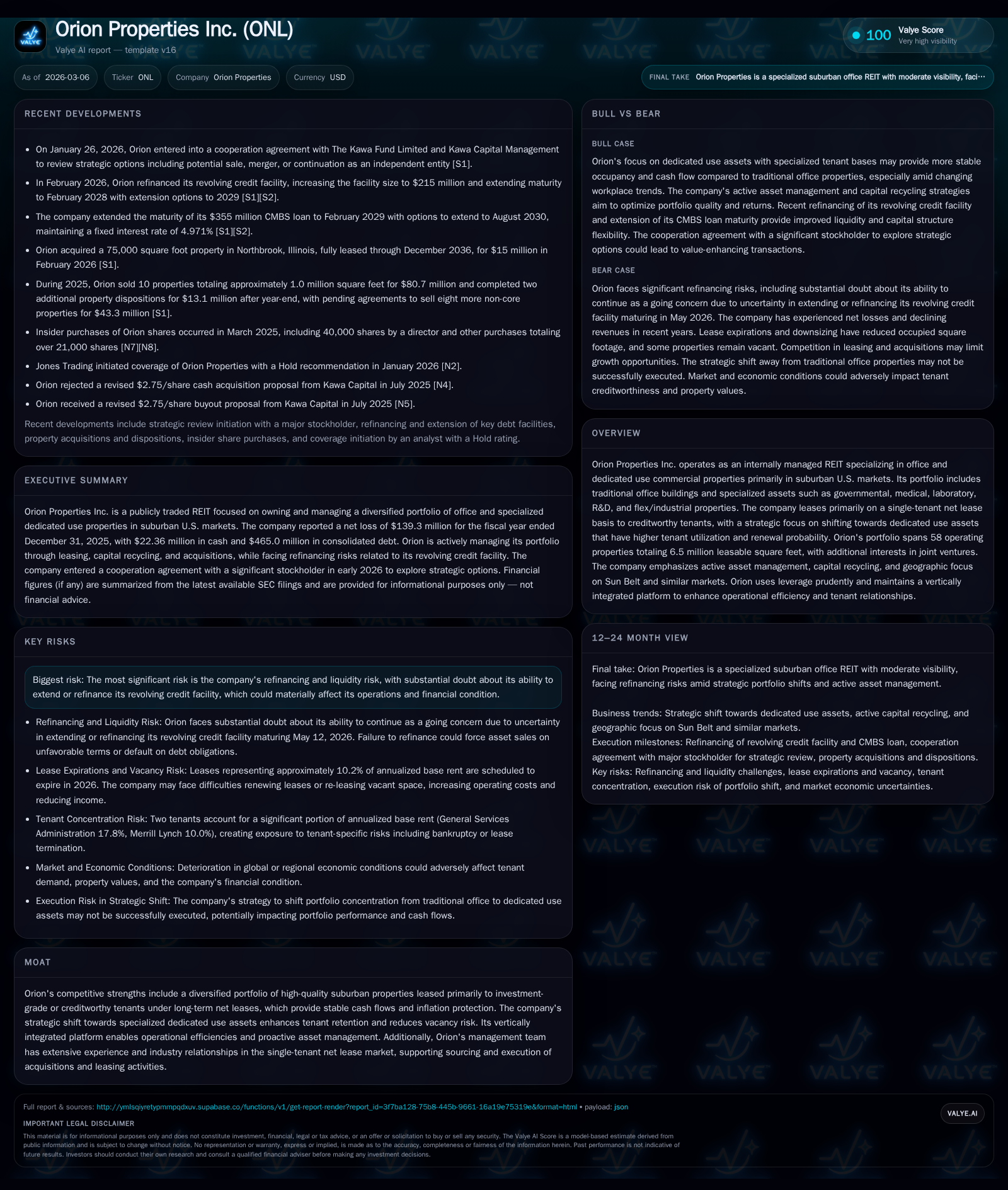
Orion Properties Inc. reported substantial declines in net income and cash flow for FY2025, driven by portfolio reductions and leasing challenges. The company is strategically shifting its holdings away from traditional suburban offices toward dedicated-use assets like government and medical properties, aiming to enhance tenant retention. Nevertheless, Orion faces significant refinancing risks with maturing credit facilities, although recent loan amendments extend maturities into 2028-2030. Capital recycling through property sales funds acquisitions and portfolio enhancements, but the firm remains challenged by occupancy rates below 80%. Monitoring refinancing outcomes and leasing renewals will be critical going forward.
Company Background and Portfolio Composition
Orion Properties Inc. operates as an internally managed REIT focusing on U.S. suburban office and dedicated use commercial real estate assets. Its portfolio encompasses traditional office buildings alongside specialized properties including governmental facilities, medical offices, laboratories, R&D spaces, and flex/industrial units. These are predominantly leased on a single-tenant net lease basis to creditworthy tenants—largely investment-grade or similarly qualified—that provide stable rent streams with inflation-linked escalations [S1, S19].
Initially established as a subsidiary of Realty Income Corporation, Orion emerged as an independent publicly traded company following Realty Income’s merger activities in late 2021 [S1]. It trades under the ticker "ONL" on the NYSE and has elected REIT tax status commencing with its taxable year ending December 31, 2021.
Historical Financial Performance and Drivers
Orion has faced significant earnings pressure over the past three fiscal years, culminating in a net loss of $139 million for FY2025—a deterioration exceeding one-third compared to FY2024’s loss of $103 million [F1]. Operating cash flow similarly declined sharply from $54.3 million in FY2024 to $23.6 million in FY2025 (-56%) [F1], indicative of underlying challenges such as lease expirations and portfolio turnover.
Capex spending increased materially in FY2025 ($15.2 million vs. $5.8 million prior year), reflecting investment in tenant improvements and property upgrades necessary for asset repositioning [F1]. Yet, these outlays coincide with shrinking equity ($623 million end-2025 vs. $764 million prior year) due primarily to accumulated losses rather than equity raises [F1]. The worsening returns are underscored by an approximate negative ROE of -22% for FY2025 calculated against equity [F1].
Historical performance (annual)
| FY | Net ($mm) | CFO ($mm) | Capex ($mm) | Net YoY |
|---|---|---|---|---|
| 2025 | -139 | 24 | 15 | -35.2% |
| 2024 | -103 | 54 | 6 | -79.8% |
| 2023 | -57 | 89 | 6 | +41.2% |
| 2022 | -97 | 114 | 3 |
Source: SEC companyfacts cache [F1].
Capital returns and efficiency (annual)
| FY | Buybacks ($mm) | FCF ($mm) | ROE% |
|---|---|---|---|
| 2025 | 0 | 8 | -22.4 |
| 2024 | 0 | 48 | -13.5 |
| 2023 | 5 | 83 | -6.5 |
| 2022 | 0 | 111 | -10.0 |
Source: SEC companyfacts cache [F1].
Net figures represent losses attributable to common stockholders; dividends are total annualized per share.
Portfolio Evolution: Dispositions and Acquisitions
Throughout FY2025, Orion undertook substantial capital recycling efforts consistent with its stated strategic focus to reduce exposure in traditional office segments while growing dedicated use asset categories [S10,S27]. The operating portfolio shrank from 69 to 58 active properties at year-end, alongside a notable contraction in leasable space from over eight million down to approximately 6.7 million square feet [S24]. Occupancy rates improved slightly but remain subdued at ~79% [S24].
Significant property dispositions included ten buildings sold during the year totaling about one million square feet for roughly $81 million gross proceeds, plus subsequent sales after year-end that brought additional liquidity of around $13 million [S10]. Pending contracts reflect potential further disposals exceeding $43 million aimed at non-core assets.
On the acquisition front, Orion added at least one fully leased Northbrook Illinois property of approximately 75k square feet for $15 million early in calendar year 2026 [S10], reinforcing its dynamic capital allocation approach whereby sales finance reinvestment into higher-conviction asset classes.
Leasing Environment and Tenant Base Dynamics
Lease management remains critical given absorbing vacancies from downsizing or expirations; six leases representing nearly 700k square feet either expired or contracted during CY2025 [S10]. The weighted average lease term remains moderately long at about 5.7 years [S24], providing some rental stream stability.
Tenant concentration shows two major tenants accounting for over a quarter of annualized base rent: the U.S. General Services Administration (GSA) (18%) and Merrill Lynch (10%) [S24]. GSA leases cluster around four years remaining term versus longer durations for Merrill Lynch (~9.9 years). Notably, investment-grade tenant exposure has decreased from over three-quarters towards two-thirds of rent base since prior periods—partly reflecting portfolio rebalancing towards specialized users less rated by agencies but potentially more sticky due to their operational specificity [S21].
Capital Structure and Liquidity
Debt load totaled approximately $465 million at the end of FY2025 comprising a secured CMBS loan ($355 million), revolving credit facilities ($92 million drawn on an original $350 million line), and smaller mortgage notes including a fixed-rate San Ramon property loan [$18M] [S5]. Notably, the revolving facility matured May 12, 2026 but was refinanced in February 2026 with a new senior secured revolving credit facility capped at $215 million expiring February 18, 2028 plus up to two six-month extension options if conditions are met [S11,S4]. This refinance also reduced lender commitments alongside interest margin cuts.
The CMBS loan maturity was extended via amendment from February 2027 out to February 2029 with further conditional extensions through August 2030 available; interest rates remain fixed on this debt tranche during extension periods [S4].
However, refinancing risks remain prominent—prior filings disclosed "substantial doubt" regarding ability to refinance the previous revolving facility before the amendment was achieved—with contingencies including property sales or alternative liquidity sources being evaluated continuously [S6,S9,S16]. Furthermore, Arch Street Joint Venture debt exposures scheduled towards late-2026 maturity add another refinancing variable impacting consolidated financial health [S16,S17].
As of December 31, 2025 Orion held approximately $22 million cash/equivalents providing some buffer but requiring prudent liquidity management going forward [F1].
Dividend Policy and Capital Allocation Priorities
Orion's board upheld a consistent quarterly dividend rate of $0.02 per share throughout CY2025 equating to an annualized payment of approximately $0.08 per share despite net losses and cash flow pressures [S4,S24,F1]. No share repurchases occurred during the year as the prior repurchase program expired at year-end without extension; this reflects conservative capital preserve stance amid refinancing uncertainties.
Capital expenditures escalated chiefly due to investments supporting leasing activity such as tenant improvements commissions plus selective building upgrades aimed at asset quality enhancement - consistent with their strategic pivot towards specialized dedicated-use properties which command longer lease terms due to operational specificity [S23,S27].
Strategic Outlook: Growth Prospects versus Risks
Orion’s growth hinges substantially on executing its strategy to rebalance its portfolio toward dedicated use office-related assets—including government facilities, medical offices, labs, R&D centers—which currently constitute about one-third plus of annual rent income compared to lower representation historically [S27,S21]. Such asset types benefit from higher tenant utilization rates less vulnerable to remote work-induced demand erosion—the prevailing challenge across office REITs post-pandemic.
Continued geographic concentration in Sun Belt markets (e.g., Texas at nearly 19% base rent portion) aligns Orion with macro trends favoring lower cost-of-living suburban hubs attracting corporate relocations away from coastal metropolitan hotspots [S21].
Notwithstanding this repositioning opportunity set, realization depends on multiple factors: competitive acquisition environment potentially raising prices; ability to replenish disposed assets efficiently; successful lease renewals or re-leasing vacant space without excessive concessions; regulatory compliance costs; and broader macroeconomic conditions affecting tenant solvency [S22,S25,S26].
Moreover, liquidity risks related to future refinancings post-2030 remain significant given current tight leverage ratios near covenant limits visible within new credit agreements highlighting debt-to-asset ceilings around .60x and adjusted EBITDA-to-fixed charges minima near .15x coverage thresholds requiring close covenant compliance monitoring moving forward [S13,S14,S28].
Substantial shareholder involvement is underway via a cooperation agreement with Kawa Capital Management initiated January 26, 2026 triggering a strategic options review—covering potential sale processes or merger targets—indicative of governance-level acknowledgment of capital structure challenges and market uncertainties surrounding standalone growth prospects [S19].
Conclusion: Monitoring Refinancing Outcomes Amid Transition Execution
Orion Properties exemplifies the struggles experienced by specialized suburban office-focused REITs reshaping their portfolios in response to evolving workspace demands while managing significant near-term liquidity pressures imposed by concentrated debt maturities. The firm’s disciplined capital recycling program combined with leverage refinancings extending maturity profiles somewhat alleviate immediate refinancing cliff risk but meaningful uncertainties remain given macroeconomic volatility impacting leasing velocity. The unrelenting losses require sustained operational improvements coupled with successful strategic shifts toward dedicated-use assets with higher tenant retention potential. Investors ought to monitor forthcoming quarterly leasing metrics closely including occupancy changes especially among key tenants like GSA alongside updates on pending property dispositions/executions under recently signed agreements. In addition, ongoing development regarding the cooperation agreement-based strategic review will be pivotal for understanding potential future corporate trajectories beyond organic operational maneuvers.
This report is intended solely for informational purposes derived from publicly available sources as current through early March 2026.
Disclaimer: This is research-only, informational analysis and not investment advice. It may include AI-generated interpretation and general industry context. Always verify important details using primary sources.

Comments