
Smith & Wesson Brands Confronts Profitability and Cash Flow Pressure in a Regulatory Complex Firearms Market
Smith & Wesson faces a sharp contraction in earnings and operating cash flow amidst strong liquidity and ongoing regulatory risks.
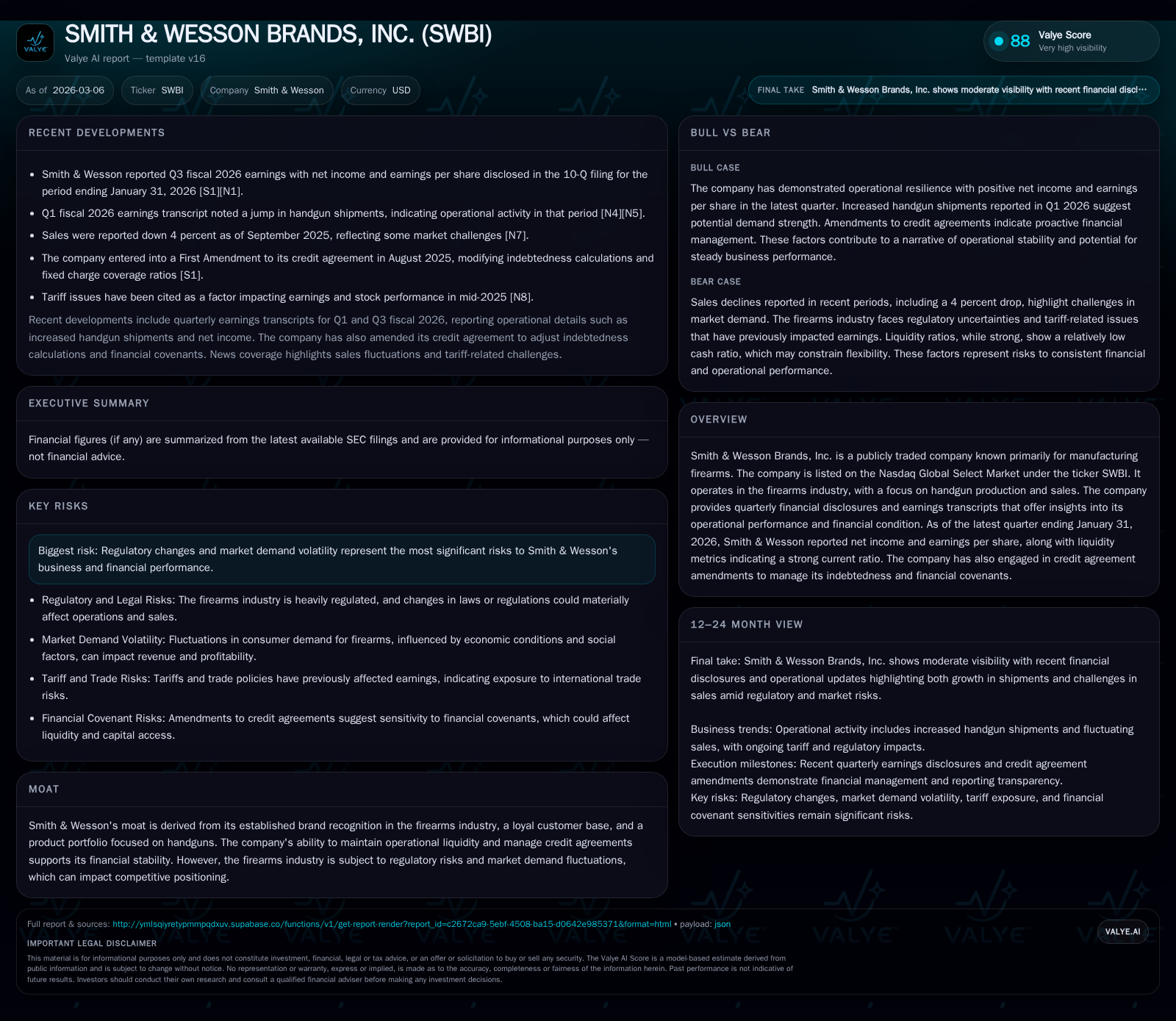
Smith & Wesson Brands, Inc. reported a notable revenue decline of nearly 25% from FY24 to FY25, accompanied by a 47% drop in operating income and a steep net income fall reflecting margin compression and handgun segment volume pressures [F1]. Operating cash flow turned negative in FY25 after years of stability, coinciding with significant capex cuts as management conserves cash amid market uncertainties. The company maintains a robust current ratio of approximately 4.5x as of January 2026, providing a liquidity buffer against regulatory challenges flagged consistently across recent SEC filings [S2-S6]. Capital allocation reflects steady dividend payments and fluctuating buyback activity influenced by credit agreement amendments aiming to preserve financial flexibility [S7-S11]. Key near-term performance indicators remain closely watched in the absence of explicit guidance [N1][N2]. Despite these pressures, Smith & Wesson’s returns on equity stayed low at around 3.6%, reinforcing the capital efficiency headwinds within the current firearm industry cycle [F1].
Revenue Reversals and Earnings Decline: Tracing Recent Results
Smith & Wesson's financial trajectory has encountered significant headwinds from fiscal year 2024 through fiscal year 2025. Total revenue plunged nearly 25%, descending from approximately $229 million in FY2024 to $172 million in FY2025, highlighting a pronounced downturn in handgun segment dynamics that historically underpin the company’s top line [F1]. This abrupt deceleration is symptomatic of broader handgun sales volume pressure compounded by competitive and market demand fluctuations influencing pricing power.
Operating income mirrored this trend sharply, eroding by almost half—from about $44.8 million in FY2024 down to $23.9 million in FY2025—indicating an acute compression on operating margins potentially driven by fixed cost absorption under declining sales volumes and possibly rising input costs or unfavorable product mix shifts [F1]. Net income fell even more steeply by roughly two-thirds to $13.4 million during this interval, underscoring the combined impact of lower operational profitability alongside increased financial or non-operational expenses.
This severe downturn represents a vital inflection point for Smith & Wesson's core handgun business that has traditionally benefited from loyal consumer demand but now confronts headwinds from changing regulatory sentiment and market saturation pressures.
Operational Cash Flow Contraction and Capital Spending Patterns
Accompanying the compressed earnings was a stark deterioration in operating cash flow (CFO), which reversed from positive territory ($106.7 million in FY2024) to negative CFO of approximately -$7.2 million in FY2025 [F1]. This shift is emblematic of tightening working capital management challenges as receivables or inventories may have extended amidst slowing end-market throughput.
In parallel, capital expenditures plunged by over 75% year-on-year—from nearly $90.8 million to only $21.6 million—signaling deliberate scaling back of investment activities likely intended to conserve liquidity during an uncertain operating phase that demands heightened financial discipline [F1]. This pattern reflects a strategic pause on expansionary or modernization projects common among manufacturing firms confronting cyclical demand softness.
Strong Liquidity Amidst Regulatory Headwinds
Despite top-line deterioration and cash flow volatility, Smith & Wesson maintains robust operational liquidity as evidenced by its current ratio hovering around 4.5x entering calendar year 2026 [F1], supported by reported current assets near $262 million relative to current liabilities just over $58 million as of January 31, 2026.
This liquidity cushion supports resilience against ongoing regulatory risks flagged consistently across quarterly SEC filings without material changes but reinforced potential volatility implications from evolving firearms regulations, litigation exposure, and compliance burdens common within this tightly legislated sector [S2],. The company appears positioned strategically with sufficient short-term financial headroom to absorb unforeseen shocks or invest selectively if conditions improve.
Capital Allocation Priorities: Dividends, Buybacks, and Debt Amendments
Smith & Wesson’s capital deployment strategy blends shareholder returns with credit facility management rigor. Dividend distributions rose annually reaching nearly $23.1 million paid out during FY2025 compared to $22 million the prior year—reflecting management commitment to steady income return despite profitability pressures [F1].
Share repurchase activity has been more volatile; after a pause yielding zero repurchases in FY2023, buybacks resumed moderately amounting to approximately $10.2 million in FY2024 then nearly doubling to about $25.5 million during FY2025—possibly signaling opportunistic share price targeting when conducive [F1],.
On the debt side, recent credit agreement amendments modify fixed charge coverage computations for measurement periods ending mid-2026 including temporary exclusions related to tax payments due to amended return filings—actions that reflect proactive covenant management aligned with safeguarding leverage capacity amidst earnings pressures [S7],[S8],[S16],[S17].
Decoding the Regulatory Risk Landscape From Disclosures
Regulatory risk disclosure remains a consistent theme without substantial change but continues to pose significant uncertainty for Smith & Wesson’s operations [S2],. The firm cites ongoing "regulatory flux" characterized by potential legislative restrictions impacting firearm sales channels and product categories alongside an unpredictable "litigation environment" that could entail costly compliance or legal defense expenditures.
Notably, "market demand volatility" intertwined with political cycles remains pervasive, necessitating careful navigation through shifting federal and state-level policies that influence consumer purchasing behavior for handguns—the company’s flagship offering.
Near-Term Performance Indicators to Watch
With no updated forward guidance provided explicitly in recent communications [N1],[N2], investors should monitor critical metrics such as quarterly unit shipments which convey underlying demand trends within the handgun segment susceptible to macro factors like gun control advocacy strength or hunting/recreational shooting popularity.
Inventory turns will be crucial for assessing supply chain efficiency amidst fluctuating order momentum while observed pricing adjustments may reveal tactical responses either via discounting or premium positioning designed to defend margins amid competitive headwinds.
These operational markers represent pragmatic barometers for near-term business health beyond headline revenue figures.
Investment Returns: ROE and Free Cash Flow Dynamics
From a returns perspective, Smith & Wesson’s ROE approximates a lowly 3.6% based on last reported annual net income over average equity levels at fiscal year-end 2025—a subdued figure given historical firearms sector cyclicality that typically benefits from brand premiums but currently constrained by the evident profit squeeze [F1].
Moreover, free cash flow remained negative at approximately -$28.8 million for FY2025 after subtracting capital expenditures from operating cash flows further emphasizing capital reinvestment challenges alongside operational liquidity considerations.
This combination underscores the pressing need for strategic recalibration around cost structures and growth avenues amid an industry climate shaped decisively by regulatory frameworks alongside shifting consumer sentiment.
Historical Financial Summary: FY2018 to FY2025 (USD millions)
Historical performance (annual)
| FY | Net ($mm) | CFO ($mm) | OpInc ($mm) | Capex ($mm) | Net YoY |
|---|---|---|---|---|---|
| 2025 | 13 | -7 | 24 | 22 | -66.1% |
| 2024 | 40 | 107 | 45 | 91 | +7.4% |
| 2023 | 37 | 17 | 48 | 90 | -81.0% |
| 2022 | 194 | 138 | 252 | 24 |
Source: SEC companyfacts cache [F1].
Capital returns and efficiency (annual)
| FY | Div ($mm) | Buybacks ($mm) | FCF ($mm) |
|---|---|---|---|
| 2025 | 23 | 25 | -29 |
| 2024 | 22 | 10 | 16 |
| 2023 | 18 | 0 | -73 |
| 2022 | 15 | 90 | 114 |
Source: SEC companyfacts cache [F1].
Table shows available key financials evidencing revenue decline starting with peak fiscal years before sharp correction into FY25 impacting profitability, cash flow generation and capital deployment.
Smith & Wesson Brands operates within a highly regulated firearms industry where persistent legal scrutiny and policy evolution continue shaping market access conditions tightly linked to political climates across U.S jurisdictions. Its established brand recognition provides moat advantages; however, current operational results emphasize severe pressure exerted by both top-line contraction driven largely by handgun segment demand softness coupled with significant margin tightening reflective of cost absorption under diminished scale. The company adopts cautious capital expenditure stance conserving resources while maintaining ample liquidity buffers underpinned by disciplined credit covenant renegotiations that afford some runway for maneuvering amid regulatory uncertainties. Consequently, steady dividends paired with opportunistic buybacks illustrate an attempt at balancing shareholder return ambitions against prudent financial stewardship given volatile outdoor leisure consumer behaviors affecting firearms sales cycles. Monitoring operational KPI shifts around unit volumes and inventory turnover will be critical for gauging recovery trajectories absent formal forward-looking statements. Overall, Smith & Wesson’s near-term outlook pivots on navigating these compounded pressures through adaptive execution while preserving core liquidity strength essential for resilience through ongoing regulatory complexity inherent in its specialized market segment.
Disclaimer: This analysis is based strictly on publicly available data as of March 6, 2026 without prediction or investment advice.
Disclaimer: This is research-only, informational analysis and not investment advice. It may include AI-generated interpretation and general industry context. Always verify important details using primary sources.

Comments