
Caribou Biosciences Reinvents Allogeneic CAR-T Therapies with chRDNA Platform
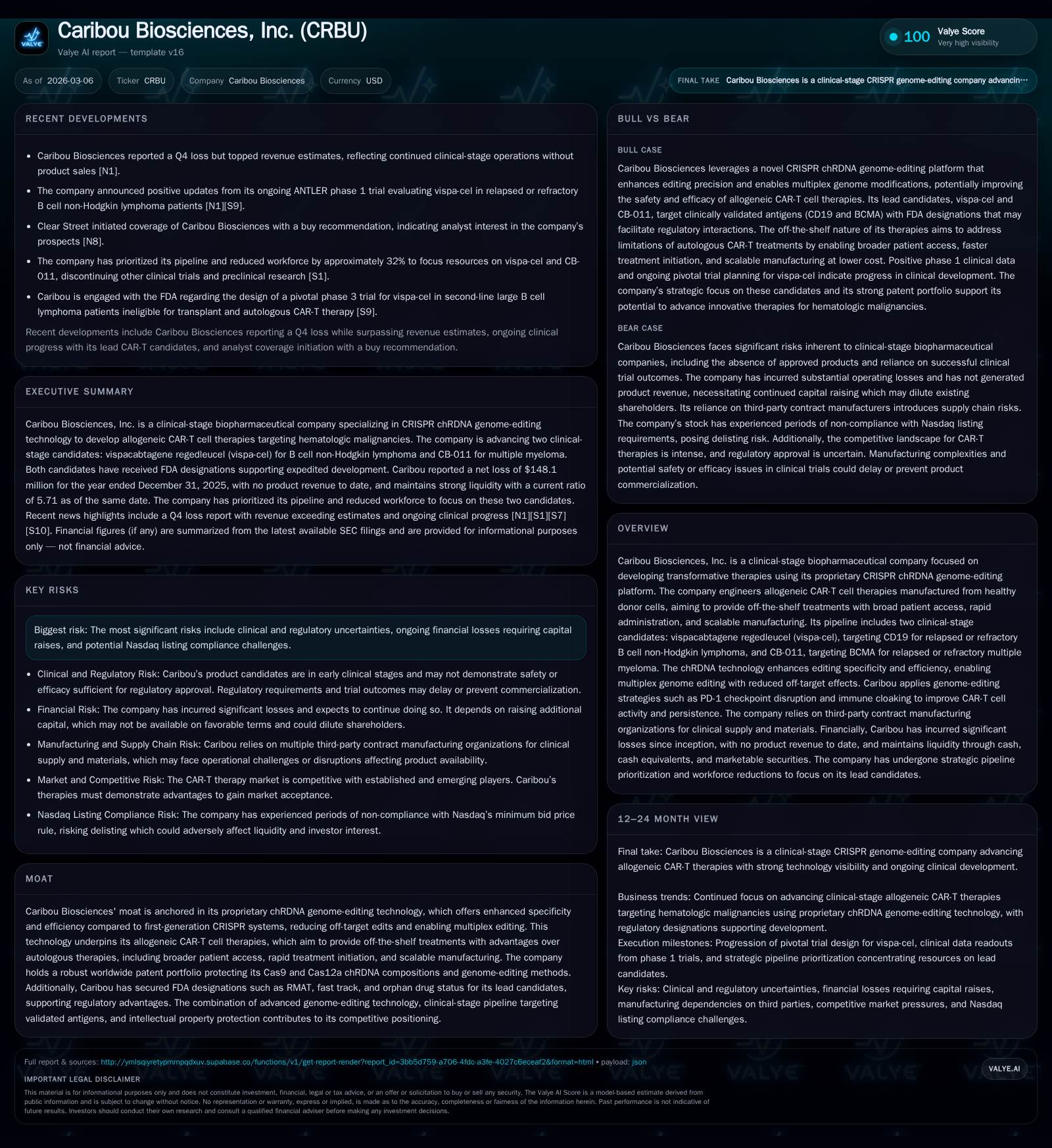
Caribou leverages its proprietary chRDNA genome-editing technology to pioneer scalable, off-the-shelf allogeneic CAR-T treatments while managing structural clinical-stage financial losses.
Caribou Biosciences is a clinical-stage biopharmaceutical company focused on advancing allogeneic CAR-T cell therapies using its novel chRDNA genome-editing platform. The company’s pipeline centers on two clinical candidates targeting hematologic malignancies, with regulatory designations supporting expedited development. Despite meaningful operating loss reductions in 2025 driven by cost prioritization, Caribou remains unprofitable and faces ongoing capital needs. Its technological moat lies in enhanced specificity and multiplex editing capabilities that aim to differentiate it from first-generation CRISPR approaches. Market and regulatory risks, including Nasdaq listing compliance challenges and litigation, remain material factors to monitor alongside pivotal clinical trial progressions.
Evolution of Growth: Clinical Progress and Operating Loss Trends
Caribou Biosciences exemplifies the financial profile of a clinical-stage biotechnology firm navigating the long runway toward commercialization. The company reported $148.3 million in operating losses for FY2025, a reduction of about 11% compared to $166.6 million in FY2024, signaling incremental progress in resource discipline as it advances its clinical programs [F1]. Net losses remained substantially unchanged year-over-year at approximately $148.1 million, reflecting the persistent investment nature of clinical development activities with no revenue inflows from product sales recorded to date.
Operating cash flow improved by nearly 20% year-over-year but remained deeply negative at -$111.0 million in 2025, similar to a pattern typical of research-driven firms where expenses predominantly consist of R&D costs and trial-related expenditures rather than operating income generation [F1]. Capital expenditures also contracted sharply by over 70% year-over-year to under $1.4 million, indicative of the company's focus on reducing fixed asset investments and possibly deferring capacity expansions pending regulatory milestones or capital availability.
Despite this loss reduction trend, Caribou maintains a substantial accumulated deficit exceeding $590 million as of December 31, 2025, underscoring that profitability remains distant and contingent on successful product approvals and commercialization efforts [[S1]].
Historical performance (annual)
| FY | Net ($mm) | CFO ($mm) | OpInc ($mm) | Capex ($mm) | Net YoY |
|---|---|---|---|---|---|
| 2025 | -148 | -111 | -148 | 1 | +0.7% |
| 2024 | -149 | -138 | -167 | 5 | -46.1% |
| 2023 | -102 | -93 | -116 | 12 | -2.7% |
| 2022 | -99 | -91 | -106 | 6 |
Source: SEC companyfacts cache [F1].
Capital returns and efficiency (annual)
| FY | FCF ($mm) | ROE% |
|---|---|---|
| 2025 | -112 | -121.2 |
| 2024 | -143 | -58.9 |
| 2023 | -105 | -27.7 |
| 2022 | -97 | -33.0 |
Source: SEC companyfacts cache [F1].
Table: Caribou Biosciences Historical Financial Overview FY2022-FY2025 emphasizing loss reduction trajectory yet persistent cash burn.
Breakthrough Technology: ChRDNA's Role in Differentiating CAR-T Therapies
At the core of Caribou’s value proposition lies its proprietary chRDNA genome-editing platform (pronounced 'chardonnay'), which represents a second-generation approach to CRISPR technology distinguished by enhanced specificity and multiplex editing capabilities []. This hybrid RNA-DNA guide system enhances precision targeting of gene sequences while substantially reducing off-target edits — a major hurdle limiting the broader adoption of first-generation CRISPR methods.
This elevated control enables simultaneous multiplex genome edits such as PD-1 checkpoint disruption—interrupting immune inhibitory signaling pathways—and immune cloaking mechanisms designed to reduce host rejection of allogeneic cell therapies post-infusion []. These modifications address key limitations of current autologous CAR-T therapies by potentially enhancing persistence, anti-tumor activity, and safety profiles.
Practically, the technology empowers Caribou’s allogeneic CAR-T product candidates to be developed as "off-the-shelf" therapeutics manufactured from healthy donor cells rather than individualized patient-derived T cells—a fundamental shift promising rapid treatment availability coupled with scalable manufacturing efficiencies uncommon in conventional autologous approaches.
Pipeline Spotlight: Clinical-Stage Candidates Vispa-cel and CB-011
Caribou’s clinical focus is concentrated on two lead allogeneic CAR-T candidates leveraging chRDNA-edited T cells aimed at hematologic malignancies []. Vispacabtagene regedleucel (vispa-cel), formerly CB-010, targets CD19-positive relapsed/refractory B cell non-Hodgkin lymphoma (r/r B-NHL). It has progressed through Phase 1 ANTLER trials demonstrating safety signals sufficient for ongoing development plans.
The second candidate, CB-011, focuses on BCMA antigen against relapsed/refractory multiple myeloma (r/r MM) within Phase 1 CaMMouflage trials []. Both candidates are distinguished by their off-the-shelf availability offering faster time-to-treatment compared to autologous regimens requiring lengthy patient-specific manufacturing.
Regulatory designations bolster their developmental positioning; vispa-cel holds regenerative medicine advanced therapy (RMAT) designation for relapsed/refractory large B cell lymphoma, fast track status for r/r B-NHL indications, and orphan drug designation for follicular lymphoma—all granted by the U.S. FDA []. Similarly, CB-011 benefits from fast track and orphan drug status within its MM indication segment.
If approved, these therapies might offer improvements over existing autologous CAR-T products by providing lower manufacturing costs due to standardized donor-cell sourcing and significantly reducing logistical complexities related to patient-specific cell harvests [, [N1]].
Financial Architecture: Capital Allocation, Operating Cash Flows, and ROE Dynamics
Caribou’s financial framework reflects typical pre-commercial biotech capital deployment primarily allocated towards research and pipeline advancement rather than infrastructure or shareholder returns [F1], [S11]. R&D expenses constitute nearly total operating expenditure volumes given absent revenues.
Capex reductions observed between FY2023 and FY2025—from $11.6 million down to roughly $1.4 million—signal deliberate curtailment of fixed asset investments likely aimed at extending runway amidst expected upcoming catalysts [[F1]]. Operating cash flow remains negative at about $111 million in FY2025 despite improvement versus prior years due to higher cash conservation efforts.
Equity balances shrunk from $368 million at end-FY2023 to roughly $122 million by end-FY2025 evidencing capital dilution or prior financing proceeds being consumed to fund operations [F1]. No dividend payments or share repurchase programs have been initiated or disclosed reflecting standard practice given absence of positive free cash flow generation [[S11], [S15]].
Return on equity is correspondingly negative at an approximate -121%, consistent with a net loss model paired with declining equity base typical across early-stage biopharma companies transitioning from discovery through clinical phases [F1]. While unfavorable from a returns standpoint today, this metric is expected pending eventual product commercialization milestones if successful.
Navigating Regulatory and Litigation Risks
Caribou confronts multifaceted regulatory challenges characteristic of pioneering gene-editing therapeutics compounded by listing compliance pressures on Nasdaq owing to historical share price volatility below minimum thresholds [[S2], [S18]]. Despite regaining compliance briefly in mid-2025 under Nasdaq’s Minimum Bid Price Rule after dipping below $1 per share earlier that year, future delisting risks remain palpable without sustainable stock price recovery [[S2]]. The Board retains authority under an approved range for reverse stock splits as a potential compliance mechanism [[S18]].
Compounding market risks are recent shareholder derivative suits alleging fiduciary breaches connected primarily with previous company disclosures on product safety and efficacy claims raised between July 2023-July 2024; these suits were consolidated then voluntarily dismissed without prejudice but remain indicative of governance scrutiny typical among emerging biotech innovators [[S4], [S5], [S23]].
Additional patent infringement or intellectual property litigations are plausible given the highly competitive gene-editing landscape; such proceedings would impose operational distractions and financial burdens exacerbating existing resource constraints [[S4], [S5]].
On regulatory fronts beyond FDA interactions related to RMAT or fast-track processes, Caribou must contend with stringent marketing oversight concerning biologics promotion practices abiding by multiple healthcare fraud laws like False Claims Act exposure risks [[S9], [S16]]. International expansion potential introduces further complexity with export controls and foreign regulatory regimes necessitating robust compliance frameworks [[S8], [S16]].
Long-Term Outlook: What the Market Should Watch Next
Absent explicit forward guidance from management beyond general pipeline prioritization statements made during restructuring announcements in April 2025 [], key milestones awaiting investor focus include initiation and progress tracking of vispa-cel's planned pivotal Phase clinical trials potentially commencing imminently given its clinical timing stage evidenced through public domain reporting [[N1], ].
Successful demonstration of manufacturing scalability for chRDNA-based off-the-shelf therapies represents another critical dimension underpinning commercial viability; the ability to produce consistent batches at scale would impact cost structures favorably relative to competing autologous platforms incentivizing market uptake.
In parallel, incremental data releases around safety—specifically immune cloaking effectiveness minimizing graft-versus-host disease—and efficacy endpoints will be paramount in validating the claimed therapeutic enhancements conferred by multiplex editing strategies central to Caribou’s MOA concept.
Given these dependencies on scientific validation and regulatory approval sequencing across multiple jurisdictions pending individual trial success trajectories remains essential for contextualizing future growth potential realistically.
Valuation Context and Investment Considerations
From an analytical perspective balancing innovation against inherent biotech risk underscores the dual narrative characterizing Caribou Biosciences’ current standing. The firm commands intrinsic value through proprietary technological differentiation encapsulated by its advanced chRDNA platform addressing tangible limitations in current allogeneic CAR-T paradigms via precision editing modalities rarely matched elsewhere.
However, continuous heavy cash burn underpinning operating losses near $150 million annually coupled with uncertain trial outcomes implies execution risk is ever-present alongside market sentiment susceptibility related to Nasdaq listing security concerns.[F1],[S2] Thus valuation considerations extend well beyond technical merits only but envelop capital runway visibility, competitive IP landscapes, forthcoming pivotal clinical catalyst sequencing timelines as well as external macroeconomic conditions influencing biotech financing markets generally.
Prudent diligence would therefore monitor early signs from pivotal studies mentioned above while weighing sustained capital access alternatives along with ongoing patent defense results which could materially alter Caribou's future operating trajectory markedly.
This analysis is based solely on information publicly disclosed through company filings and news reports up to March 2026 without any offer or solicitation regarding securities.
Disclaimer: This is research-only, informational analysis and not investment advice. It may include AI-generated interpretation and general industry context. Always verify important details using primary sources.

Comments