
Nutex Health Builds Growth Momentum Through Physician-Driven Micro-Hospital Expansion
Nutex Health’s physician-led micro-hospital model propels robust revenue growth while managing legal and capital allocation complexities.
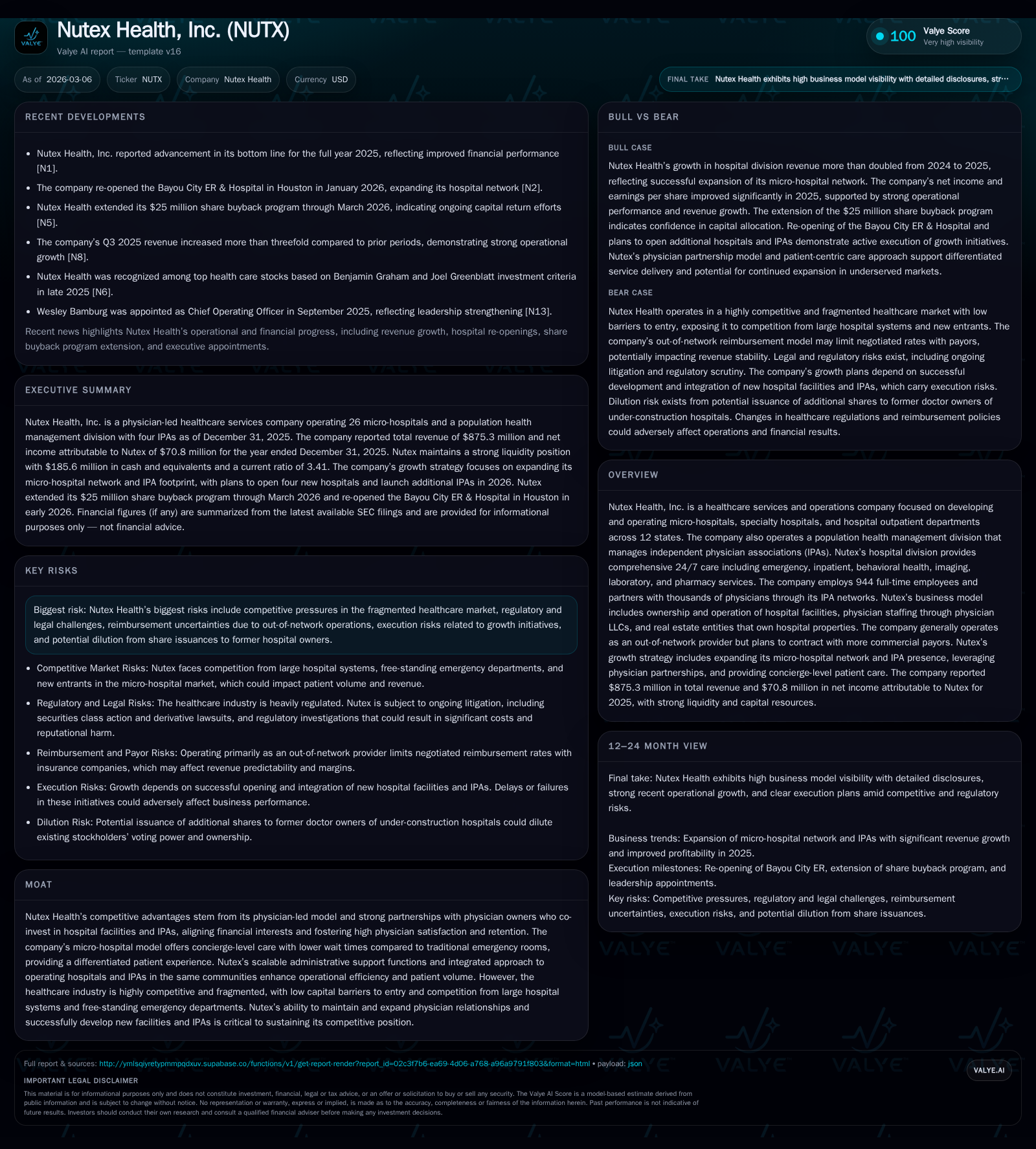
Nutex Health, Inc. has demonstrated a rapid acceleration in financial performance, driven largely by its hospital division’s expansion across 12 states and integrated population health management operations. The company’s physician-led approach and micro-hospital format differentiate it within a fragmented healthcare market marked by regulatory scrutiny and ongoing litigation. While Nutex navigates risks tied to out-of-network reimbursement strategies and share dilution, it continues to invest prudently with strong cash flows fueling share repurchases and facility development. Key future milestones include securing commercial payor contracts and advancing a pipeline of nine new hospital openings.
Financial Surge Fueled by Hospital and Population Health Divisions
Nutex Health has achieved a remarkable turnaround in its financial profile from FY2022 through FY2025. Revenue exploded from roughly $53.7 million in FY2022 to $875.3 million by FY2025, representing an accelerated compound growth trajectory culminating in an impressive 82.4% year-over-year increase in the latest year [F1]. This top-line surge is principally attributable to the hospital division's rapid expansion of outpatient and inpatient services delivered via its micro-hospital network. The offering includes comprehensive urgent care emergency services complemented by behavioral health and ancillary diagnostic facilities—positioning Nutex as a full-spectrum care provider amid growing patient demand.
Operating income mirrored this upward momentum vividly: after incurring operating losses in both FY2022 (-$5.8 million) and FY2023 (-$26.1 million), Nutex swung to profitable territory with operating income of $130.7 million in FY2024 before nearly doubling it to $275.6 million in FY2025 (+110.9% YoY) [F1]. Net income followed a similar pattern with a positive swing culminating at $70.8 million in FY2025 versus prior years' deficits.
Operating cash flow growth was even more striking; after posting modest inflows just over a million dollars in FY2023, CFO increased dramatically to $231.5 million in FY2024 and further to $248.1 million in FY2025—an evolution signaling both strong underlying operational leverage and improved working capital management [F1]. Capital expenditures remained subdued at approximately $2.5 million for FY2025 (+9.6% YoY), yielding free cash flow near $245.6 million that demonstrates a highly efficient cash conversion cycle relative to revenue scale.
Historical performance (annual)
| FY | Rev ($mm) | Net ($mm) | CFO ($mm) | OpInc ($mm) | Rev YoY | Net YoY |
|---|---|---|---|---|---|---|
| 2025 | 875 | 71 | 248 | 276 | +82.4% | +35.9% |
| 2024 | 480 | 52 | 23 | 131 | +588.9% | +264.8% |
| 2023 | 70 | -32 | 1 | -26 | +29.7% | -114.3% |
| 2022 | 54 | -15 | 51 | -6 |
Source: SEC companyfacts cache [F1].
Capital returns and efficiency (annual)
| FY | FCF ($mm) | ROE% |
|---|---|---|
| 2025 | 246 | 21.5 |
| 2024 | 21 | 39.3 |
| 2023 | -51.5 | |
| 2022 | 36 | -15.4 |
Source: SEC companyfacts cache [F1].
Nutex Health’s recent years show steady scaling from initial operating losses toward significant profitability fuelled by hospital-driven multi-service revenues.
Physician-Led Micro-Hospitals: A Differentiated Service Model
At the core of Nutex's competitive strategy lies its physician-led model, which fosters alignment between the company's financial interests and those of its medical staff through co-investment structures within hospital entities and independent physician associations (IPAs). This partnership model encourages high physician retention and satisfaction—critical factors given the well-documented challenges of physician burnout and turnover in healthcare operations.
The company operates a portfolio of micro-hospitals typically spanning from about 15,000 up to 25,000 square feet per facility including multiple emergency treatment rooms alongside inpatient beds ranging from two to ten per site [S1]. These facilities strategically blend concierge-level care traditionally seen at larger hospitals with the agility of smaller outpatient settings.
Such micro-hospitals emphasize lower wait times compared to traditional ERs—a tangible patient-experience advantage—and benefit from integration with population health management via IPAs that enable coordinated care delivery tailored around primary care physicians’ local networks.
Importantly, Nutex provides end-to-end turnkey hospital development services encompassing site selection, real estate design, training protocols, staffing deployment (notably through physician LLCs), billing operations, and regulatory compliance support—services vital for maintaining scalable standards across geographically dispersed locations [S1]. This holistic approach leverages economies of scale while mitigating operational friction common in greenfield healthcare ventures.
Progress Toward Commercial Payor Contracting: Implications for Revenue Mix
Historically, Nutex's hospitals have functioned predominantly as out-of-network providers—invoking patient out-of-network benefits instead of negotiated insurance reimbursement rates—which inherently introduces volatility into revenue predictability due to claim denials or patient collection challenges [S1]. This positioning has contributed both margin upside opportunities but also downside risks tied to potential reimbursement contestations.
The company acknowledges these risks publicly and articulates a strategic pivot toward increasing direct commercial payor contracting relationships as essential for long-term stabilization of reimbursement streams [S1][N1]. Execution here could also align Nutex more closely with value-based care trends emerging within healthcare payors aiming for quality-adjusted payments rather than fee-for-service structures.
Negotiating such contracts presents complexity owing to Nutex’s uniquely differentiated service model and historical out-of-network pricing premiums; thus payor discussions are likely to be protracted with potentially mixed margin impacts depending on negotiated rate floors versus current collection profiles.
Navigating Material Risks: Litigation and Regulatory Landscape
While operational achievements are noteworthy, Nutex faces meaningful legal challenges that add layers of uncertainty—particularly securities class action litigation stemming from allegations concerning disclosures about vendor conduct linked to the No Surprises Act independent dispute resolution process as well as issues regarding stock-based compensation accounting treatments [S1][S7][S13]. The company plans a motion to dismiss pleading scheduled for early April 2026.
In tandem are derivative lawsuits asserting alleged breaches of fiduciary duty by senior executives and board members claiming mismanagement or unjust enrichment, consolidated into a single proceeding currently stayed pending the securities case outcome [S1][S6][S13].
Additionally, Nutex is embroiled in disputes with former doctor owners contesting share issuance calculations tied to merger-related agreements adjusted post-reverse stock splits—a matter pending trial later this year that may affect shareholder dilution levels [S24].
These legal entanglements represent distractions that could impact reputation or financial resources deployed toward defense; however, management counsel currently opines that aside from the listed items no other lawsuits present material risk imminently affecting consolidated statements [S24].
Capital Allocation Strategy: Share Repurchases and Free Cash Flow Generation
Nutex’s impressive operating cash flow generation supports an active capital allocation framework balancing reinvestments into new hospital builds with shareholder returns via share repurchases.
In FY2025 alone, Nutex generated approximately $248 million in operating cash flow while maintaining modest capital expenditure near $2.5 million—resulting in substantial free cash flow estimated at ~$245.6 million—alluding to high operating efficiency post scalability milestones [F1].
Correspondingly, during the year ending December 31, 2025, the company repurchased nearly $5 million worth of shares under an authorized $25 million repurchase program covering six months commencing August 14, followed shortly after by completion of the remaining ~$20 million allotment early in January 2026 [S4][S5][F1]. Shortly thereafter on March 4, management announced authorization of a second repurchase plan constrained similarly at $25 million demonstrating continued confidence in capital redeployment opportunities balanced against growth investments [S15].
This disciplined buyback activity occurs alongside an expanding equity base—now standing at roughly $329 million—and reflects proactive steps toward optimizing capital structure amidst continuing expansion capital needs linked primarily to facility developments captured through low capex spend but likely supplemented by leasing arrangements under real estate entities affiliated with operations [F1][S21][S14].
Balance Sheet Strength: Liquidity and Debt Profile
Liquidity remains robust as reflected by current assets totaling approximately $539 million against current liabilities near $158 million at year-end 2025—a current ratio exceeding three times—which supports short-term solvency comfortably [F1].
Total long-term debt stood at about $29 million as reported for fiscal year-end with various term loans secured against assets bearing interest rates mostly between mid-3% up into double digits for convertible notes; all debt covenants were reportedly met without breach during the period [S9][S14][S21].
The company also maintains access to lines of credit providing additional liquidity buffers while managing repayments actively throughout the year including reductions on lines totaling nearly $8 million during fiscal periods analyzed [S14].
What to Watch: Expansion Pipeline and Contracting Milestones
Investors would do well to track several catalysts shaping Nutex’s near-term trajectory:
- Progress execution on nine de novo microsite hospitals currently under various development stages will be crucial indicators of sustained rollout capabilities coupled with potential incremental revenue sources [S1][N1].
- Milestones toward formalizing contracts with major commercial insurers will elucidate if revenue diversification away from unpredictable out-of-network billing can be achieved without eroding margins materially [N1]
- Resolution timing around ongoing securities litigation will influence investor sentiment surrounding governance practices while impacting resource allocation decisions by management teams [S7]
- Management commentary extracted from quarterly earnings calls or annual reports concerning margin evolution, cost discipline initiatives, or expanded IPA partnerships promises insight into operating leverage dynamics going forward [N1][S3]
Given limited explicit quantitative guidance disclosed currently across filings or releases these considerations remain analytical watchpoints shaping prospective outlooks rather than firm forecasts.
This report synthesizes publicly available SEC filings as well as verified news sources without extrapolation beyond stated facts; it does not constitute investment advice but offers an analytic narrative framework intended for professional consideration only.
Disclaimer: This is research-only, informational analysis and not investment advice. It may include AI-generated interpretation and general industry context. Always verify important details using primary sources.

Comments