
Aditxt Faces Severe Liquidity Crisis as ADI-100 Enters Clinical Trials
The latest quarterly filings reveal critical financial distress for Aditxt amid pivotal clinical progress and Nasdaq compliance challenges.
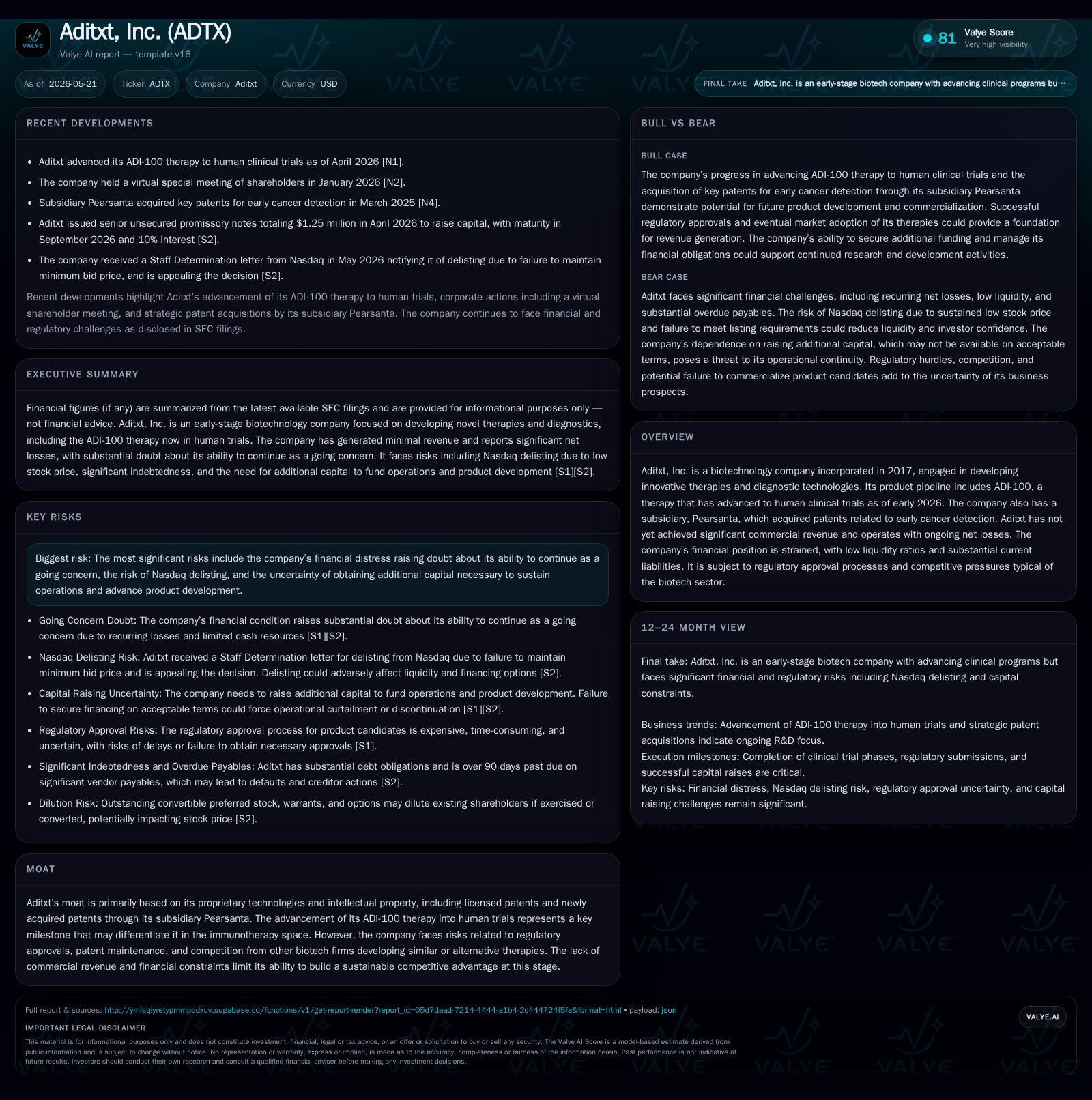
Aditxt, Inc. reported acute liquidity constraints with cash reserves under $270,000 and a current ratio of 0.06 as of Q1 2026, compounded by over $5.8 million in accounts payable past due by more than 90 days. The company faces significant default risk and potential asset foreclosure under secured creditor agreements. Despite these financial pressures, Aditxt’s lead immunotherapy candidate, ADI-100, advanced into human clinical trials in early 2026, marking a key milestone. The firm’s biotechnology business model remains heavily reliant on continued capital raises, regulatory approvals, and patent license maintenance amid intense competition and Nasdaq delisting threats.
Latest Quarterly Filing Highlights Acute Financial Distress
Aditxt’s May 20, 2026 Form 10-Q filing discloses a critical liquidity shortfall with cash and cash equivalents of approximately $268,852 as of March 31, 2026 [S2]. This is juxtaposed against total current liabilities exceeding $13.3 million, resulting in an extremely low current ratio of 0.06 per companyfacts data [F1]. Accounts payable stand at roughly $6.6 million with about $5.8 million overdue by more than 90 days [S2][S5], indicating severe vendor payment defaults that threaten operational continuity.
The company also maintains secured creditor obligations with outstanding principal around $600,000 subject to weekly payments of $99,000; failure to meet these obligations could trigger foreclosure on assets [S4]. These conditions collectively raise substantial doubt about Aditxt’s ability to continue as a going concern absent immediate capital infusion or restructuring.
Nasdaq Delisting Risk Amid Reverse Stock Split Efforts
Nasdaq notified Aditxt on May 6, 2026, of its determination to delist the company’s securities due to failure to sustain the minimum bid price of $1.00 per share over a consecutive 30-business-day period ending May 5, 2026 [S4][S17]. The company is ineligible for the standard compliance extension given prior cumulative reverse stock splits exceeding a ratio of 250-to-1.
In response, Aditxt effected a one-for-twenty-seven reverse stock split approved on May 14, effective May 15, with trading on a split-adjusted basis beginning May 18 [S3][S13][S16]. The firm has filed an appeal with the Nasdaq Hearings Panel seeking continued listing; however, the outcome remains uncertain and represents a material risk factor [S4][S11].
Business Model Focused on Immunotherapy R&D with Nascent Commercialization
Aditxt is an early-stage biotechnology company centered on developing immunotherapies for unmet medical needs. Its lead product candidate ADI-100 commenced human clinical trials in early 2026—a pivotal validation step toward eventual commercialization—but significant development and regulatory hurdles remain [S1]
Commercial revenues are minimal; reported full-year revenue was approximately $3,195 for fiscal year ended December 31, 2025 [F1]. Operating losses persistently burden the company with net losses of approximately $43 million in FY25 driven primarily by research expenses [F1][S2]. The lack of meaningful sales underscores dependence on external funding sources to sustain operations.
Complementing its immunotherapy focus is Pearsanta, a subsidiary holding patents related to early cancer detection diagnostics. These patents may support future revenue diversification through licensing or product commercialization if successfully developed [S1]
Industry Dynamics: Competitive Pressures and Intellectual Property Dependencies
The immunotherapy sector demands high R&D investment with lengthy clinical trial timelines before achieving regulatory approval—factors that amplify capital intensity for companies like Aditxt still in early-phase development.
Intellectual property rights are crucial; Aditxt relies heavily on licensed technologies from Loma Linda University (LLU) and Stanford University underpinning ADI-100’s platform. Failure to meet milestone payments or other license conditions could result in revocation of access to these patents, jeopardizing development continuity [S1].
Competitive pressures stem from numerous biotech firms pursuing immune-modulatory therapies or oncology diagnostics leveraging novel biomarkers. Market success depends on demonstrating differentiated clinical efficacy and securing robust intellectual property protection.
Growth Drivers: Clinical Trial Progress and Patent Portfolio Expansion
The advancement of ADI-100 into human trials marks a significant developmental milestone that could unlock subsequent phases contingent upon positive safety and efficacy data [S1]. Successful trial outcomes may catalyze strategic partnerships or milestone payments necessary to alleviate capital constraints.
Pearsanta’s expanding patent portfolio in cancer early detection presents additional growth avenues through potential licensing deals or product launches targeting non-invasive diagnostics—a field attracting growing industry interest.
These drivers hinge on measurable trial milestones and sustained intellectual property maintenance efforts which serve as barriers to entry for competitors.
Risks: Financial Strain and Regulatory Challenges Threaten Viability
Severe liquidity shortages evidenced by low cash reserves (~$269k), an eroded current ratio (0.06), and substantial overdue payables ($5.8 million+) impose heightened risk of operational disruptions or insolvency without timely financing solutions [F1][S2][S5]
Nasdaq delisting risk threatens share liquidity and investor confidence further constraining capital raising capabilities [S4][S15]. Equity dilution looms from outstanding options (55 shares), warrants (699k shares), and convertible preferred stock reserved shares (1.9 million) exercisable into common stock potentially depressing market value upon conversion [S2][S5].
Dependency on licensed patents from LLU and Stanford introduces vulnerability if license terms are not met or revoked—a scenario that could halt pipeline progression abruptly [S1]. Regulatory pathways remain uncertain with lengthy approval processes that entail significant costs and no guarantee of success.
Debt covenants requiring weekly creditor payments limit financial flexibility while default would trigger asset foreclosures exacerbating existential risks [S4][S6]
Outlook: Key Catalysts to Monitor
Investors should closely monitor:
- The outcome of Nasdaq Hearings Panel appeal regarding continued listing status which will impact market access and financing options [S4][S11];
- Progress reports from ADI-100 clinical trials including enrollment milestones and interim safety/efficacy data critical for valuation inflection points [S1];
- Financing activities such as equity raises or debt restructuring aimed at addressing pressing liquidity challenges disclosed in Q1 filings [S2][S3];
- Strategic collaborations or licensing transactions involving ADI-100 or Pearsanta assets that may provide essential capital injection or validate technology platforms.
Financial Summary: Liquidity Crisis Amid Continued Losses
As of March 31, 2026, cash reserves stood at approximately $268,852 versus current liabilities of about $13.3 million resulting in a current ratio of merely 0.06 ([F1]). Overdue accounts payable totaled roughly $5.8 million out of total payables near $6.6 million highlighting severe payment defaults ([F1],[S2],[S5]). Net loss for fiscal year ended December 31, 2025 was about $43 million with operating losses close to $19.5 million reflecting ongoing cash burn mainly from research activities ([F1],[S2]). Total debt was last reported at around $3.1 million as of August 31, 2023 with secured creditor agreements mandating weekly payments that constrain cash flow flexibility ([F1],[S4]). These financial metrics underscore urgent capital needs essential for sustaining operations and avoiding insolvency risks flagged by management disclosures ([S2],[S6]).
This analysis is based solely on publicly available SEC filings as of May 2026 without providing investment advice.
Disclaimer: This is research-only, informational analysis and not investment advice. It may include AI-generated interpretation and general industry context. Always verify important details using primary sources.

Comments