
Senmiao Technology’s Shift from Ride-Hailing to Auto Leasing and AI: Assessing Strategic Pivot amid Market Pressures
Senmiao Technology exits ride-hailing platform operations to refocus on automobile leasing and financing while exploring AI infrastructure, confronting competitive and financial challenges.
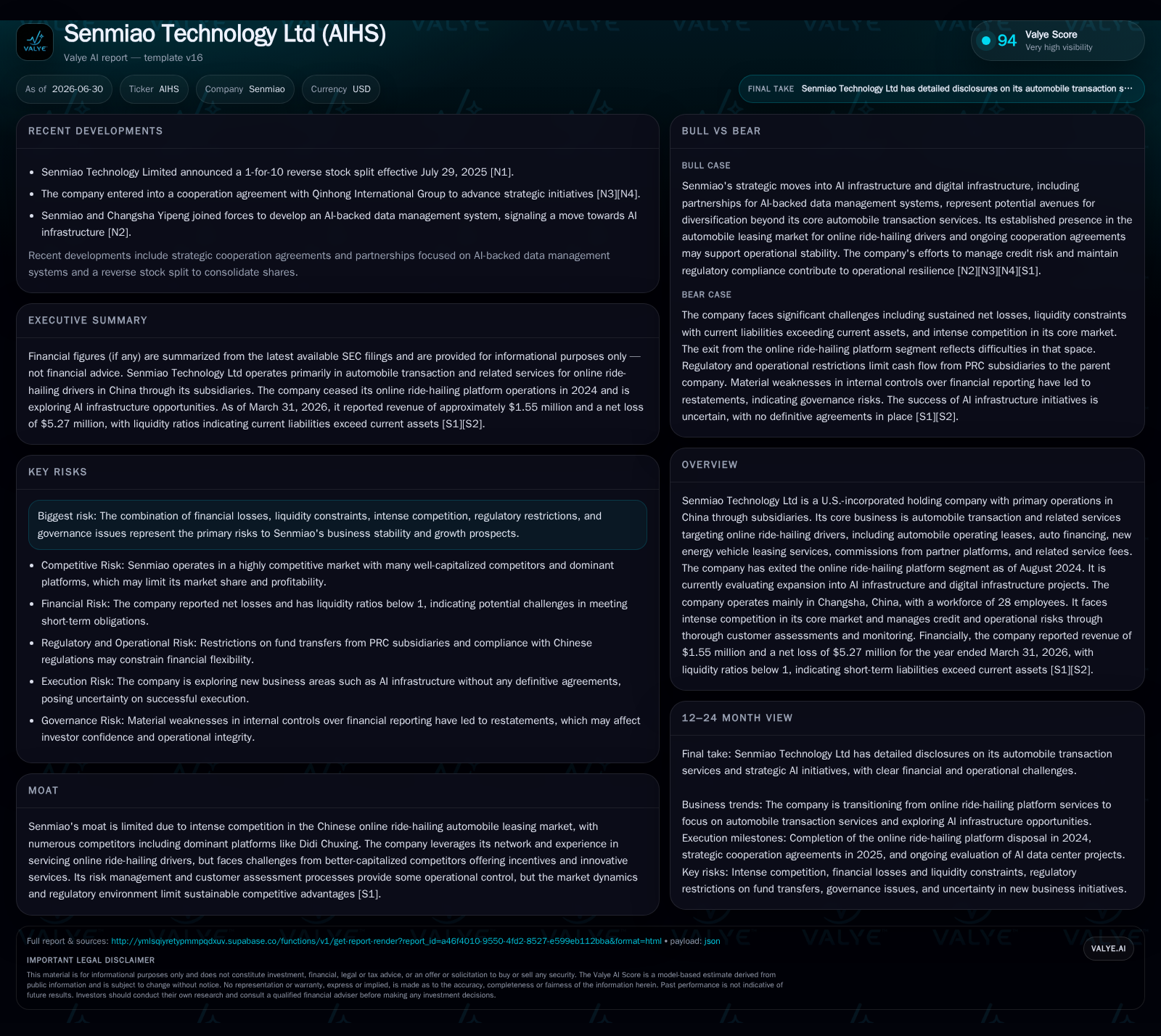
Senmiao Technology Ltd has completed its strategic divestiture of the online ride-hailing platform business as of August 2024, significantly reshaping its revenue base to automobile transaction services including operating leases, auto financing, and commissions tied to ride-hailing drivers using leased vehicles. The company’s latest quarterly report reveals continuation of net losses and liquidity pressures amid intense competition from established players like Didi Chuxing and integrated auto financiers in China. Senmiao is simultaneously exploring growth avenues through AI infrastructure projects, though these initiatives remain early-stage and uncommitted. Market and regulatory dynamics in China's auto financial services sector underscore structural headwinds alongside opportunities driven by rising new energy vehicle leasing demand and digitization trends.
Latest Quarter Reveals Strategic Exit from Platform Operation and Financial Pressure Points
Senmiao Technology's most recent quarterly filing for the period ended December 31, 2025 explicitly confirms the company’s completion of its divestiture from the online ride-hailing platform segment. This exit was consummated through the sale of their wholly owned subsidiary XXTX in August 2024, marking a decisive pivot away from platform operations generating transaction volume toward a concentrated focus on automobile-related financial services [S2], [S8]. The immediate impact is a scaled-back top line primarily sourced from automobile transaction services rather than rideshare platform fees, compressing total revenue to approximately $1.55 million for the latest reported period [F1]. Operating income remains negative at nearly -$2.9 million with a consequential net loss tallying over $5.27 million, highlighting persistent profitability challenges during this transitional phase [F1]. This strategic shift reflects management's response to both intensifying competition in ride-hailing platforms—dominated by incumbents like Didi Chuxing—and capital allocation realities necessitating concentration on asset-light leasing and financing products where operational control may be tighter.
The company also disclosed a non-reliance notice on its originally issued unaudited condensed financial statements for this quarter following an audit committee review that revealed material accounting classification errors primarily relating to warrants valuation. Although this restatement does not alter the fundamental narrative of ongoing losses or strategic repositioning, it underscores internal control weaknesses that Senmiao must address alongside its operational turnaround efforts [S3], [S16].
Automobile Leasing and Financing: Core Revenue Engines amidst Intense Competition
Now anchored in automobile transaction services within China—particularly focused on serving online ride-hailing drivers—the company derives revenues primarily via three mechanisms: operating lease contracts providing short-term vehicle access (mostly under twelve months), auto financing arrangements leveraging finance leases, and commission fees charged through partnerships with driver platforms tied to vehicle use [S1], [S8]. These services cater to a specialized commercial user segment requiring high vehicle utilization flexibility without ownership burdens. Maintaining robust credit risk assessment protocols is critical here due to variable earnings profiles among gig drivers; Senmiao emphasizes comprehensive customer credit monitoring systems to mitigate delinquency risks that can erode operating margins.
Operationally, key value chain metrics such as lease portfolio size—the number of vehicles under lease—and delinquency rates on lease payments directly influence revenue yield sustainability. While specific figures for portfolio growth are undisclosed, Senmiao's continued focus on these metrics aligns with industry standards where controlling payment defaults amidst volatile driver incomes is essential for managing credit losses and overall profitability.
Despite these targeted strategies, Senmiao acknowledges limited moat characteristics stemming from crowded competition with well-funded incumbents offering more innovative financing packages or incentives. Its operational footprint remains geographically concentrated around Changsha with a small workforce approximating 28 employees, delineating scale limitations relative to larger Chinese auto financial service providers [S1].
Industry Dynamics: Competitors, Regulatory Backdrop, and New Energy Vehicle Trends Shape Opportunity Set
Senmiao operates within a fiercely competitive landscape marked by dominant players such as Didi Chuxing who integrate extensive vehicle leasing offerings within their vast driver ecosystems, often leveraging superior capital resources and established market penetration. Parallelly, incumbent auto financing entities like Geely Auto Financial Services exert pressure through scale advantages and regulatory navigation expertise across China’s provinces.
Regulatory complexity further challenges operational agility. Senmiao must comply with China’s stringent data security laws including the Cybersecurity Law and measures governing cross-border data flows impacting platform digital infrastructure costs. Moreover, corporate governance practices reflect ongoing oversight adjustments initiated by the Audit Committee following financial restatements tied to derivative liabilities classification issues—highlighting layered regulatory scrutiny particularly affecting foreign-listed PRC enterprises like Senmiao [S1], [S9], [S16].
On the product front, burgeoning demand for new energy vehicles (NEVs) reshapes leasing service requirements. Although still exploratory at this stage for Senmiao, expanding NEV leasing provisions offers future upside aligned with regulatory encouragements promoting clean energy mobility solutions. Meanwhile, companies like Tesla Financial Services exemplify how NEV-focused financing can transform automotive fleet operations by tapping into sustainability-driven end-user adoption curves.
Growth Levers Centered on Expanded Leasing Penetration and Digital Infrastructure Adoption
As direct ride-hailing platform involvement ceased post-2024 divestiture, Senmiao increasingly evaluates leveraging its core competency in automobile leasing towards adjacent digital infrastructure domains including AI-powered fleet management systems or data center investments tailored for mobility service back-ends [S1], [S8]. Appointment of a strategic advisor specializing in AI infrastructure since fiscal year-end signals intent to pursue capital formation partnerships targeting power origination projects essential for energy-intensive AI data centers.
This nascent strategy dovetails with broader sector trends favoring urbanization-fueled Mobility-as-a-Service models where flexible leasing combined with digitized risk management offers scalable growth potential. However, concrete commitments or contractual milestones remain pending—making these initiatives conditional growth vectors rather than immediate revenue contributors.
Core KPIs that will evidence traction include expanded lease portfolio size reflecting new vehicle add-ons; reduced delinquency rates signaling improved credit discipline; enhanced commission fee streams marking deeper partner ecosystem integration; and eventually demonstrable progress on AI infrastructure project development validating diversification success.
Risks Converging Around Competitive Landscape, Credit Profile, and Capital Constraints
Senmiao confronts multiple compounding risk factors intrinsic to China’s densely contested auto financial services space. Foremost is intense competition from better capitalized incumbents enabling aggressive client acquisition spending or product innovation inaccessible at Senmiao’s current scale range. This competitive dynamic constrains pricing power for operating leases or finance charges applied to volatile ride-hailing drivers.
Credit risk remains elevated given lessees’ fluctuating incomes combined with macroeconomic uncertainties affecting gig-sector stability—heightening exposure to missed payments or increased loan loss provisions despite ongoing customer credit assessments.
Regulatory compliance costs related to cybersecurity mandates and foreign investment rules consume nontrivial resources that could otherwise support expansion or margin improvement efforts. These are compounded by corporate governance issues flagged by audit restatements pointing towards historic internal control weaknesses potentially distracting management focus.
Liquidity poses a clear short-term constraint; the latest balance sheet shows current assets at about $4.09 million against current liabilities near $7.78 million resulting in a working capital deficit captured by a current ratio around 0.53—illustrating limited near-term buffer against unexpected cash outflows amid ongoing operational losses exceeding $5 million recently reported [F1], [S2]. However, low absolute debt levels somewhat temper solvency risks even while limiting capacity for scaling investment-intensive leasing portfolios or AI infrastructure pursuits.
Next Steps Metric Guide: What Signals Will Validate Senmiao's Turnaround Path?
Progress validation hinges on several measurable KPIs signaling operational stabilization and growth reacceleration:
- Lease portfolio size expansion: An increasing count of active leased vehicles would confirm traction in core automobile transaction services supporting scaling revenue.
- Delinquency rate reduction: Demonstrable improvements here would imply tightened credit controls effectively mitigating historical credit losses characteristic of gig economy lending.
- Commission fee revenue growth: Strengthened partnership engagements reflected by rising commissions would showcase enhanced ecosystem integration compensating for lost platform ownership revenues.
- AI infrastructure milestones: Advancement from due diligence stages into signed development agreements or pilot launches would reinforce diversification prospects beyond traditional leasing models. Monitoring these quantifiable markers across successive quarterly disclosures will provide clarity on whether Senmiao can overcome capital scarcity effects while adapting competitively in evolving mobility finance environments.
Financial Profile Discussion: Balancing Liquidity Constraints with Strategic Reinvestment Plans
This currency imbalance signals narrowed operational flexibility constraining capacity for sizable investments necessary either for aggressive lease fleet acquisitions or catalytic AI infrastructure project development without external capital injection or partnership funding structures.
Disclaimer: This analysis is based exclusively on publicly filed SEC documents as of June 2026 combined with industry-standard framing of automobile financial services markets in China. It does not constitute investment advice or forecasts but aims solely to elucidate operating fundamentals amid strategic transition.
Financial position in context
Current assets of $4mm and current liabilities of $8mm imply a current ratio near 0.53x for 2026-03-31 [F1]
Disclaimer: This is research-only, informational analysis and not investment advice. It may include AI-generated interpretation and general industry context. Always verify important details using primary sources.

Comments