
Alexander & Baldwin's Stable Hawai‘i Portfolio Faces Growth Ceiling and Merger Uncertainty
Strong local positioning underpins A&B’s operations, yet geographic concentration and merger execution risks cloud growth outlook.
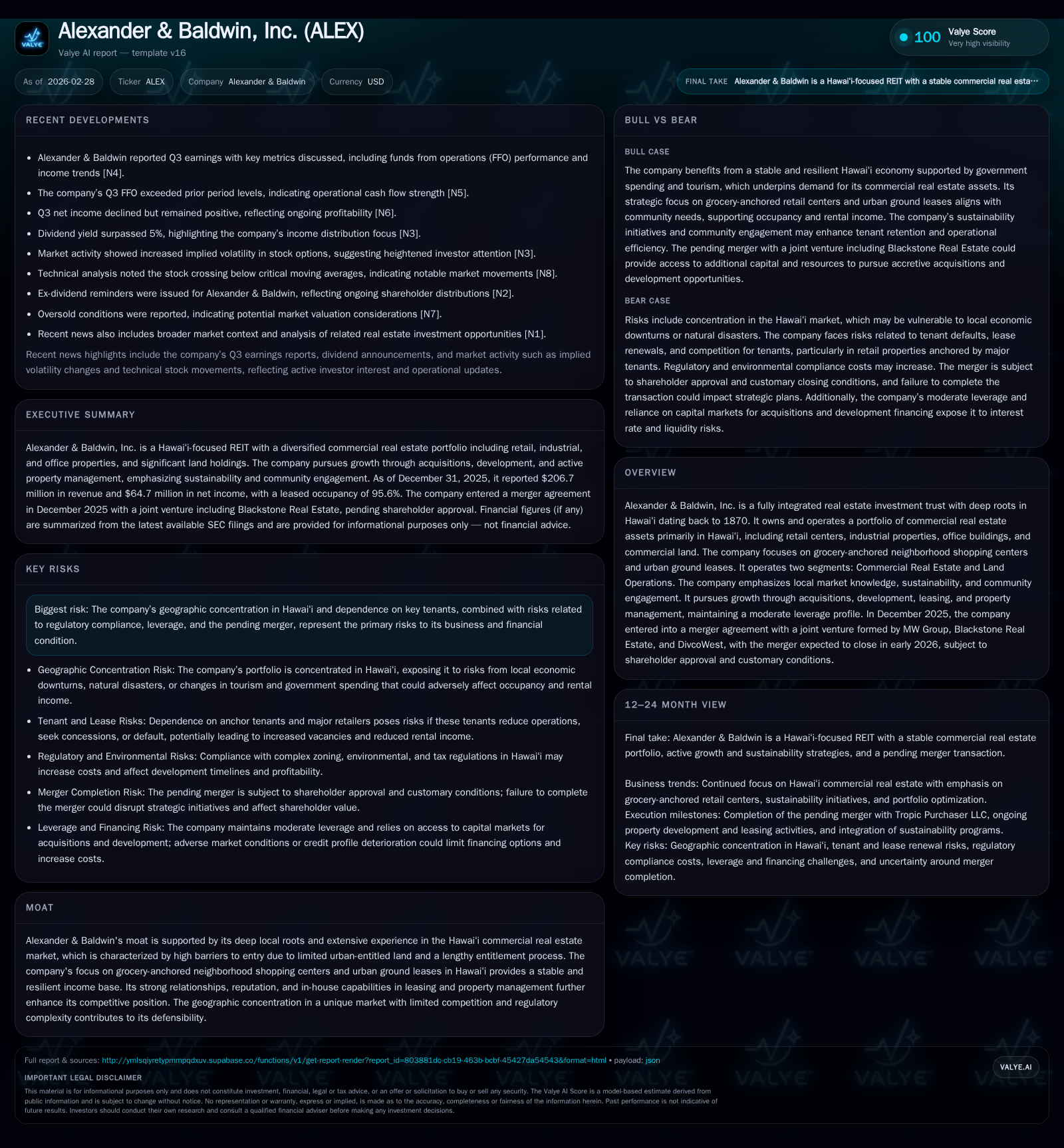
Alexander & Baldwin, Inc. (ALEX) leverages over 150 years of deep Hawai‘i roots to operate a focused commercial real estate portfolio anchored by grocery-centered retail centers and urban ground leases. Historical performance shows steady operating income and earnings despite recent topline volatility, driven by a resilient tenant mix and high occupancy rates. However, geographic concentration in Hawai‘i, regulatory complexity, and escalating leverage pose challenges. The company’s pending merger with a consortium led by MW Group, Blackstone Real Estate, and DivcoWest marks a significant strategic inflection point but introduces uncertainties around execution risk and shareholder value realization. Capital allocation remains disciplined amid the transition, maintaining moderate leverage and cautious investment amid a complex financing environment.
Company Background and Historical Performance
Alexander & Baldwin, Inc. (A&B) is a fully integrated real estate investment trust with roots dating back to 1870 when it operated as a sugar plantation in Hawai‘i. Over time, it has transformed into one of the state’s premier commercial real estate companies focusing on grocery-anchored neighborhood shopping centers, industrial properties, office buildings, and urban ground leases exclusively within Hawai‘i [S1][S22]. This geographic concentration allows A&B to capitalize on its deep local expertise and longstanding relationships.
Financial results for fiscal years 2022 through 2025 illustrate stable profitability despite fluctuations in revenue largely due to portfolio simplification efforts disposing of non-core assets [F1]. Revenue decreased by 12.7% in 2025 to approximately $207 million from $237 million in 2024; however, operating income remained largely unchanged at about $80 million demonstrating operational resilience.
Historical performance (annual)
| FY | Rev ($mm) | Net ($mm) | CFO ($mm) | OpInc ($mm) | Rev YoY | Net YoY |
|---|---|---|---|---|---|---|
| 2025 | 207 | 65 | 80 | 80 | -12.7% | +6.8% |
| 2024 | 237 | 61 | 98 | 80 | +13.3% | +103.1% |
| 2023 | 209 | 30 | 67 | 65 | +195.1% | +141.6% |
| 2022 | 71 | -72 | 34 | 27 |
Source: SEC companyfacts cache [F1].
Capital returns and efficiency (annual)
| FY | Buybacks ($mm) | FCF ($mm) | ROE% |
|---|---|---|---|
| 2025 | 6 | 27 | 6.6 |
| 2024 | 3 | 77 | 6.0 |
| 2023 | 5 | 45 | 3.0 |
| 2022 | 7 | 12 | -6.9 |
Source: SEC companyfacts cache [F1].
The company’s improved properties maintained a leased occupancy rate of approximately 95.6% as of December 31, 2025 [S22]. Its tenant base includes national grocers such as Albertsons Companies (Safeway), regional retailers, and government entities with no single tenant accounting for more than about 10% of commercial real estate revenues over recent years, reducing tenant concentration risk.
Commercial Real Estate Portfolio Overview
A&B’s portfolio comprises roughly four million square feet of gross leasable area divided among:
- 22 retail centers, predominantly grocery-anchored,
- 14 industrial properties,
- 4 office properties,
- 145 acres of commercial land mainly under long-term urban ground leases [S22].
The company’s focus on stabilized cash-flowing assets leverages Hawai‘i’s high barriers to entry—including limited urban-entitled land (~5%) and protracted entitlement processes lasting nine to fifteen years—supporting long-term portfolio value [S15]. Vertical integration in leasing and property management further enhances operational control.
Growth Drivers and Constraints
Growth Drivers
- Local market expertise: Deep roots in Hawai‘i provide competitive advantages in regulatory navigation, tenant relations, leasing activity, and acquisition sourcing [S11][S15].
- Redevelopment initiatives: Capital expenditures increased substantially in FY2025 (+149%) reflecting efforts to enhance existing assets and pursue development opportunities aimed at accretive returns [F1][S15].
- Pending merger: Agreement reached on December 8, 2025 to merge with Tropic Purchaser LLC—a joint venture including MW Group, Blackstone Real Estate Partners, and DivcoWest—potentially unlocking scale benefits post-closing expected in Q1 2026 [S1][S3].
- Stable tenant base: Grocery anchors provide resilience against shifts toward e-commerce impacting general retail.
Growth Constraints
- Geographic concentration: Exclusive focus on the Hawai‘i market exposes A&B to regional economic cycles and regulatory changes [S1][S12].
- Asset dispositions: Ongoing sales of non-strategic assets could limit future income unless offset by new acquisitions or development [S14].
- Regulatory complexity: Environmental regulations including dam safety requirements and zoning constraints may delay projects or increase costs [S16][S17].
- Leverage considerations: The company maintains moderate leverage highlighted by a November 2025 $200 million term loan facility replacing prior revolving credit borrowings; rising interest rates pose expense risks despite hedging strategies [S4][S5][F1][S10].
- Merger execution risk: Completion depends on shareholder approval and satisfaction of closing conditions; pending litigation related to the merger introduces uncertainty that could disrupt operations or delay closing [S1][N1].
Financial Health and Capital Allocation
A&B returned to profitability after a loss in FY2022 primarily linked to restructuring or impairments [F1]. Net income grew modestly by nearly 7% year-over-year in FY2025 reaching approximately $64.7 million while operating cash flow declined by almost 19% to $79.5 million reflecting revenue pressures.
Capital expenditures more than doubled versus FY2024 levels ($52 million vs ~$21 million), underscoring reinvestment into redevelopment projects or internal growth initiatives [F1]. Free cash flow after capex is estimated at roughly $27 million.
Share repurchases continued at moderate levels (~$5–6 million annually), balancing capital returns against liquidity preservation ahead of the merger completion [F1][S19]. Dividend guidance is not explicitly provided for the near term amid the ownership transition; historically dividends were subject to REIT distribution rules requiring payout of taxable income.
Equity stood near $987 million at year-end 2025 alongside manageable debt levels supported by refinancing efforts designed to stagger maturities and maintain covenant compliance [F1][S25][S26]. Interest expense risks are partly mitigated through fixed-rate debt preferences supplemented by interest rate hedging arrangements; however, cost increases remain possible as variable-rate debt resets [S10].
Industry Context and Competitive Positioning
Hawaiian commercial real estate is characterized by its insular nature with limited developable urban land (~5%), lengthy entitlement processes heavily influenced by environmental considerations, high dependence on tourism complemented by government spending due to strategic defense installations—all contributing to significant entry barriers [S15].
These factors advantage well-established operators like A&B who benefit from entrenched local relationships securing access to prime locations before regulatory bottlenecks became pronounced.
Forward-Looking Considerations
Absent explicit forward guidance following the merger announcement:
- Monitor shareholder vote outcomes expected early Q1 2026 for merger approval,
- Evaluate post-closing integration effectiveness including realization of scale synergies within the MW Group-led joint venture,
- Observe leasing trends particularly for grocery-anchored retail segments amid broader brick-and-mortar retail shifts,
- Track capital deployment plans post-merger regarding development intensity,
- Assess debt maturity profiles relative to refinancing needs amid evolving interest rate environments,
- Watch for management commentary on dividend policy adjustments during ownership transition.
Risk Summary
Key risks include:
- Geographic concentration heightening sensitivity to local economic fluctuations,
- Leverage constraints potentially limiting operational flexibility,
- Regulatory compliance costs especially environmental rules and permitting delays,
- Merger-related uncertainties encompassing financing contingencies plus possible disruptions affecting employee or tenant relations,
- Tenant concentration mitigated but still present given reliance on key anchors. These risks warrant ongoing attention alongside operational execution capabilities [S1][S8][S12][S16][S29].
Disclaimer: This report is based solely on publicly available information as of February 28, 2026; it does not constitute investment advice or an offer to buy or sell securities.
Disclaimer: This is research-only, informational analysis and not investment advice. It may include AI-generated interpretation and general industry context. Always verify important details using primary sources.

Comments