
Alkermes’ Integration of Avadel and Technology Platforms Support Neuroscience Growth Amid Leverage
Recent quarterly updates highlight Alkermes’ progress integrating its narcolepsy acquisition and expanding proprietary neuroscience therapies, though leverage remains a key operational consideration.
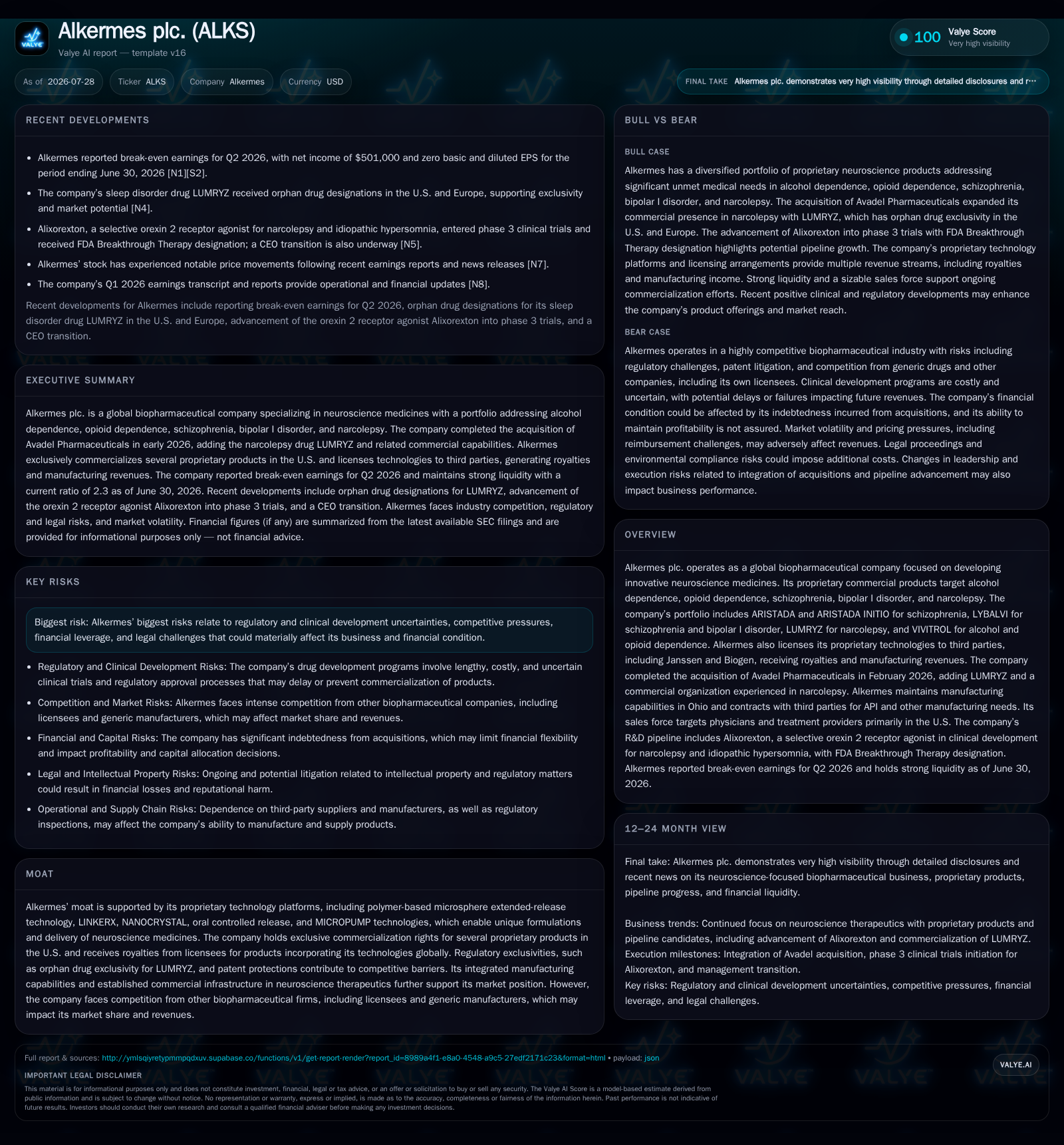
Alkermes plc continues to consolidate its position in specialty neuroscience therapeutics following its February 2026 acquisition of Avadel Pharmaceuticals, notably adding the narcolepsy treatment LUMRYZ and commercial capabilities. The company’s unique extended-release drug delivery technologies underpin a portfolio addressing complex disorders such as schizophrenia, bipolar disorder, addictions, and sleep disorders. While Alkermes reported stable earnings in Q2 2026 and progressed clinical programs, ongoing integration challenges and significant debt from the acquisition pose financial and operational watchpoints. Regulatory exclusivities and a targeted sales force support market penetration, but competitive pressures and payor dynamics temper near-term visibility.
Recent Operating Update: Q2 2026 and Acquisition Integration
Alkermes plc’s latest quarterly filing for Q2 ended June 30, 2026 confirms steady operational progress following the pivotal February completion of its acquisition of Avadel Pharmaceuticals [S2][S3]. This transaction brought LUMRYZ (an extended-release oral sodium oxybate suspension) into Alkermes’ commercial portfolio and added commercial expertise in the narcolepsy indication. The company is actively integrating Avadel’s business across multiple operational dimensions including sales, distribution, manufacturing systems, finance, regulatory affairs, and R&D activities [S1][S3]. Given the complexity of merging corporate cultures and systems in biopharma—especially within specialty neuroscience markets—full synergy realization will be a multi-quarter process with visible milestones expected as integration advances.
Operating earnings for Q2 show a break-even result [N2], reflecting stable commercial execution but also investment related to integration activities and pipeline development. Although Alkermes did not provide explicit Q2 revenue figures in the snippets available here, the stability in operating income relative to prior periods suggests maintained sales momentum in core products such as ARISTADA (schizophrenia), LYBALVI (schizophrenia/bipolar I), VIVITROL (opioid/alcohol dependence), along with revenues from LUMRYZ since takeover [S2][S3].
Business Model: Proprietary Neuroscience Medicines With Unique Delivery Platforms
Alkermes operates principally as an innovator and marketer of proprietary neuroscience therapeutics targeting diseases characterized by high unmet medical need: alcohol dependence, opioid dependence, schizophrenia, bipolar disorder, and narcolepsy [S1]. The company’s portfolio includes:
- ARISTADA and ARISTADA INITIO extended-release injectable formulations for schizophrenia,
- LYBALVI oral therapy for schizophrenia and bipolar I disorder,
- VIVITROL injectable receptor antagonist for alcohol/opiate dependence,
- LUMRYZ extended-release oral sodium oxybate for narcolepsy added through Avadel acquisition.
A cornerstone of Alkermes’ competitive positioning lies in its proprietary drug delivery technologies — polymer-based microsphere extended-release formulations (e.g., LINKERX) enable sustained therapeutic exposure reducing dosing frequency [S1][S11]. This technological moat fosters differentiation versus oral or immediate-release generics and supports patent-protected exclusivity periods enhancing pricing power.
Revenue streams are diversified beyond direct product sales: Alkermes licenses these technology platforms to pharma partners such as Janssen (notably manufacturing RISPERDAL CONSTA) and Biogen, earning royalties plus contract manufacturing fees [S24][S19]. Monetization involves selling finished drug products primarily to pharmaceutical wholesalers and specialty distributors who then supply outpatient clinics or pharmacies focusing on psychiatric or addiction treatment specialty channels. The company maintains a dedicated U.S.-based sales force of approximately 540 representatives spread across the neuroscience portfolio—with about 435 reps promoting ARISTADA/LYBALVI to psychiatrists and about 105 reps concentrated on VIVITROL’s addiction-treatment market [S24]. The newly acquired Avadel commercial team enhances this footprint specifically for narcolepsy.
Industry Structure and Competitive Position
The neuroscience biopharma sector is heavily R&D-driven with long product development lead times governed by rigorous regulatory review cycles. Companies compete on clinical efficacy/safety profiles, differentiation through dosing innovations like extended-release formulations, intellectual property protection duration, payer reimbursement access, sales force reach into specialized physician networks, and patient adherence improvements [S11][S29]. Compared to peers with trademarked delivery systems (such as Janssen’s Invega platform or other biotech firms targeting CNS disorders), Alkermes’ microsphere technology remains competitive but faces potential pressure from emerging modalities including novel oral agents or biologics under development
Market exclusivity is supported by regulatory mechanisms such as orphan drug designation granted recently for LUMRYZ in both U.S. and Europe—providing seven years data exclusivity in the U.S.—that limits direct generic entry for critical periods [N11]. Nevertheless, the industry frequently contends with patent litigation challenges (“Paragraph IV” cases) from generic entrants particularly post-patent expiry of blockbuster products like RISPERDAL CONSTA which Alkermes manufactures under contract but does not commercialize directly [S8][S19].
Growth Drivers: Pipeline Expansion & Commercial Footprint Enhancement
Key growth catalysts include advancing clinical trials—particularly phase 3 initiation for Alixorexton (a selective orexin 2 receptor agonist targeting narcolepsy types NT1/NT2)—which benefits from FDA Breakthrough Therapy designation awarded in late 2025 [S21]. Positive data readouts would drive label expansion opportunities beyond current products while potentially unlocking new indications such as idiopathic hypersomnia.
Commercially, uptake of LUMRYZ post-acquisition leverages Avadel’s focused gastro-intestinal disease experience transposed into narcolepsy specialist clinics [S1]. Expanding indication breadth within schizophrenia/bipolar disorder with next-gen formulations (e.g., ARISTADA INITIO allowing rapid initiation without oral supplementation) can increase market penetration by improving prescribing convenience [S24]. Licensing revenues from partners incorporating Alkermes technologies continue as stable royalties backed by technology IP protections.
Other growth enablers include:
- Successful REMS compliance minimizing regulatory disruption risk,
- Sales force effectiveness measured by prescriber adoption rates,
- Patient adherence/persistence improving overall therapy duration statistics,
- Favorable reimbursement environment navigating increasing payer co-pay burdens via assistance programs,
- Strategic management of manufacturing capacity ensuring reliable supply against demand fluctuations.
Risks and Watchpoints: Financial Leverage and Regulatory Complexities
Alkermes carries substantial financial leverage after funding the Avadel deal via approximately $1.5 billion debt balanced against $511 million cash at quarter-end June 30, 2026—a net debt close to $991 million—and a healthy current ratio near 2.3 indicating satisfactory short-term liquidity coverage [F1]. However, this elevated indebtedness requires prudent cash flow management particularly as ongoing R&D expenditures remain sizeable given late-stage pipeline ambitions [S4][S9]. Interest rate variability presents additional financing cost risks.
Regulatory risks are multifaceted encompassing potential delays/refusals on pending approvals stemming from varying FDA interpretations or evolving guidelines (e.g., orphan exclusivity maintenance or REMS administration changes that are costly to implement) [S20][S22]. Legal exposures related to ongoing investigations around pricing practices or marketing conduct could impact reputation or impose financial penalties [S5][S10].
Competitive threats manifest both from newer drug entrants designed with improved safety/efficacy profiles as well as generic versions eroding incumbent product revenue bases once patent protections lapse. Payor trends tightening patient out-of-pocket costs through accumulator adjustment programs may further pressure volume shifts requiring agility in co-pay assistance strategies [S7][S19]. Lastly integration risks persist around cultural alignment post-Avadel takeover—failure here could dilute anticipated financial synergies or disrupt ongoing commercial operations [S6][S25].
What to Watch Next
Key upcoming milestones include production updates on Alixorexton phase 3 trial commencement timelines projected early 2026 initially announced during year-end disclosures [S21]. LUMRYZ launch performance indicators—prescriber adoption curves tracked against narcolepsy diagnosis prevalence—will help gauge acquisition payoff velocity. Monitoring any FDA feedback or labeling changes affecting REMS obligations is important given their direct impact on distribution complexity.
Fiscal discipline signals including quarterly cash flow generation relative to debt servicing requirements will be telling regarding leverage management. Potential announcements related to expanded licensing deals leveraging Alkermes’ delivery platforms or new collaborations could also provide incremental revenue diversification.
Analyst consensus over the mid-term reflects cautious optimism balancing strong technology fundamentals with current financial leverage burdens combined with an increasingly complex regulatory/risk environment characteristic of specialty biotech focused on neuroscience disorders.
Financial Profile Discussion
At quarter-end June 30, 2026, Alkermes reported approximately $511 million in cash equivalents against total debt near $1.5 billion resulting from its recent acquisition financing structure—the net leverage position stands around $991 million [F1]. The company maintains a current ratio of roughly 2.3x reflecting adequate liquidity to cover short-term liabilities of about $662 million relative to current assets over $1.5 billion [F1]. These metrics indicate sufficient working capital cushion even though high gross debt levels elevate solvency risk should operating cash flows falter due to clinical setbacks or integration inefficiencies.
In summary, Alkermes displays a solid blend of proprietary technological differentiation within neuroscience therapeutics coupled with an expanded commercial presence following its Avadel acquisition. Nonetheless elevated indebtedness alongside inherent biopharma regulatory complexities positions financial vigilance as critical amid an evolving competitive marketplace emphasizing innovation speed and reimbursement adaptability.
This analysis is based solely on publicly available regulatory filings (), recent news (), company facts ([F1]), and industry-standard biotechnology sector knowledge without any investment advice implied or intended.
Disclaimer: This is research-only, informational analysis and not investment advice. It may include AI-generated interpretation and general industry context. Always verify important details using primary sources.

Comments