
Applied Materials Q3 2026: Solid Liquidity and Stable Hedging Amid Semiconductor Demand Cycles
Applied Materials’ Q3 2026 filings reveal stable derivative hedging outcomes and a strong liquidity position supporting resilience in a cyclical semiconductor equipment market.
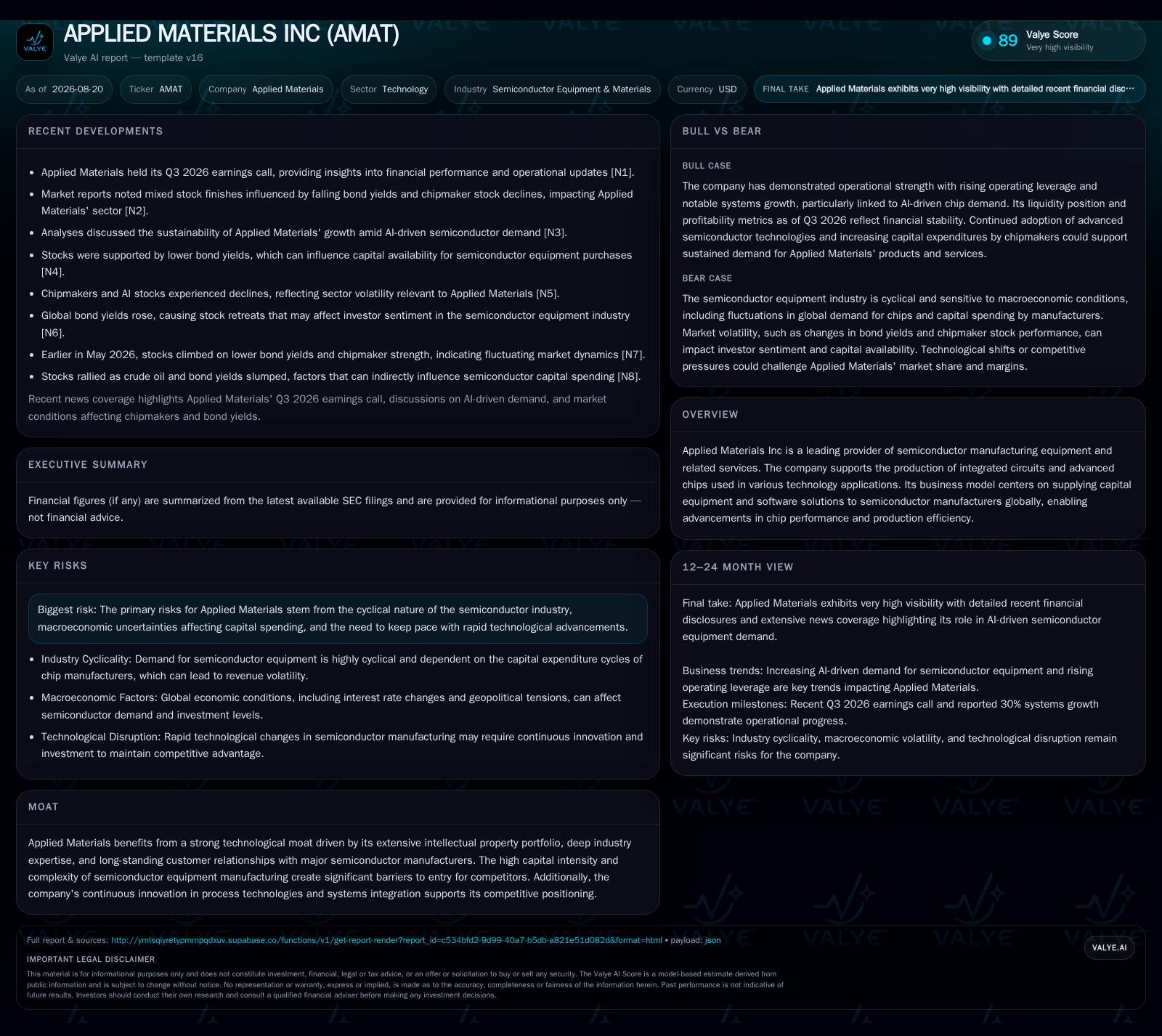
Applied Materials Inc reported immaterial gains or losses from derivative instruments for Q3 2026, consistent with the prior year, indicating stable financial risk management. The company maintains a strong liquidity profile with a current ratio of 2.42, cash and equivalents of $7.04 billion, and a $2.0 billion revolving credit facility established in September 2025. These factors provide financial flexibility to manage upcoming debt maturities and operational needs amid semiconductor capital spending cycles. The business model centers on supplying semiconductor manufacturing equipment and software globally, where cyclical demand and capital intensity shape financial dynamics.
Q3 2026 Financial Risk Management and Derivative Impact
Applied Materials Inc's latest quarterly 10-Q filing for the period ended July 26, 2026, reports that the gain or loss on derivatives in cash flow hedging relationships recognized in accumulated other comprehensive income (AOCI) was not material for both the three and nine months ended July 26, 2026, and the comparable period in 2025 [S2]. Similarly, the effects of derivative instruments—whether designated as cash flow or fair value hedges or not—on the consolidated statements of operations were also immaterial in these periods [S2]. This stability in derivative impact suggests that Applied Materials' financial risk management strategies effectively mitigate market volatility risks or that the company’s exposure to such volatility remains limited in the near term.
In the semiconductor equipment manufacturing industry, where capital intensity and global operations expose companies to interest rate, foreign exchange, and commodity price risks, derivative instruments are commonly used to hedge these exposures. The immaterial derivative effects reported by Applied Materials indicate that either the hedging instruments are well-matched to the underlying exposures or that market conditions during the quarter did not produce significant valuation fluctuations. The company reported cash and cash equivalents totaling $7.04 billion and current assets of $25.1 billion against current liabilities of $10.36 billion, yielding a current ratio of 2.42 [F1]. This ratio indicates that Applied Materials holds ample short-term assets to cover its short-term obligations, a critical measure of liquidity health especially in capital-intensive industries.
Further enhancing liquidity flexibility, Applied Materials entered into a $2.0 billion 364-day committed revolving credit agreement in September 2025, with an option to increase the facility by up to $1.0 billion subject to lender commitments and customary conditions [S2]. This committed credit line provides a readily available source of funding to support operational needs or manage refinancing of upcoming debt maturities.
Regarding debt maturities, the company’s current portion of long-term debt includes $1.2 billion of 3.3% senior notes due in 2027 [S2]. The presence of this near-term maturity underscores the importance of liquidity and credit facilities in managing refinancing risk. Customers in this sector make capital expenditures to acquire advanced technology tools that enable wafer processing, chip fabrication, and process integration. The company’s revenue generation is primarily driven by the sale of capital equipment and associated service contracts, which often involve long sales cycles and require continuous technological innovation.
The semiconductor equipment manufacturing industry is characterized by high capital intensity, rapid technological change, and cyclical demand patterns tied closely to semiconductor market capital spending. Companies like Applied Materials face competitive constraints including the need for extensive intellectual property portfolios, deep industry expertise, and strong customer relationships. Barriers to entry are high due to the complexity and cost of developing advanced process technology tools.
Financially, margins and cash conversion are influenced by product mix, innovation premiums, and service revenue proportions. The cyclical nature of semiconductor capital spending requires companies to maintain liquidity buffers and manage working capital carefully to navigate fluctuations in order flow and equipment utilization rates.
Analytical Conclusions and Scenario Analysis
The reported immaterial impact of derivative instruments on both earnings and accumulated other comprehensive income in Q3 2026 indicates stable financial risk management and limited near-term exposure to market volatility [S2]. This stability is important in the semiconductor equipment sector, where fluctuations in interest rates or currency exchange rates could otherwise affect earnings unpredictably.
One possible interpretation is that Applied Materials may have the capacity to sustain operations and capital investments through semiconductor industry cycles without significant financial distress, assuming current conditions persist. Confirmation would come from continued immaterial derivative impacts in future filings, stable or improving liquidity ratios, and capital spending trends consistent with industry expectations.
Conversely, a bear scenario could arise if semiconductor capital spending contracts sharply or market volatility increases, potentially leading to material derivative losses and liquidity pressure. This scenario would be confirmed by future filings reporting significant derivative losses, declining liquidity ratios, or challenges in refinancing debt maturities.
Watchpoints
Investors and analysts should monitor Applied Materials’ future quarterly disclosures for any material gains or losses related to derivative instruments, as these would signal changes in financial risk exposure. Changes in liquidity ratios and cash balances will also be critical indicators of financial flexibility, especially in light of upcoming debt maturities. Additionally, tracking semiconductor capital spending trends and order backlog will provide insight into the company’s revenue outlook and operational resilience.
Disclaimer: This is research-only, informational analysis and not investment advice. It may include AI-generated interpretation and general industry context. Always verify important details using primary sources.

Comments