
Ambiq Micro: Ultra-Low Power Edge AI Ambition Meets the Realities of Semiconductor Cycles and Geopolitical Exposure
Ambiq Micro’s proprietary SPOT® platform addresses a critical bottleneck in edge AI—power efficiency—but the company’s path to profitability is shaped by heavy R&D investment, customer concentration, and dependence on a single wafer supplier. Its recent capital raises and geographic repositioning offer strategic flexibility, yet the cyclical, competitive, and geopolitically sensitive nature of the semiconductor sector remains a persistent challenge.
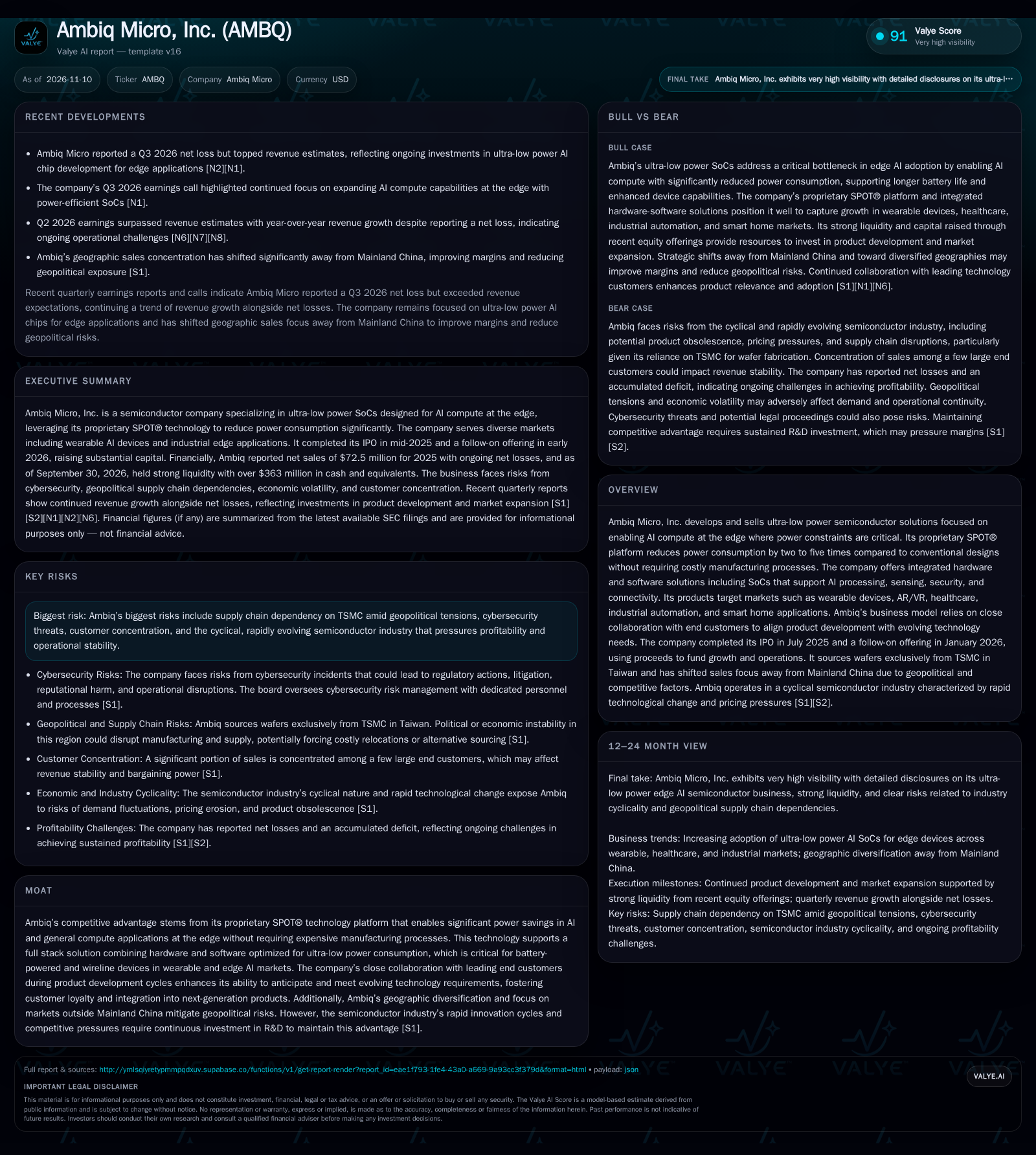
Ambiq Micro, Inc. has raised substantial capital post-IPO and continues to grow revenue by supplying ultra-low power AI SoCs for edge devices, but remains unprofitable amid heavy R&D spend and industry headwinds. Its strategic shift away from Mainland China and reliance on TSMC for wafer supply highlight both risk mitigation and vulnerability. The next phase will test whether its proprietary technology and geographic repositioning can deliver sustainable margins and customer diversification in a fiercely competitive, cyclical market. [S1] [S2] [N1] [N2] [N6]
Ambiq Micro, Inc. stands at the intersection of two powerful trends: the proliferation of AI at the edge and the relentless demand for lower power consumption in connected devices. By leveraging its SPOT® platform, Ambiq seeks to enable next-generation wearables, healthcare monitors, and industrial sensors with AI capabilities that do not sacrifice battery life. The company’s recent IPO and follow-on offering have equipped it with significant capital for R&D and market expansion. However, persistent net losses, reliance on TSMC for wafer supply, and customer concentration underscore the formidable challenges of scaling a differentiated semiconductor business in a rapidly evolving, cyclical, and geopolitically sensitive sector. The coming quarters will reveal whether Ambiq’s technological edge and strategic repositioning can translate into durable commercial advantage and margin improvement.
Recent Capital Raises and Shifting Sales Geography Reshape Ambiq’s Risk Profile
Ambiq Micro reported net sales of $72.5 million for 2025 but remains loss-making, with continued net losses through Q3 2026 despite topping revenue estimates in recent quarters. These losses reflect ongoing investments in product development and market expansion. As of September 30, 2026, Ambiq held over $363 million in cash and equivalents, bolstered by its IPO in July 2025 and a follow-on offering in January 2026. Notably, the company has shifted its sales focus away from Mainland China, a move that has reduced geopolitical exposure and may be supporting improved margins. However, Ambiq sources all of its wafers exclusively from TSMC in Taiwan, maintaining a significant supply-chain vulnerability amidst ongoing regional tensions. [S1] [S2] [N1] [N2] [N6]
Ultra-Low Power Edge AI: Economics of Differentiation and Investment
Ambiq’s business model centers on selling ultra-low power system-on-chips (SoCs) designed for AI compute at the edge, primarily into markets where power constraints are critical—such as wearables, medical devices, and industrial IoT endpoints. The company’s proprietary SPOT® platform claims to deliver two to five times the power efficiency of conventional designs without incurring higher manufacturing costs. If these claims hold, Ambiq’s technology could enable device makers to extend battery life or add new AI features at a similar bill-of-materials cost, potentially commanding premium pricing or higher volumes in design wins.
Revenue is driven by a mix of average selling price (ASP), product volume, and the adoption of new product generations. However, the semiconductor industry is historically cyclical, with ASPs subject to downward pressure as products mature and competitors enter the market. Ambiq’s cost structure is characterized by high fixed R&D and SG&A expenses as it invests in next-generation chip designs and customer enablement. Gross margins are heavily influenced by wafer input costs (entirely sourced from TSMC), yield rates, and product mix. With ongoing net losses, Ambiq’s path to profitability likely depends on achieving sufficient scale to absorb fixed costs and on maintaining a technology advantage that justifies premium ASPs or protects against rapid commoditization.
The company reported cash and liquidity metrics for the period; these figures do not by themselves establish operating runway, investment capacity, financial flexibility, or financing capacity. However, persistent losses suggest that near-term self-funding from operations is unlikely without a combination of margin improvement, volume ramp, or cost control.
Technology Edge Versus Industry Realities: Competitive and Substitution Pressures
Ambiq’s core competitive advantage resides in its SPOT® platform—a proprietary technology stack that enables ultra-low power AI compute at the edge. This differentiation is most valuable in battery-constrained applications where incremental power savings translate directly to end-user value. The company’s integrated hardware-software approach and close customer collaboration may foster design wins and embed its chips in next-generation devices.
However, the semiconductor landscape is intensely competitive and fast-moving. Larger analog/mixed-signal and microcontroller vendors, as well as emerging AI chip startups, are all targeting edge AI opportunities. Many possess greater scale, broader ecosystems, and deeper customer relationships. Price-based competition is fierce, and product cycles are short, raising the risk of rapid obsolescence.
Substitution risk is also material: device OEMs could opt for alternative low-power microcontrollers, custom silicon, or integrated SoCs from broader platforms if Ambiq’s power savings become less differentiated or if competing vendors close the efficiency gap. The company’s exclusive reliance on TSMC for wafer supply is a double-edged sword—TSMC’s process leadership is an asset, but geographic concentration increases vulnerability to supply disruptions or political shocks. Customer concentration further limits bargaining power and revenue stability; a lost design win or delayed product cycle at a major customer could have outsized impact.
If Design Wins Scale and Edge AI Adoption Accelerates, Margin Expansion Becomes Plausible
In the most favorable scenario, Ambiq’s SPOT® technology becomes the standard for ultra-low power edge AI in wearables, medical devices, and industrial sensors. Device OEMs, facing ever-stricter power and form factor constraints, increasingly adopt Ambiq’s SoCs to enable longer device life and new AI-driven features. Successful R&D execution yields a steady cadence of new products, maintaining the company’s power efficiency advantage and sustaining premium ASPs relative to commoditized competitors.
Geographic diversification away from Mainland China continues, reducing margin drag and mitigating geopolitical risk. Strong design win momentum with diversified end customers leads to higher volumes, improved gross margins through scale efficiencies, and eventual operating leverage as top-line growth outpaces fixed cost increases.
Evidence supporting this scenario would include: disclosure of major new design wins with leading wearable or medical device OEMs; sustained revenue growth outpacing market averages; sequential improvement in gross margins; and a narrowing of net losses as operating expenses grow more slowly than revenue. Additional confirmation would come from customer testimonials or third-party benchmarks validating Ambiq’s power savings relative to peers.
Steady Progress Amid Cyclicality: Growth, Losses, and Gradual Margin Improvement
The most plausible path forward is one of continued revenue growth driven by gradual adoption of Ambiq’s ultra-low power SoCs in edge AI markets, but offset by the realities of semiconductor cyclicality, pricing pressure, and ongoing investment requirements.
Profitability remains elusive in the near term as fixed costs and competitive pricing pressure margins, though incremental improvements are possible if higher-margin products gain traction and geographic repositioning yields benefits. The risk of customer or supply-chain disruption remains elevated, and quarterly results may remain volatile. Evidence for this scenario would be continued mid-teens or higher year-over-year revenue growth, stable or slowly improving gross margins, and operating losses that gradually narrow but do not vanish. Confirmation would also include new product launches aligned with emerging edge AI use cases and ongoing announcements of design wins, albeit with ongoing customer concentration.
Supply Chain Disruption or Lost Major Customer Could Trigger Sharp Downturn
A negative outcome could be triggered by one or more adverse events: a geopolitical crisis disrupts TSMC wafer supply, a key customer switches to a competing or internally developed chip, or Ambiq’s technology advantage erodes faster than expected. In this scenario, Ambiq’s revenue drops or stalls, fixed costs become burdensome, and cash burn accelerates. If the company is unable to adapt quickly—by securing alternative suppliers, winning new customers, or reducing costs—liquidity could erode, forcing a strategic reset or capital raise under unfavorable terms.
Additional confirming evidence would include: abrupt revenue declines, warnings about supply interruptions or delayed customer launches, worsening gross margins, or a spike in operating expenses relative to revenue. Other red flags would be the loss of a major design win, increased inventory write-downs, or the announcement of restructuring plans. This scenario would also be supported if competitors announce new products that match or exceed Ambiq’s power efficiency, eroding its differentiation.
What Will Test Ambiq’s Edge AI Thesis in the Next 12–24 Months?
Gross margin trends: Sustained improvement would suggest higher-value product mix or scale benefits; erosion may indicate pricing pressure or input cost increases.
Revenue concentration: Disclosure of revenue share by top customers (if disclosed) or new customer wins would clarify diversification progress.
Design win announcements: New partnerships or contracts with leading OEMs in wearables, healthcare, or industrial IoT would signal market traction.
R&D expenditure as a percentage of sales: Stabilization or decline (with continued product innovation) could indicate operating leverage.
TSMC supply continuity: Updates on supply chain risk management, geographic diversification, or contingency planning would help test resilience.
Geographic revenue mix: Further reduction in Mainland China exposure or growth in other regions would support margin and risk mitigation arguments.
Product roadmap execution: Timely launch of next-generation SoCs and platform features would confirm R&D effectiveness and competitive positioning.
Operating cash flow trends: Movement toward breakeven or positive cash flow would signal progress toward long-term sustainability.
Disclaimer: This is research-only, informational analysis and not investment advice. It may include AI-generated interpretation and general industry context. Always verify important details using primary sources.

Comments