
Chase Packaging Corp: Shell Status, Merger Hopes, and the Realities of Value Creation
With no operating business since the late 1990s, Chase Packaging Corp remains a shell seeking a merger or acquisition to generate shareholder value. Its minimal cash reserves and rising net losses underscore both the urgency and uncertainty of its search for a viable transaction.
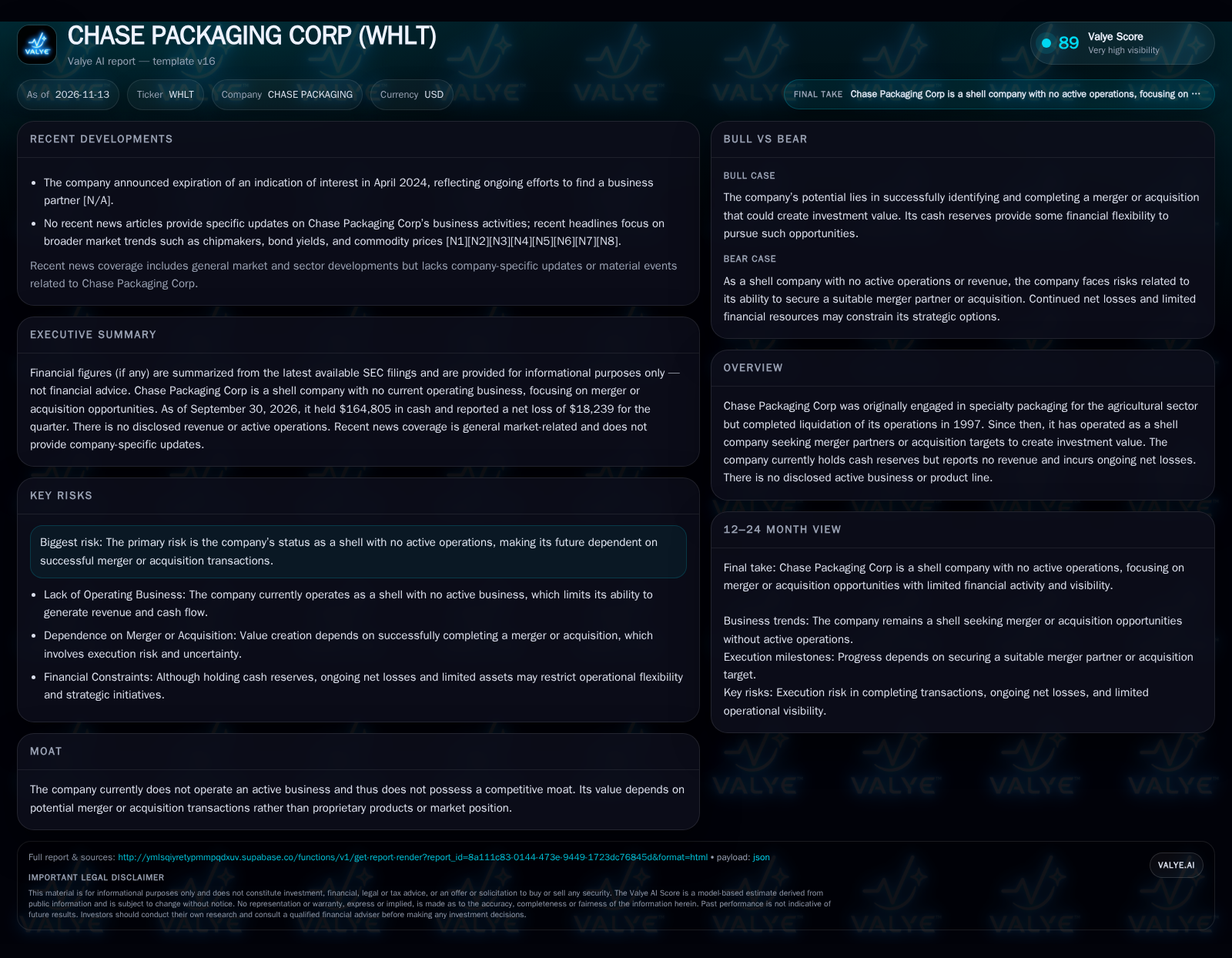
Chase Packaging Corp is a shell company with no ongoing operations, no revenue, and a reported cash balance of $164,805 as of September 30, 2026. The company's only activities are maintaining regulatory compliance and searching for a merger or acquisition. Recent financials show a net loss of $196,909 for the first nine months of 2026, primarily due to a one-time warrant modification expense. [S2]
Chase Packaging Corp exemplifies the challenges and risks inherent in shell companies that have ceased commercial operations but remain publicly listed in search of a transformative transaction. Recent financial results highlight the increasing urgency of this search, as administrative costs and transaction-related expenses continue to erode its limited capital base. Investors in Chase Packaging are effectively betting on the success—and timing—of a future deal, with little operational or financial cushion in the interim.
Minimal Operations, Mounting Losses: The Current State of Chase Packaging
Chase Packaging Corp is a shell company with no operating business, no revenue, and no products or services as of September 30, 2026. The company reported cash and liquidity metrics for the period; these figures do not by themselves establish operating runway, investment capacity, financial flexibility, or financing capacity. [S2] The net loss for the first nine months of 2026 was $196,909, primarily driven by a one-off $138,180 warrant modification expense [S2]. The company’s only material activity continues to be compliance with reporting requirements and the search for a merger partner or acquisition target—a process that has not yielded results in recent years. These facts underscore that Chase Packaging’s future is wholly contingent on a successful transaction, with its diminishing cash resources adding urgency to this pursuit.
Shell Company Economics: Value Creation Hinges on a Single Event
Chase Packaging’s economics are fundamentally distinct from operating businesses: it generates no revenue and incurs only administrative and compliance costs, which have averaged roughly $63,000 per nine months in recent periods [S2]. The possibility for value creation resides entirely in the prospect of a merger or acquisition, which could allow a private company to access public markets via a reverse merger or similar vehicle. For potential merger partners, the appeal may lie in Chase’s public listing, share base, and clean corporate structure—provided these are maintained efficiently.
The company’s fixed costs are modest but persistent, covering audit, legal, payroll, and registration expenses. These outflows steadily erode the available cash balance, which is not replenished by operations. Any transaction that does occur would likely involve significant additional costs—legal, advisory, and possibly recapitalization—further straining resources unless the incoming business is well-capitalized. Without a transaction, the company’s economics are a slow burn of capital, with the risk that eventual insolvency or delisting could eliminate any remaining option value for shareholders.
Shell Market Dynamics: Supply, Demand, and Structural Hurdles
Chase Packaging’s competitive position is defined by the broader market for shell companies. It competes with other public shells seeking to attract private businesses that want to go public without a traditional IPO or SPAC process. Key differentiators in this market include the shell’s cleanliness (absence of legacy liabilities), the size and structure of its shareholder base, the efficiency of its regulatory compliance, and the absence of toxic financing instruments.
However, the supply of shell companies has increased over the past decade, while regulatory scrutiny and investor wariness—especially post-SPAC boom—have made reverse mergers a less attractive pathway for some targets. Chase Packaging’s lack of an operating business or unique assets means it offers no intrinsic value beyond its listing status and capital structure. The expiration of an indication of interest in 2024 and terminated negotiations in 2020 suggest that the company has struggled to differentiate itself or provide compelling value to would-be partners [S1].
If a Transformative Merger Materializes: Value Unlock and Potential Re-rating
The most favorable scenario for Chase Packaging is the successful consummation of a merger or acquisition with a private business seeking a public listing. In this scenario, Chase’s public shell would serve as the vehicle for a reverse merger, enabling the private company’s management and business plan to become the new operating focus. Shareholders could benefit if the post-merger entity is well-capitalized, has a credible growth plan, and attracts investor interest—leading to a re-rating of the share price.
Confirmation of this scenario would require a formal transaction announcement, detailed disclosure of the target business, and evidence that the combined entity will be sufficiently funded to cover integration and operating costs. Key falsifiers would be the continued absence of deal progress or disclosures suggesting that negotiations have again broken down, as has happened with the expired indication of interest in April 2024.
Incremental Erosion: The Most Likely Course Absent a Deal
The most plausible near-term scenario is that Chase Packaging continues as a shell, incurring modest but persistent net losses as it maintains compliance and seeks a transaction. The company’s cash reserves, while adequate for now, will continue to decline as administrative and regulatory costs outpace nominal interest income. Without revenue or a credible business plan, the stock’s value will remain tethered to the hope of a future deal, with the risk of delisting or dissolution rising as resources dwindle.
Evidence supporting this status quo would include continued absence of deal announcements, ongoing net losses in future filings, and no material changes to the balance sheet. A change in this trajectory would be signaled by a significant uptick in expenses related to transaction activity, new financing, or public disclosure of a business combination under negotiation.
When the Clock Runs Out: Capital Exhaustion and Loss of Option Value
The adverse case is that Chase Packaging fails to secure a merger or acquisition before its cash reserves are depleted. As administrative costs erode the balance, the company could be forced to seek dilutive financing, suspend compliance activities, or ultimately dissolve and liquidate. Shareholder value would be at risk of being entirely wiped out if the cost of maintaining the public shell exceeds the remaining assets or if the company is delisted due to non-compliance.
Evidence confirming this scenario would include sharply rising or unsustainable losses, drawn-out periods with no deal activity, regulatory warnings, or formal steps toward liquidation. A further negative signal would be the announcement of highly dilutive financings or the inability to pay basic compliance costs.
Milestones and Developments That Will Determine If Chase Packaging Delivers Value
Any formal announcement of a letter of intent, merger agreement, or acquisition target would be the clearest signal of potential value creation.
Disclosure of transaction terms, especially the capital structure and funding of a proposed merger partner, would help assess whether the deal is likely to benefit current shareholders.
Evidence of new financing, capital infusion, or strategic investors participating in a deal would be important for evaluating post-merger viability.
A useful metric would be the rate of cash burn and projected runway, if disclosed, to gauge how long the company can maintain its shell status without a transaction.
Changes in the company’s compliance status, such as late filings or regulatory warnings, would indicate rising risk of delisting or dissolution.
Announcements about changes in board composition, strategic advisors, or other signals of increased deal activity could foreshadow transaction progress.
If disclosed, the profile and reputation of the proposed merger target's management team would matter for long-term value creation.
Any indication that deal negotiations have again terminated or that the company is considering liquidation would be a major negative development.
Disclaimer: This is research-only, informational analysis and not investment advice. It may include AI-generated interpretation and general industry context. Always verify important details using primary sources.

Comments