
TriLinc Global Impact Fund: Navigating Credit Complexity Across a Diversified Impact Portfolio
TriLinc Global Impact Fund LLC manages a geographically and sector-diverse portfolio of senior secured loans and trade finance participations, facing elevated credit and collection risks while leveraging active restructuring, experienced risk oversight, and adaptive valuation methods. The fund’s recent net loss and Watch List exposures highlight ongoing challenges—and the operational levers that could define future performance.
TriLinc Global Impact Fund’s latest disclosures reveal a net loss, limited cash, and a portfolio with significant credit risk, including investments under restructuring or default. The fund’s broad diversification, active risk management, and experienced governance offer potential resilience, but operational complexity and valuation uncertainty remain central to the thesis. Watch for portfolio-level recoveries, restructuring outcomes, and shifts in credit risk as critical markers for the next phase.
TriLinc Global Impact Fund LLC operates at the intersection of impact investing and credit-intensive alternative lending, holding a portfolio of senior secured loans and trade finance participations diversified across sectors and geographies. The company’s active risk management—including restructurings, arbitration, and collateral-based settlements—underscores both the complexity and the potential for recovery or further impairment. With experienced leadership and adaptive valuation practices, TriLinc’s future hinges on its ability to manage these risks and convert operational diligence into portfolio stability or upside.
Recent Results Spotlight Credit Risk and Operational Pressure
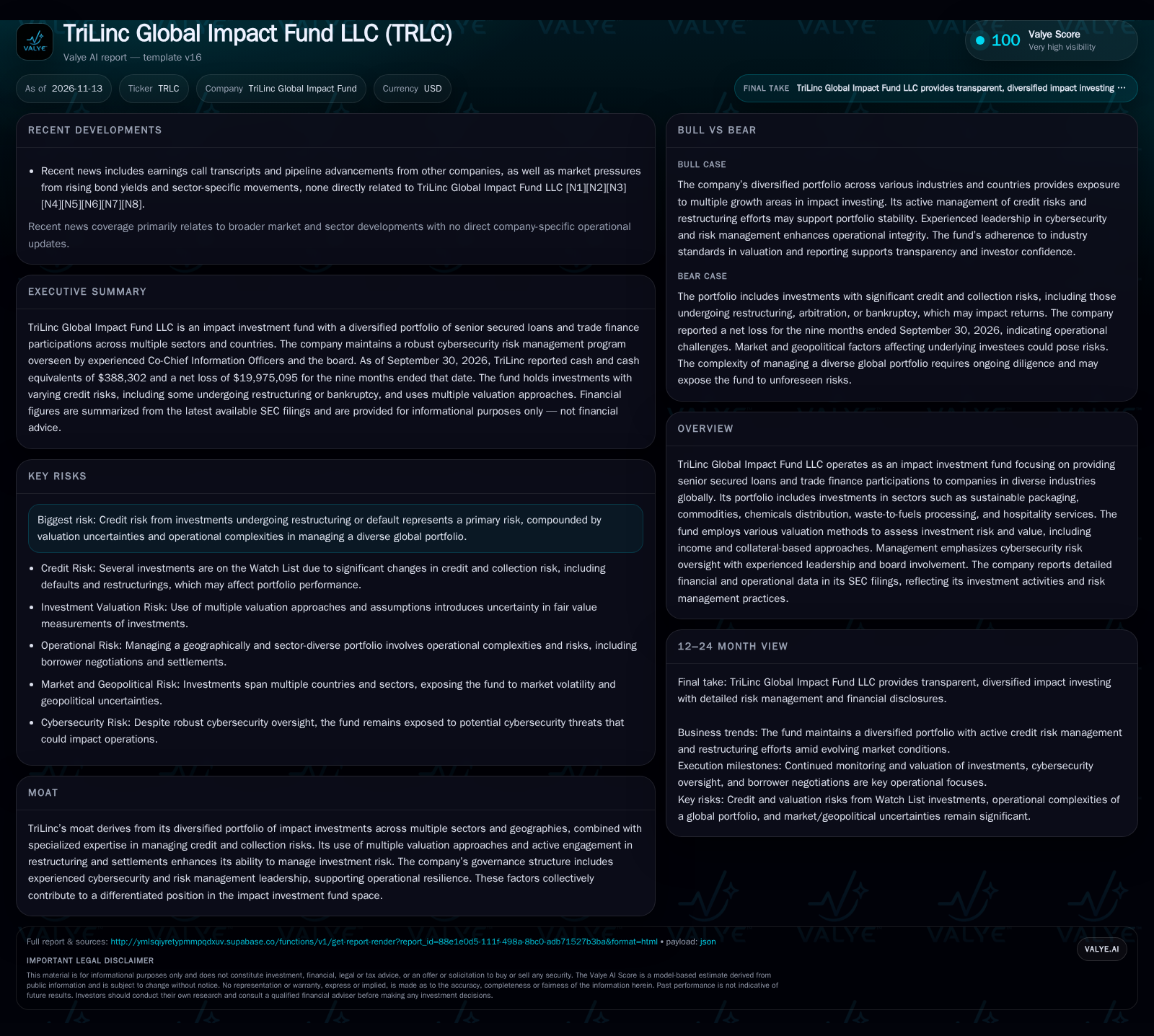
As of September 30, 2026, TriLinc Global Impact Fund reported cash and cash equivalents of $388,302 and a net loss of $19,975,095 for the nine months then ended, translating to basic EPS of -$0.42 per share [S2]. This negative result coincides with a portfolio that includes a significant number of investments on a Watch List, reflecting heightened credit and collection risks, including assets in restructuring, arbitration, or bankruptcy. The fund’s portfolio remains broad, spanning sectors from sustainable packaging to commodities and waste-to-fuels processing, and is geographically diverse, with investments in Latin America, Asia, and Africa [S1] [S2]. Management continues to pursue active settlement and restructuring strategies, including extending debt maturities and negotiating collateral-based recoveries. These facts frame a business in the midst of credit repair and operational challenge, with outcomes dependent on the success of ongoing workouts and the stability of remaining performing assets.
How TriLinc’s Economics Depend on Credit Recovery and Portfolio Mix
TriLinc’s revenue and value creation model is built around interest income, fees, and potential upside from equity or convertible positions in portfolio companies. Most assets are senior secured loans and trade finance participations, which, under normal conditions, would offer predictable cash flows and relatively lower risk due to collateralization. However, the economics shift dramatically when credit quality deteriorates: non-performing loans reduce interest income, trigger additional legal and workout costs, and can force downward valuation adjustments.
Portfolio diversification across sectors and geographies is intended to mitigate idiosyncratic risk, but it can also increase operational complexity, especially when multiple credits simultaneously experience stress. The presence of equity warrants and convertible notes introduces optionality but may have limited near-term value if underlying borrowers are distressed—as evidenced by the zero value assigned to the Blue Arrow Biojet Holdings LLC warrant as of December 31, 2025 [S1] [S2].
Operating leverage in this model is nuanced: while fixed costs are relatively modest compared to direct lending institutions (given the fund structure), impairment charges and legal expenses can erode results quickly in a high-default environment. The company reported cash and liquidity metrics for the period; these figures do not by themselves establish operating runway, investment capacity, financial flexibility, or financing capacity. The question is whether portfolio recoveries and restructuring can restore earning power faster than further losses accumulate.
Differentiation and Vulnerability in the Impact Lending Landscape
TriLinc’s competitive positioning is defined by its dual focus on impact and credit, with a portfolio that cuts across emerging markets and sectors often underserved by traditional lenders. The fund’s breadth offers exposure to growth opportunities in sustainability, commodities, and infrastructure, but also exposes it to markets with higher volatility and weaker legal enforcement. Its use of multiple valuation methods and active risk management—including board-level cybersecurity oversight—contributes to operational credibility and may provide a measure of investor confidence.
However, the fund faces competition from other impact-focused lenders, private debt funds, and development finance institutions, many of which may have deeper pockets, concessional capital, or stronger local relationships. The lack of recurring fee income or high-margin proprietary products means TriLinc’s economics are heavily tied to credit outcomes. Switching costs for investors are typically low in the closed-end fund space, so persistent underperformance could drive outflows or limit new capital formation. Ultimately, TriLinc’s edge may rest on its ability to underwrite and restructure credits more effectively than peers, a claim that will be tested by the outcome of current Watch List exposures.
What Recovery and Stabilization Could Look Like
A favorable scenario would see TriLinc successfully negotiating or enforcing restructurings on troubled investments, resulting in either resumed interest payments, collateral recoveries, or outright settlements that reduce principal losses. If macroeconomic conditions in key geographies stabilize and commodity-linked borrowers return to health, the fund could see a reversal of impairment charges and a restoration of cash income streams.
Confirmation of this scenario would require evidence of declining Watch List balances, positive net recoveries on previously impaired loans, and new performing investments outpacing any incremental defaults. Improved cash generation would enable TriLinc to reinvest opportunistically, potentially capturing discounted credits or equity positions in distressed but viable companies. If disclosed, sequential improvements in net asset value (NAV), lower restructuring expense, and resumption of distributions to investors would further validate the upside.
Portfolio Turnover and Credit Workouts Define the Likely Trajectory
The most plausible scenario is one of gradual but uneven progress: TriLinc continues to work through existing credit issues, with some troubled assets ultimately being written down and others partially recovered. New investments are likely to be limited until cash balances recover or existing positions are exited, constraining immediate growth.
Operationally, management will be focused on maximizing recoveries, minimizing legal and restructuring costs, and maintaining robust oversight of cybersecurity and valuation practices. Investors should expect ongoing volatility in both earnings and NAV, with periodic updates on the disposition of Watch List assets serving as the main barometer of forward momentum. Evidence supporting this scenario would include stable or slightly improving NAV, a steady cadence of restructuring updates, and no large new credit impairments.
Further Credit Deterioration Could Trigger Capital Erosion
An adverse scenario would involve continued or worsening defaults among portfolio companies, leading to additional write-downs, higher legal and workout expenses, and shrinking cash reserves. If TriLinc is unable to enforce collateral claims or if restructuring negotiations fail, realized losses could accelerate and NAV could decline sharply.
This scenario could be confirmed by a growing Watch List, persistent negative net income, and further reductions in cash and cash equivalents. If the fund is forced to liquidate assets at distressed prices or faces regulatory or investor pressure due to sustained underperformance, its ability to operate as a going concern could come into question. In such an environment, investor redemptions or inability to raise new capital could further constrain options.
What Will Test TriLinc’s Ability to Restore Value and Manage Risk
The proportion and dollar value of portfolio assets classified as Watch List or under restructuring, if disclosed, will be a primary indicator of credit risk trajectory.
Updates on specific restructuring outcomes, settlements, or recoveries—especially for large or long-dated distressed positions—would help test the effectiveness of the fund’s active management approach.
Sequential changes in net asset value (NAV) and net income, particularly any reversal of prior impairments, should be monitored for signs of stabilization or further stress.
Cash and cash equivalents trends will be critical, as persistently low balances could limit operational flexibility and new investment capacity.
If disclosed, the rate of new defaults or additions to the Watch List versus resolutions would provide insight into whether credit issues are stabilizing or compounding.
Legal, restructuring, and workout costs as a percentage of assets or income would shed light on the drag imposed by ongoing credit events.
Evidence of renewed investor inflows, secondary market pricing for fund units, or resumed distributions would indicate improved confidence and potential for recovery.
Disclaimer: This is research-only, informational analysis and not investment advice. It may include AI-generated interpretation and general industry context. Always verify important details using primary sources.

Comments