
Strategic Student & Senior Housing Trust: Asset-Light, Illiquid, and Facing a Ticking Debt Clock
With its student housing portfolio fully exited and distributions suspended, STSR is now a thinly resourced, debt-laden REIT reliant on third-party operators. The absence of acquisition plans and ongoing net losses shift the focus to asset preservation, debt management, and the challenges of illiquid shares—raising questions about long-term value realization and the viability of the current structure.
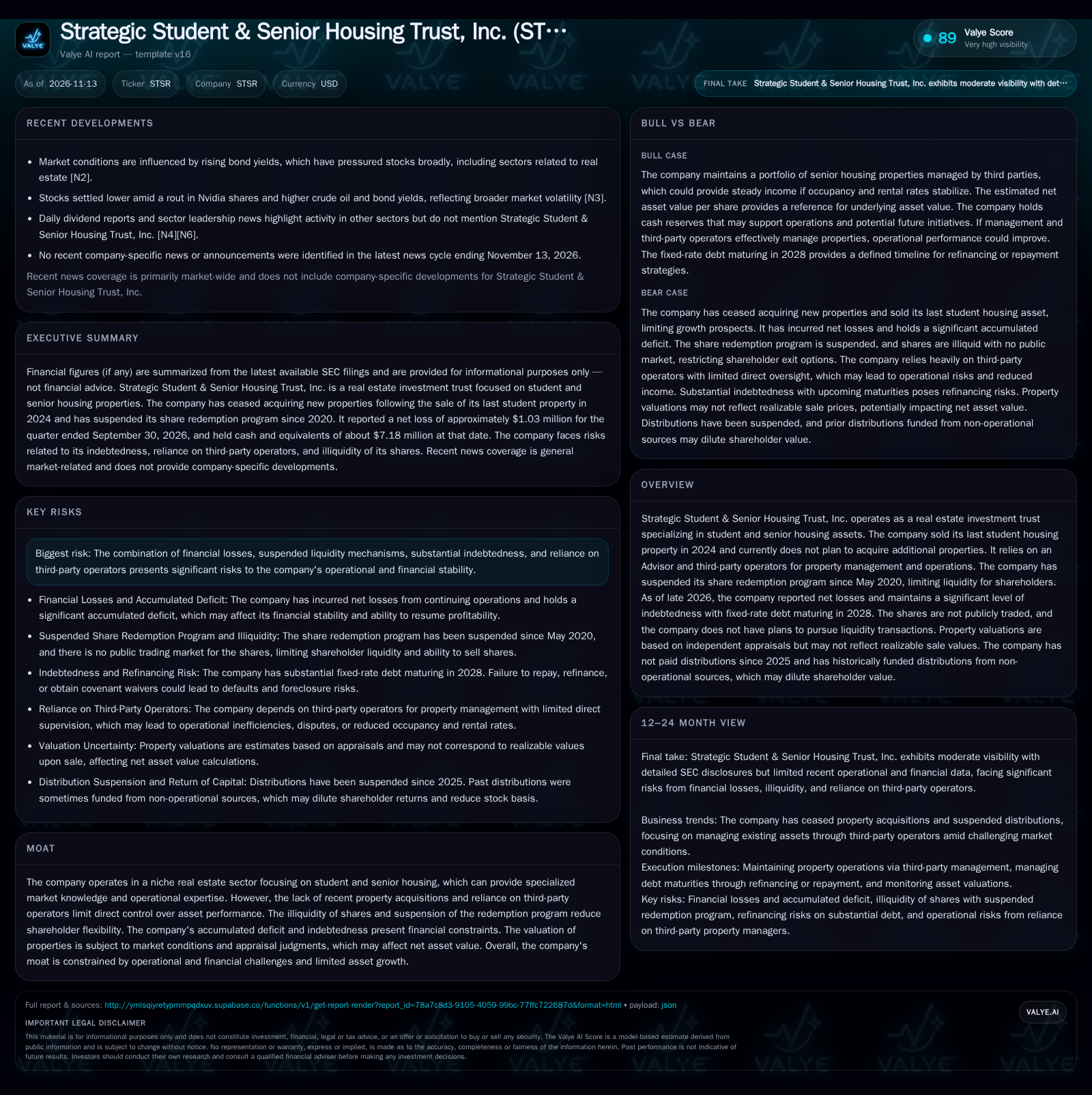
STSR has exited its student housing assets, holds significant debt, and has suspended both distributions and share redemptions. With no plans for new property acquisitions and heavy reliance on third-party managers, the company’s future hinges on managing its remaining senior housing assets and navigating debt maturities in an illiquid environment. The key variables are operational performance, asset value realization, and debt refinancing prospects. [S2]
Strategic Student & Senior Housing Trust, Inc. (STSR) once aimed to capture niche real estate demand in student and senior living, but its business has fundamentally retrenched. After selling its last student housing asset in 2024, STSR now manages only senior housing properties through third-party operators, with no stated intention to expand its portfolio. The company’s net asset value is anchored in property appraisals that may not reflect market realities, while significant debt and suspended distributions constrain shareholder value. With no public trading market and redemption programs on hold, liquidity for investors is virtually nonexistent. The coming years will test whether STSR can preserve value and service debt—or whether its structure will ultimately require a strategic reset. [S1] [S2]
A Business in Stasis: Asset Sales, Debt Overhang, and Frozen Liquidity
The most consequential recent development for STSR is the sale of its last student housing property in 2024, effectively ending diversification and growth in that segment. The company now manages only senior housing assets and, crucially, has no plans to acquire additional properties. This makes the portfolio static and exposes shareholders solely to the operational outcomes of the current assets. [S1]
Financially, STSR reported a net loss of about $1.03 million for Q3 2026, with a cumulative deficit reaching $68.1 million by the end of 2025. Distributions have been suspended since 2025, and the share redemption program has been on hold since 2020. The company reported cash and liquidity metrics for the period; these figures do not by themselves establish operating runway, investment capacity, financial flexibility, or financing capacity. [S2]
There is no public trading market for STSR shares, and the company’s charter does not require pursuing a liquidity event, leaving investors with no clear exit path. Net asset value per share, last estimated at $6.37, is based on appraisals rather than actual sale proceeds and may not be realizable. [S2]
How Value Is (or Isn’t) Created: The Economics of a Stagnant REIT
REITs typically depend on property income—primarily rent flows—offset by operating costs, debt service, and management fees. In STSR’s case, with no new acquisitions and a shrinking asset base, future economics hinge almost entirely on the performance of the remaining senior housing properties. Revenue generation is conditioned on occupancy, rental rates, and operational efficiency, all of which are managed by third-party operators. Because STSR does not directly control day-to-day operations, there is limited ability to drive margin improvement or cost discipline.
The company’s significant fixed-rate debt—$102.7 million maturing in 2028—creates a hard deadline for asset performance or capital raising. Interest expense is likely a substantial drag on operating cash flow, and with distributions suspended, there is no current income for shareholders. Historically, some distributions were funded from non-operational sources, effectively returning capital rather than generating economic profit. [S1] [S2]
Absent new investment, operating leverage is negative: fixed costs and interest must be covered by a potentially declining rental base, and there is little prospect for scale-driven margin expansion. The lack of a public market or redemption program further reduces the ability to recycle capital or respond opportunistically to market shifts.
Competitive Constraints: Niche Focus but Limited Control and Strategic Options
STSR’s specialization in student and senior housing once provided access to relatively resilient demographic demand drivers. However, the full exit from student housing removes portfolio diversification, leaving the company exposed to the fortunes of the senior housing sector alone. In this space, competition comes from both national REITs with scale and local owner-operators with deep market knowledge.
The company’s reliance on third-party operators for property management introduces additional competitive risk: operational outcomes depend on the quality and incentives of these partners, not on STSR’s own execution. Larger REITs often internalize management, capturing more margin and control, while STSR’s asset-light, outsourced model limits its ability to respond to underperformance or seize operational upside.
Moreover, with no new acquisitions and no public trading market, STSR cannot pursue accretive growth or use its shares as acquisition currency. Its illiquidity and capital constraints make it a less attractive platform for consolidation or partnership. The presence of preferred units held by a sponsor subsidiary, senior to common equity, further subordinates common shareholders in any value realization scenario. [S2]
What Could Go Right: Asset Value Realization and Debt Resolution
The most favorable scenario for STSR is that its remaining senior housing properties maintain or improve occupancy and rental rates, generating steady cash flow that covers operating costs and debt service. If property values hold up or rise, the company could potentially refinance its $102.7 million in debt on acceptable terms as it approaches the 2028 maturity. Alternatively, strong property-level performance could allow for asset sales at or above the latest appraised values, supporting a partial or full return of capital to shareholders. [S1] [S2]
For this scenario to materialize, evidence would include: stable or improving property-level metrics (occupancy, rent), successful negotiations with lenders or refinancing at reasonable rates, and actual asset sale prices that at least match the $6.37 per-share NAV. Confirmation would also come from reinstatement of distributions or some form of liquidity mechanism for shareholders. Falsification would occur if property performance deteriorates, refinancing proves unavailable, or realized sale prices fall below appraised values.
Preservation Mode: Managing Decline and Delaying Restructuring
The company may seek to extend or refinance its debt as 2028 approaches, but terms may be costly or require asset sales. Illiquidity persists, with no redemption program and no public trading market, leaving shareholders with limited options.
Evidence confirming this scenario would include continued net losses, no material change in property portfolio or acquisition strategy, and ongoing suspension of distributions. Falsifying the scenario would require a material operational turnaround, a strategic transaction (such as a portfolio sale or merger), or unexpected access to capital that enables growth or liquidity provision.
When Debt and Illiquidity Collide: Forced Asset Sales and Value Erosion
The adverse scenario is triggered if property-level performance deteriorates—due to declining occupancy, rising costs, or poor operator execution—while debt service remains fixed. If realized prices fall below appraised NAV, both common and preferred equity holders could see substantial value impairment.
Inability to refinance or extend the $102.7 million in debt due in 2028 would exacerbate these pressures, potentially leading to lender enforcement, foreclosure, or even a structured wind-down. The absence of liquidity options for shareholders would magnify frustration and could lead to legal or governance challenges. Evidence for this scenario includes accelerating net losses, operator disputes, failed refinancing attempts, and asset sales well below book or appraised values.
Concrete Signals for Testing the STSR Value Thesis
Reported occupancy rates, rental growth, and operating margins for the remaining senior housing properties—if disclosed—would provide direct insight into asset performance.
Updates on refinancing negotiations or amendments to existing debt terms, especially as the 2028 maturity approaches, will be critical for assessing solvency risk.
Realized sale prices for any disposed properties, compared to the most recent appraised NAV per share, would test the accuracy of asset valuations.
Any indication of reinstated distributions or a revised capital return policy would signal improved operational and financial health.
Announcements regarding the share redemption program—whether partial reopening, permanent suspension, or alternative liquidity mechanisms—would directly affect shareholder value realization.
Changes in third-party operator agreements (renewals, terminations, or disputes) could materially impact operational stability and cash flow.
Disclosure of major capital expenditures or property-level investment needs would inform future cash requirements and potential dilution risk.
Board or management commentary on strategic alternatives (portfolio sale, merger, or wind-down) would clarify the company’s long-term intentions.
Disclaimer: This is research-only, informational analysis and not investment advice. It may include AI-generated interpretation and general industry context. Always verify important details using primary sources.

Comments