
BV Financial’s Commercial Real Estate Focus: Valuation, Credit Exposure, and the Search for Regional Stability
BV Financial, Inc. has delivered improved earnings on the back of lower funding and operating costs, but its heavy tilt toward commercial real estate lending in Maryland exposes it to concentrated credit and economic risks. The company’s valuation—highlighted by a low EV/Sales ratio—raises questions about whether operational efficiency is enough to offset geographic and asset-class vulnerabilities.
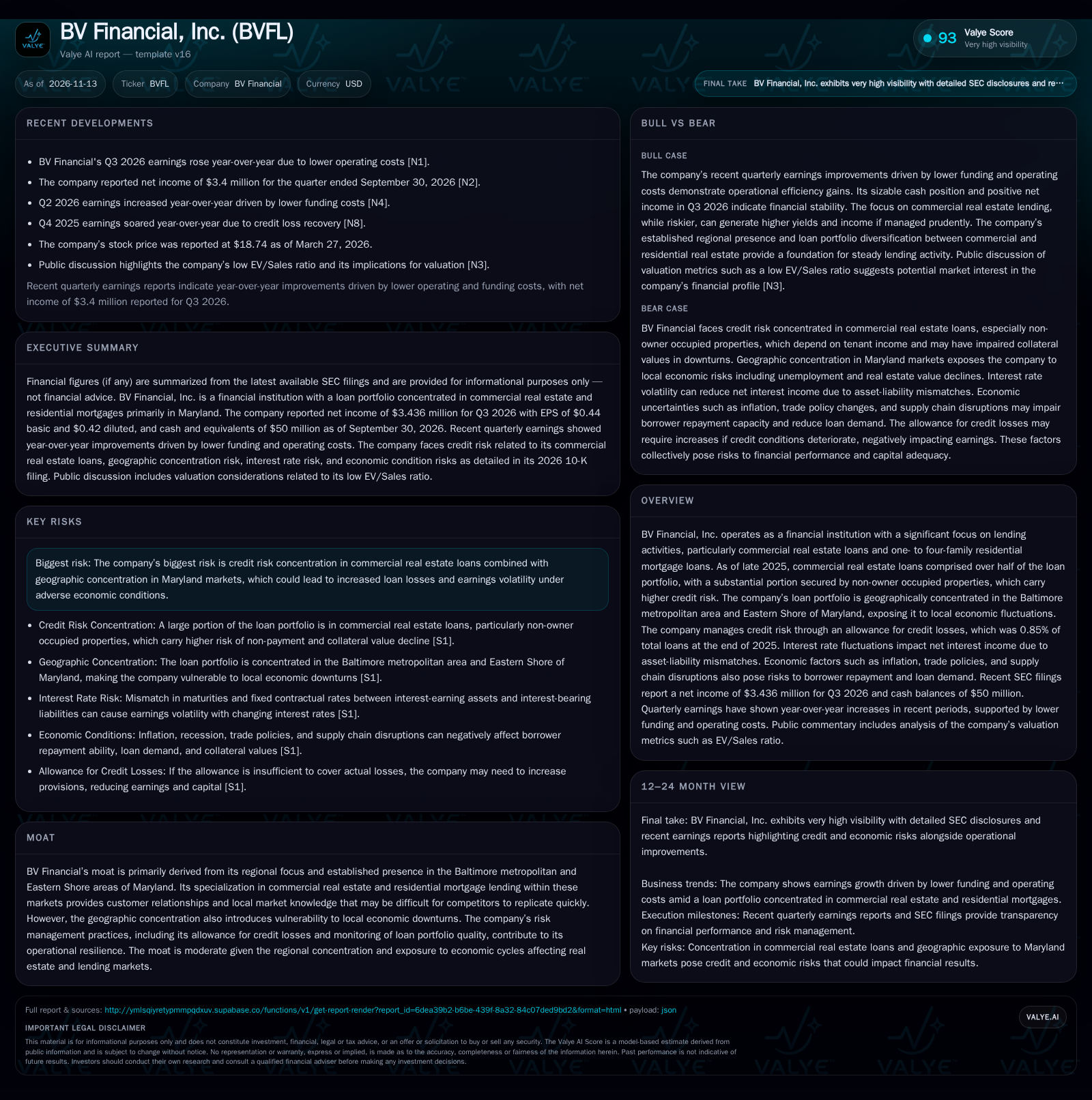
BV Financial, Inc. reported $3.4 million in Q3 2026 net income, continuing a trend of earnings improvement due in part to lower costs. The company’s loan book is dominated by commercial real estate—especially non-owner occupied properties—in the Baltimore and Eastern Shore Maryland markets, making it sensitive to local economic cycles. While credit loss reserves appear robust relative to non-performing loans, public discussion centers on whether the firm’s low EV/Sales ratio signals undervaluation or latent risk. The sustainability of cost efficiencies and credit quality will be pivotal for future performance. [S1] [S2] [N2] [N3]
BV Financial, Inc. occupies a distinctive niche as a regional lender with a portfolio heavily weighted toward commercial real estate and residential mortgages in Maryland. While recent quarters have shown positive net income trends—driven by decreased funding and operating expenses—the company’s asset mix and geographic concentration pose acute credit and economic risks. The combination of a sizable cash position, robust allowance coverage, and below-peer valuation metrics has sparked debate over whether BV Financial is a value opportunity or a play on regional real estate stability. The sustainability of these apparent strengths will depend on the company’s ability to manage credit risk and navigate local economic cycles.
Current Financial Snapshot and Portfolio Composition: What’s Changed
As of September 30, 2026, BV Financial reported net income of $3.4 million for the quarter, with basic EPS of $0.44 and diluted EPS of $0.42. The company’s cash and cash equivalents stood at $50 million at quarter-end [S2] [N2]. Over half of the loan portfolio remains concentrated in commercial real estate, totaling $401.4 million as of December 31, 2025, with non-owner occupied commercial loans making up $321.7 million, or 42.6% of total loans [S1]. Residential real estate loans accounted for another $258.5 million, or 34.2% [S1]. The allowance for credit losses was 0.85% of loans and covered non-performing loans at nearly 285% [S1]. The company reported cash and liquidity metrics for the period; these figures do not by themselves establish operating runway, investment capacity, financial flexibility, or financing capacity. Recent earnings gains have been attributed to lower funding and operating costs, but the core risk profile remains defined by its commercial real estate exposure and regional concentration [N1] [N2].
How BV Financial Generates Returns: Lending Margins, Cost Discipline, and Risk Absorption
BV Financial’s primary revenue driver is net interest income, derived from the spread between interest-earning assets—primarily commercial and residential real estate loans—and interest-bearing liabilities like deposits and borrowings. The company’s recent earnings improvement has been attributed to lower funding and operating costs, suggesting that management has found efficiency gains or benefited from benign funding markets [N1] [N4]. However, lending margins are highly sensitive to both the competitive rate environment and the credit profile of the loan book.
Commercial real estate loans, especially non-owner occupied properties, typically offer higher yields but carry greater credit risk and loss severity in downturns. These loans often have larger principal balances and are more sensitive to tenant cash flows and collateral value fluctuations. Residential mortgages provide somewhat lower yields but more stable credit performance. BV Financial’s allowance for credit losses at 0.85% of loans and nearly 285% of non-performing loans suggests a conservative reserve posture, though this coverage could be tested in a regional downturn [S1].
Operating leverage is a potential tailwind if loan growth or yield expansion can be achieved without commensurate cost increases. On the other hand, the need to increase provisions for loan losses or absorb non-performing assets could quickly erode profitability. [S2]
Regional Specialization: Competitive Advantages and Structural Exposures
BV Financial’s moat is rooted in its entrenched relationships and market knowledge within the Baltimore metropolitan area and Maryland’s Eastern Shore. This local expertise and customer familiarity can create switching frictions for borrowers, particularly in commercial real estate lending, where underwriting often depends on nuanced understanding of local property values and tenant dynamics.
However, the same geographic and asset-class concentration that supports customer intimacy also exposes the company to outsized risks. In the event of a local economic downturn—such as declines in commercial occupancy rates or residential property values—BV Financial’s loan performance would likely deteriorate faster than a more geographically diversified peer. Larger regional and national banks, as well as non-bank lenders, can compete aggressively on price or underwriting terms, potentially eroding BV Financial’s pricing power. Moreover, technology-driven lenders and fintechs could gradually chip away at the frictional advantages of community banking by offering more streamlined digital origination and servicing.
The company’s moderate moat is thus a double-edged sword: it provides some insulation from new entrants and supports relationship banking, but it magnifies vulnerability to local shocks and to secular shifts in borrower preferences.
Operational Improvements and Local Market Stability Unlock Higher Returns
The most favorable scenario for BV Financial combines continued cost discipline, stable or improving credit performance, and benign economic conditions in its core Maryland markets. If commercial real estate fundamentals in Baltimore and the Eastern Shore remain robust—supporting low default rates and steady collateral values—the company could realize higher yields from its riskier loan book without incurring outsized losses. Cost efficiencies, if sustainable, would further magnify operating leverage and support above-peer returns.
Confirmation of this scenario would require evidence of persistently low non-performing loan ratios, stable or growing net interest margins, and further earnings growth without significant increases in provision expenses. Additional signals would include positive trends in local employment, commercial occupancy, and property values, as well as continued commentary on the sustainability of funding and operating cost reductions. A re-rating of the company’s valuation multiples—such as a narrowing of the EV/Sales discount relative to peers—could also signal that the market is recognizing improved fundamentals [N3].
Falsification would occur if credit quality deteriorates, if cost efficiencies prove fleeting, or if local economic headwinds drive higher loan losses and compress margins.
Earnings Resilience is Tested by Cyclical and Structural Pressures
The most plausible trajectory is that BV Financial continues to post modest profitability, supported by its current cost base and regional lending franchise. Net interest income may remain stable if the company can defend its loan yields and manage funding costs, but the risk/return profile is unlikely to shift meaningfully without a change in local market conditions or a strategic move to diversify the loan book.
Incremental increases in non-performing loans or the need to boost credit loss provisions could pressure earnings, but the current allowance coverage ratio suggests some buffer against moderate deterioration [S1]. The company’s ongoing dependence on local economic health means that even in the absence of a major downturn, any softening in commercial or residential real estate could gradually erode asset quality metrics.
Evidence supporting this scenario would include stable but unremarkable quarterly earnings, limited volatility in credit metrics, and continued discussion of the company as a value stock—without a material change in market sentiment or valuation [N3]. Falsification would require either a marked improvement in growth and credit quality (tilting toward the upside case) or a significant spike in delinquencies or losses (tilting toward the downside).
Local Real Estate Stress or Economic Shock Triggers Credit Losses and Margin Compression
A negative scenario would be catalyzed by a local recession, sharp declines in commercial property occupancy, or a correction in residential home values within BV Financial’s geographic footprint. Given that 42.6% of the loan portfolio is in non-owner occupied commercial real estate, a wave of tenant defaults or property value write-downs would likely result in higher non-performing loans and force the company to increase its provision for credit losses, directly impacting earnings and potentially eroding capital [S1].
Interest rate volatility could further compress net interest margins if the company is unable to reprice loans quickly enough to offset higher funding costs, or if competitive pressures force rate concessions to retain borrowers.
Confirmation of this downside path would include a rising trend in non-performing assets, sequential increases in provision expenses, deteriorating local economic indicators, and negative earnings surprises. Falsification would require evidence that the company is able to maintain or improve asset quality and earnings despite external shocks.
What Could Shift the BV Financial Thesis in the Next 12 Months?
Quarterly changes in non-performing loan ratios and charge-off rates—if disclosed—would help test the durability of credit quality.
Sustained net interest margin trends, especially in the face of interest rate volatility, are critical for future profitability.
Updates on the geographic diversification of the loan portfolio, or any shift in lending strategy, would signal management’s risk appetite and adaptability.
Evidence of continued cost containment or further reductions in operating/funding expenses would support the operational efficiency narrative.
Monitoring local economic indicators such as commercial vacancy rates, unemployment, and property price trends in the Baltimore and Eastern Shore regions is essential given the company’s concentration.
Any material change in the allowance for credit losses as a percentage of total loans or as a multiple of non-performing loans would indicate shifting risk perceptions.
Market commentary or analyst coverage on the company’s valuation multiples—especially the EV/Sales ratio—could serve as a leading indicator of sentiment shifts.
Disclaimer: This is research-only, informational analysis and not investment advice. It may include AI-generated interpretation and general industry context. Always verify important details using primary sources.

Comments