
Blue Biofuels: Can Cellulosic Innovation Overcome Liquidity and Commercialization Hurdles?
Blue Biofuels has developed and piloted a patented technology to convert cellulosic feedstocks into biofuels with higher yield and lower cost than corn ethanol.
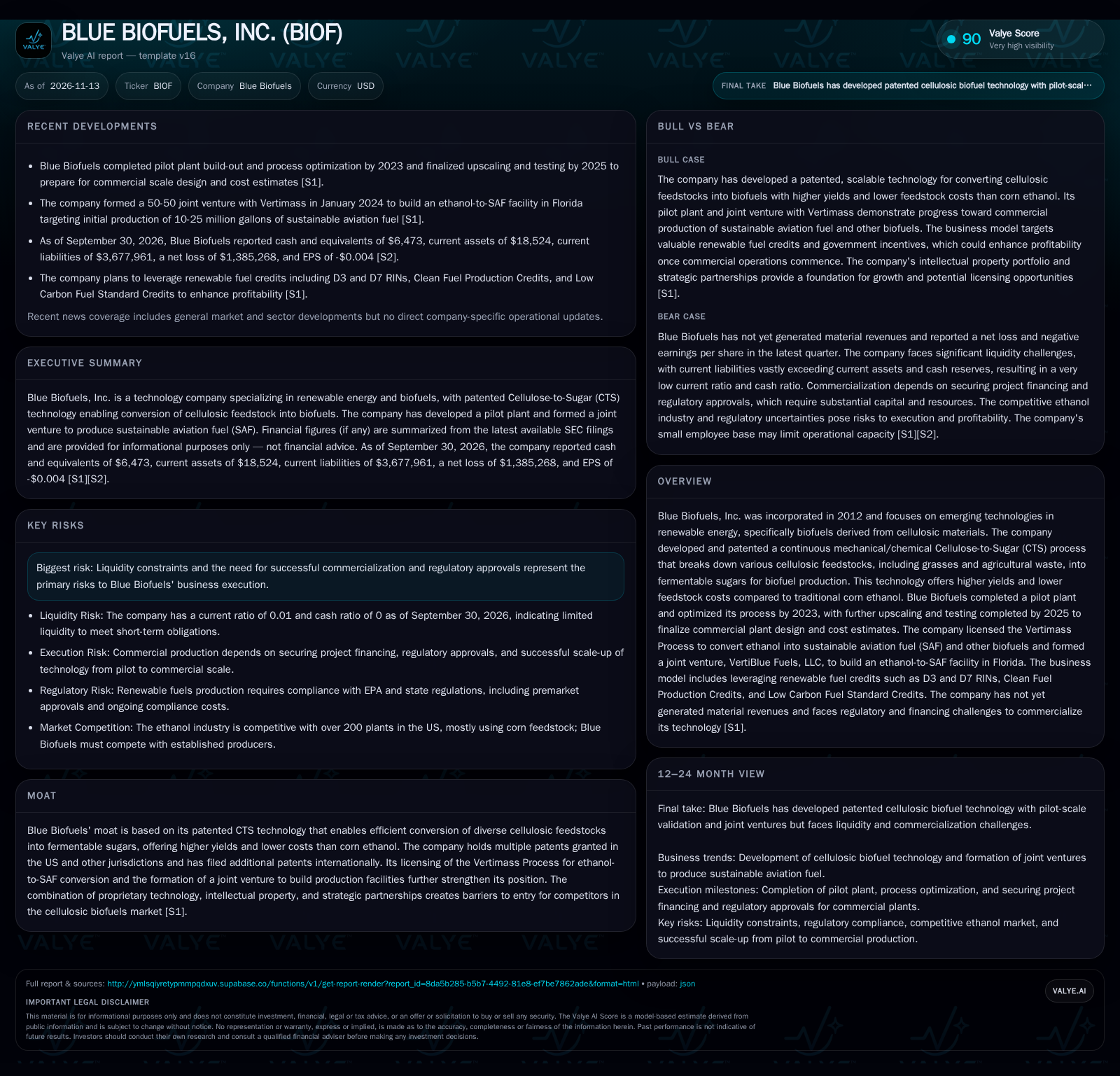
Blue Biofuels has developed and piloted a patented technology to convert cellulosic feedstocks into biofuels with higher yield and lower cost than corn ethanol. Commercial success will depend on raising capital, navigating regulatory hurdles, and demonstrating reliable large-scale economics. [S1] [S2]
Blue Biofuels, Inc. is at a critical juncture: it has taken patented cellulosic conversion technology from pilot plant to the threshold of commercial design, and has formed a joint venture to pursue sustainable aviation fuel at industrial scale. Yet, despite technical progress and a clear regulatory incentives framework, the company remains pre-revenue and faces severe liquidity pressures, with its cash reserves dwarfed by current liabilities. The coming quarters will test whether Blue Biofuels can secure the capital, regulatory clearances, and operational scale needed to convert technical promise into a viable, competitive business. [S1] [S2]
Pilot Validation Complete, Joint Venture Launched—But Liquidity Crisis Looms
Blue Biofuels has established several critical milestones: its patented Cellulose-to-Sugar (CTS) process completed pilot plant build-out and optimization by 2023, with commercial upscaling and cost estimation completed by 2025. This technical progress is paired with a strategic partnership—Blue Biofuels and Vertimass formed VertiBlue Fuels, LLC in January 2024, aiming to build a Florida facility producing 10-25 million gallons of sustainable aviation fuel (SAF) using a licensed, patented ethanol-to-SAF process. These advances position Blue Biofuels to participate in high-value renewable fuel credit markets if commercialization is achieved. The company reported cash and liquidity metrics for the period; these figures do not by themselves establish operating runway, investment capacity, financial flexibility, or financing capacity. The company remains pre-revenue and posted a net loss of $1.39 million for the quarter. [S1] [S2]
Unlocking Value: Cost Structure, Incentives, and the Economics of Cellulosic Biofuels
Blue Biofuels’ business model is predicated on producing cellulosic biofuels with higher yields and lower feedstock costs than traditional corn ethanol. The core economic thesis is twofold: first, the CTS process can use low-cost, non-food biomass (such as grasses and agricultural waste) as input, reducing raw material expense and avoiding food-versus-fuel tradeoffs. Second, the company targets regulatory incentives—specifically D3 and D7 Renewable Identification Numbers (RINs), Clean Fuel Production Credits, and Low Carbon Fuel Standard (LCFS) credits—which can materially enhance realized margins for qualifying low-carbon fuels. If commercial throughput and yields match pilot results, Blue Biofuels could achieve favorable unit economics relative to corn-based peers, especially in SAF, where premiums and credits are substantial.
However, the economics are not yet proven at scale. Capital intensity is high: building and commissioning a commercial plant requires significant upfront investment, and ongoing operating costs will include feedstock sourcing, labor, maintenance, and regulatory compliance. Fixed costs will dominate until sufficient volume is reached for operating leverage to improve margins. The company plans to pursue project-based financing, but acute current liquidity constraints and a lack of revenue history may raise the cost of capital or make funding contingent on external validation or offtake agreements. Without scale and reliable credit capture, breakeven could be elusive.
Patented Process and Partnerships: Where Blue Biofuels Could Stand Out
Blue Biofuels’ primary competitive lever is its proprietary CTS technology, which is designed to efficiently convert a wide array of cellulosic feedstocks into fermentable sugars. In theory, this enables higher yields and greater feedstock flexibility than conventional corn ethanol processes, potentially translating to lower input costs and reduced supply risk. The company has also secured a license to the Vertimass Process for ethanol-to-SAF conversion, and the VertiBlue joint venture provides a plausible pathway to early commercial deployment.
However, the US biofuels market is highly competitive, with over 200 established plants—mostly corn-based—enjoying entrenched supply chains, customer relationships, and regulatory experience. Other cellulosic and advanced biofuel startups have often struggled with scale-up, capital access, and offtake risk. Blue Biofuels’ moat depends on successful demonstration of technical reliability, cost advantage, and regulatory compliance at commercial volumes. The company’s small workforce may be a constraint relative to larger, better-capitalized peers, and competitive pressure from both traditional ethanol and emerging alternative fuels (such as renewable diesel and electrofuels) remains formidable.
From Pilot to Profits: How Commercial Scale Success Could Transform Blue Biofuels’ Trajectory
The most favorable scenario is that Blue Biofuels secures project-based financing, completes construction of its first commercial-scale plant, and achieves reliable, high-yield cellulosic biofuel production. If the CTS process delivers lower feedstock costs and higher yields than corn ethanol at scale, the company could capture valuable D3/D7 RINs and other low-carbon credits, driving attractive gross margins. The VertiBlue joint venture could prove out the ethanol-to-SAF pathway, opening access to premium aviation fuel markets and potentially attracting offtake agreements or strategic partners.
Evidence that would support this scenario includes: successful financial close and ground-breaking on the Florida SAF facility; published commercial throughput/yield data that matches or exceeds pilot metrics; first revenues from fuel sales and regulatory credits; and demonstration of regulatory compliance. Further confirmation would come from new financing at non-punitive terms, expanded staffing, and interest from offtakers or additional joint ventures.
Navigating Funding Gaps and Regulatory Hurdles on the Road to Commercialization
The most plausible path is a drawn-out transition from pilot to commercial operations, characterized by incremental progress but continued financial strain. Blue Biofuels may secure bridge or project financing, but likely at high cost or with significant dilution, given its current balance sheet and lack of revenue. Delays in permitting, construction, or regulatory compliance are probable, as are technology de-risking hurdles that could require further optimization.
In this scenario, the company could announce project milestones, but revenue generation remains modest or lumpy, dependent on the timing and success of regulatory approvals and plant commissioning. Financial pressure persists, and the company’s ability to maintain operations without significant new capital is limited. Confirmation would include continued net losses, limited revenue, and persistent negative working capital, while falsification would require evidence of stable operating cash flow, successful scaling, or rapid progress on regulatory and commercial fronts.
Liquidity Crunch and Execution Stalls: The Threat of Value Erosion
The adverse scenario is that Blue Biofuels is unable to secure sufficient capital or regulatory approvals to advance beyond the pilot stage. If project financing falls through, commercial plant construction could stall indefinitely.
Further downside risk includes technical setbacks during scale-up, cost overruns, or regulatory non-compliance that block market entry or access to credits. In this scenario, the company’s IP and partnerships may have residual value, but equity holders could be severely diluted or wiped out in a restructuring or asset sale. Confirmation would come from missed payroll, default notices, going concern warnings, or the absence of progress on financing, permitting, or plant construction.
Signals That Will Define Whether Blue Biofuels Can Bridge the Gap to Commercialization
Securing project-based financing or non-dilutive capital for the first commercial-scale plant will be the earliest and most critical milestone.
Evidence of regulatory approvals (EPA, state-level, and permitting for the Florida SAF facility) would be a strong indicator of forward momentum.
First commercial production runs and published throughput/yield data—if disclosed—would validate technical and economic claims.
Material revenue generation and receipt of renewable fuel credits (D3/D7 RINs, LCFS, Clean Fuel Production Credits) would test the business model’s ability to capture regulatory incentives.
Expansion of the workforce and operational footprint (hiring, plant commissioning) would suggest operational scaling.
Disclosure of offtake agreements, long-term supply contracts, or further strategic partnerships would demonstrate market acceptance and revenue visibility.
Any setbacks in permitting, construction, or regulatory compliance should be closely monitored, as they could delay or derail commercialization.
Disclaimer: This is research-only, informational analysis and not investment advice. It may include AI-generated interpretation and general industry context. Always verify important details using primary sources.

Comments