
DeltaSoft Corp: AI-Driven Project Management Faces the Realities of Platform Economics and Early-Stage Constraints
DeltaSoft Corp is attempting to carve out a niche in the crowded project management and freelancer marketplace through an AI-assisted platform and margin-based revenue model. Despite reporting $11.3 million in Q2 revenue, the company remains loss-making and reliant on continued marketing and product development to gain traction, all while contending with reported liquidity position and formidable incumbent competition. The next phase will test whether DeltaSoft’s differentiated approach can translate into sustainable user adoption and financial viability in a rapidly evolving digital work ecosystem.
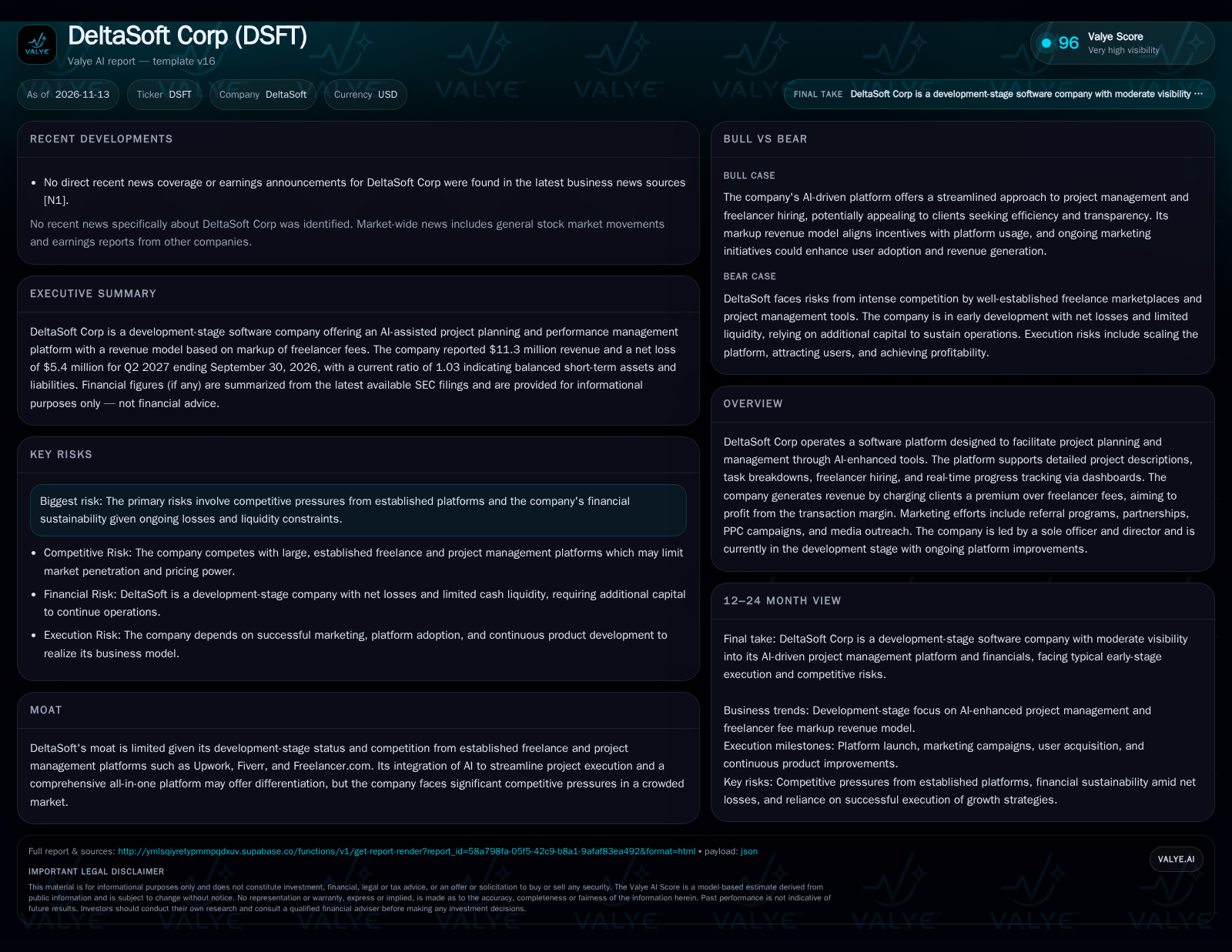
DeltaSoft Corp operates a development-stage AI-powered project management and freelancer platform, generating revenue from markups on freelancer fees. The company reported $11.3 million in Q2 2027 revenue but continues to post net losses and has a current ratio near parity, indicating tight liquidity. With only a sole officer and director, DeltaSoft is pushing marketing and software development to drive platform adoption against established competitors. Its ability to scale, attract users, and move toward profitability remains unproven.
DeltaSoft Corp is positioning its all-in-one, AI-driven project management platform as a streamlined solution for clients needing both organizational tools and access to freelance talent. The company’s revenue model is based on a markup over freelancer fees, a structure that depends heavily on transaction volume, platform trust, and the ability to attract both sides of the marketplace. Despite generating $11.3 million in quarterly revenue, DeltaSoft remains in the early stages of development with ongoing net losses, minimal liquidity headroom, and a single part-time executive. The next twelve months will be critical in determining whether its differentiated approach can break through against entrenched incumbents and deliver a path to sustainable growth.
DeltaSoft’s Current State: Revenue Emergence Amid Operating and Liquidity Pressures
As of September 30, 2026, DeltaSoft Corp reported $11.3 million in revenue for the quarter but a net loss of $5.4 million, continuing a pattern of losses typical of development-stage technology companies [S2]. The company’s total assets stood at $54.2 million, with $11.3 million in cash and a current ratio of 1.03. The company reported cash and liquidity metrics for the period; these figures do not by themselves establish operating runway, investment capacity, financial flexibility, or financing capacity. [S2] DeltaSoft is led solely by Andrey Novokhatski, who dedicates about twenty hours per week and has no other employees, underscoring both the lean structure and the magnitude of scaling and execution risks [S1] [S2]. The platform is actively marketed and improved, but the company’s financials and organizational structure highlight the challenges of moving from product development to sustainable operation in a competitive and capital-intensive digital marketplace.
How DeltaSoft’s Margin-Driven Model Could Scale—And Where Friction May Arise
DeltaSoft’s business model relies on capturing a markup between what clients pay and what freelancers receive—a mechanism that is fundamentally dependent on transaction volume, user trust, and the ability to consistently match supply (freelancers) with demand (client projects) [S1] [S2]. This model can be attractive if the platform achieves scale, as each incremental transaction generates additional margin with limited marginal cost, potentially yielding high operating leverage. However, the economics are sensitive to both pricing power and platform adoption: competitive fee pressure from larger platforms could squeeze margins, while the need to subsidize early adoption or offer incentives may further compress profitability.
Fixed costs are currently low, given the absence of employees beyond the founder, but ongoing investment in software development, marketing, and customer acquisition is essential. The $20 million in prepaid expenses and $22.9 million in intangibles suggest capital is being deployed into future marketing and product capabilities [S2].
Ultimately, the path to attractive economics hinges on DeltaSoft’s ability to drive repeat usage, reduce churn, and extract higher transaction margins without triggering user defection to larger, more established alternatives.
Facing the Giants: DeltaSoft’s Differentiation Challenge in a Crowded Marketplace
DeltaSoft directly competes with entrenched freelance marketplaces and project management tool providers—a category that includes global platforms as well as specialized SaaS vendors [S1] [S2]. Incumbents offer extensive freelancer pools, robust client-side tools, and established reputations, creating high switching frictions for both freelancers and clients. For DeltaSoft, the integration of AI-assisted planning and a unified platform experience is positioned as a differentiator, but the challenge lies in convincing users that these enhancements outweigh the network effects and trust advantages of larger rivals.
Pricing is another battleground: larger platforms can afford to compress margins or offer promotional pricing to retain users, potentially pressuring DeltaSoft’s ability to maintain its markups. Additionally, the absence of a sizable user base may limit the platform’s attractiveness to high-quality freelancers, further dampening liquidity and engagement. While AI-driven features and an all-in-one UI may appeal to certain segments, these alone may not be sufficient to overcome the inertia and embeddedness of incumbent solutions without substantial marketing investment and demonstrable performance advantages.
What Success Would Look Like: Network Effects, AI Differentiation, and Margin Expansion
A favorable outcome for DeltaSoft would require the platform to achieve critical mass among both clients and freelancers, creating self-reinforcing network effects and enabling the company to command meaningful transaction margins. If the AI-assisted planning and performance management capabilities demonstrably improve project outcomes or freelancer matching, DeltaSoft could carve out a defensible niche among users seeking efficiency and transparency.
Confirmation of this scenario would be visible in accelerating user growth, high engagement metrics (repeat project launches, active freelancer participation), and rising gross margins as platform adoption increases. Partnerships or enterprise adoption deals could also validate the platform’s differentiation. Conversely, if user growth remains stagnant or margins erode due to competitive pricing, this upside scenario would be challenged.
Most Probable Course: Incremental Adoption and Persistent Financial Strain
The most plausible trajectory for DeltaSoft over the next 12-24 months involves slow but steady increases in platform usage, driven by ongoing marketing and incremental product improvements. In this scenario, revenue continues to grow but net losses persist as marketing and development expenses remain high relative to the scale of the platform.
Support for this scenario would come from modest but consistent quarter-over-quarter revenue growth, stable or slightly improving net loss figures, and evidence of user acquisition and engagement. However, if costs outpace revenue growth or if user churn remains elevated, the company may be forced to reconsider its marketing approach or seek strategic alternatives.
When Competitive Pressure and Liquidity Constraints Collide
The negative case for DeltaSoft is that aggressive competition from established platforms stifles user adoption, compresses margins, and renders the company unable to scale to profitability. If marketing spend fails to generate sustainable engagement or if the value proposition of AI-assisted planning proves insufficient to drive switching, DeltaSoft could face a downward spiral of rising losses and mounting liquidity pressure.
This scenario would be confirmed by stagnating or declining revenue, deteriorating gross margins, increasing net losses, or the need for frequent related-party financings to cover operating shortfalls. Any evidence of user or freelancer churn, inability to attract repeat business, or negative feedback on platform usability would further reinforce the downside risk.
Milestones to Gauge DeltaSoft’s Platform Traction and Economic Resilience
Quarterly trends in active users and project volume—if disclosed—would provide direct evidence of platform adoption and engagement.
Gross profit margin evolution as a proxy for pricing power and competitive pressure.
Churn rates among both clients and freelancers—if disclosed—would test the stickiness of the platform’s value proposition.
Conversion rates from marketing campaigns to active platform users.
Any large partnership announcements or enterprise adoption deals that could accelerate network effects.
Product development milestones, particularly around AI enhancements or new feature launches, that could improve user experience and retention.
Quarterly updates on liabilities, especially director loans, to assess financial sustainability and independence.
Disclaimer: This is research-only, informational analysis and not investment advice. It may include AI-generated interpretation and general industry context. Always verify important details using primary sources.

Comments