
YUNHONG GREEN CTI LTD.: Financial Structure, Dilution Risk, and the Search for Sustainable Profitability
YUNHONG GREEN CTI LTD. Absent detailed business model disclosure, the company's path to profitability and resilience depends on operational discipline and capital structure management.
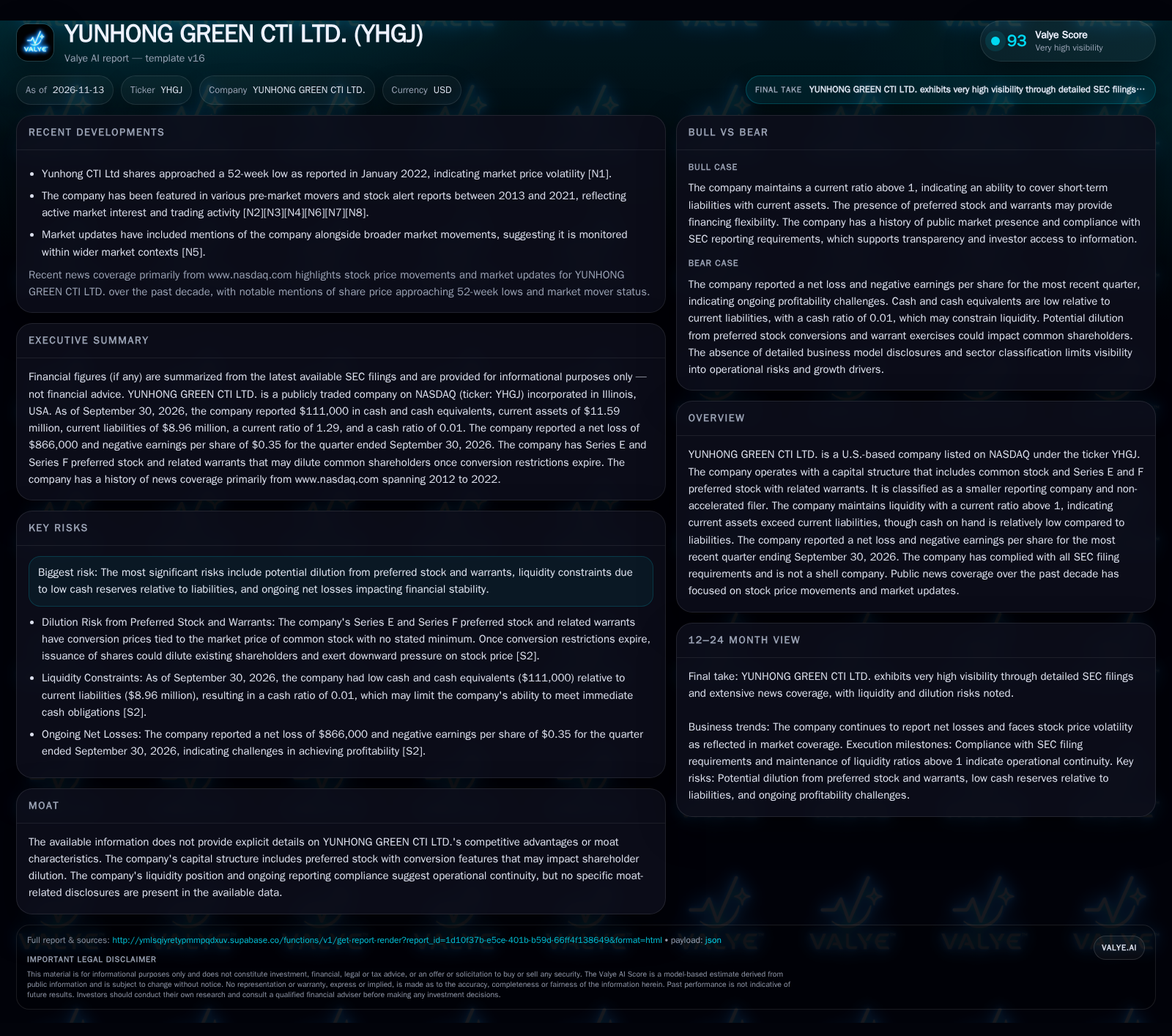
YUNHONG GREEN CTI LTD. (NASDAQ: YHGJ) maintains its public listing and regulatory compliance but reported a net loss of $866,000 for the quarter ended September 30, 2026. With just $111,000 in cash and a cash ratio of 0.01, the company’s liquidity is constrained. Series E and F preferred stock and related warrants carry near-term dilution risk, with conversion prices tied to market price and no stated minimum. The absence of sector or business model disclosure leaves future profitability and competitive positioning unclear. Investors should focus on dilution events, cash runway, and any evidence of business model improvement or strategic shift. [S2]
YUNHONG GREEN CTI LTD. Absent specific disclosure about its business model or industry focus, the company’s near-term outlook is dominated by the mechanics of its capital structure and ongoing net losses. For investors, the central questions are whether YUNHONG GREEN CTI LTD. can stabilize its operations, manage dilution, and eventually articulate a path to profitability.
Capital Structure and Liquidity Pressures Define the Present
As of September 30, 2026, YUNHONG GREEN CTI LTD. reported $111,000 in cash and cash equivalents—a figure dwarfed by $8.96 million in current liabilities—resulting in a cash ratio of 0.01 and a current ratio of 1.29 [S2]. This means that while the company’s current assets technically exceed its current liabilities, its immediately available cash is extremely limited relative to obligations coming due. The company posted a net loss of $866,000 and reported negative earnings per share of $0.35 for the quarter, continuing a trend of unprofitability [S2]. Additionally, Series E and Series F preferred stock and related warrants could convert into common shares at market prices, with no floor, and conversion restrictions expiring 61 days after certain conditions. This introduces the risk of substantial dilution for existing shareholders once those restrictions lift [S2].
Unclear Revenue Streams and the Mechanics of Survival
The company’s filings do not disclose its current revenue streams, sector, or principal business activities. This lack of transparency means that outside observers cannot directly assess the durability or scalability of its underlying economics. However, as a smaller reporting company and non-accelerated filer, it is plausible that YUNHONG GREEN CTI LTD. operates with a lean cost structure and limited fixed overhead. The presence of preferred stock and warrants suggests a history of raising capital through equity-linked securities, a common approach among small caps seeking to avoid onerous debt covenants or high cash interest outlays.
If the company’s historical business included manufacturing or distribution—such as the 2021 news reference to novelty balloons [N4]—it would likely face low gross margins, high working capital needs, and price competition. In such a scenario, operating leverage would be limited, and the company’s ability to achieve profitability would depend on scale, cost discipline, and possibly product innovation. Alternatively, if the company has transitioned toward a service or technology platform model, it could theoretically benefit from higher gross margins and more flexible cost structures, but no such pivot is disclosed in current filings. The ongoing net losses and low cash suggest that, whatever the business model, revenue is insufficient to cover operating costs and that the company is reliant on external financing for survival.
Competitive Position Obscured by Limited Disclosure and Dilution Risk
Without explicit disclosure of YUNHONG GREEN CTI LTD.’s sector, customer base, or competitive landscape, it is not possible to identify direct peers or assess the company’s relative advantages. The overhang of convertible preferred stock and warrants, with conversion prices set at the market rate and no minimum, is a material vulnerability: if exercised, these instruments can dramatically increase the float, dilute existing shareholders, and pressure the stock price, making capital raising even more challenging. This structure is often viewed unfavorably by sophisticated investors and can signal distress or limited access to conventional financing.
If the company operates in a commoditized segment—such as low-value manufacturing or distribution—it is likely to face intense pricing pressure and limited customer stickiness. If it is in a niche or specialty market, the absence of recurring revenue or high-margin products would still make it vulnerable to shocks. The company’s ongoing compliance with SEC filings and public market presence do provide a degree of transparency that some microcaps lack, but absent evidence of a differentiated product, service, or brand, the competitive position appears weak and highly sensitive to capital market sentiment.
Pathways to Recovery: Strategic Shift, Capital Infusion, or Business Model Clarity
A favorable turn for YUNHONG GREEN CTI LTD. would likely require one or more of the following: a meaningful capital infusion to stabilize liquidity, a strategic shift toward a higher-margin or recurring-revenue business model, or the emergence of a differentiated product or market niche. For example, if the company were to secure a significant equity investment or non-dilutive financing, it could shore up short-term liquidity and buy time to execute an operational turnaround. Alternatively, clear disclosure of a scalable, defensible business—such as a proprietary product with strong customer demand—could re-rate investor perceptions.
Evidence that would confirm this scenario includes the announcement of new capital raises on favorable terms, a reduction in net losses or return to profitability, or the articulation of a sector-specific growth strategy. Additional transparency regarding customer concentration, product innovation, or recurring revenue would also support the upside case. Conversely, the absence of such disclosures or continued reliance on dilutive financing would falsify this scenario.
Continued Strain: Modest Operations, Dilution, and Uncertain Direction
The most plausible near-term outcome is that YUNHONG GREEN CTI LTD. continues to operate with minimal cash, ongoing net losses, and periodic reliance on dilutive equity instruments to meet obligations. The expiration of conversion restrictions on Series E and F preferred stock and warrants will likely result in increased share issuance, diluting existing holders and potentially depressing the stock price further. Absent a clear business model or growth catalyst, the company may remain in a cycle of operational stasis, with management focused on regulatory compliance and liquidity management rather than strategic expansion.
Confirmation of this scenario would come in the form of continued net losses, low or declining cash balances, and additional filings related to share issuance or preferred stock conversions. Falsification would require a clear and sustained improvement in profitability, cash flow, or a well-articulated shift in business strategy supported by tangible results.
Dilution Cascade and Liquidity Erosion Trigger a Downward Spiral
The adverse scenario is defined by an accelerating dilution event as preferred stock and warrants convert following the expiration of restrictions. This could flood the market with new shares, severely depress the stock price, and erode the company’s ability to raise additional equity capital. With only $111,000 in cash against nearly $9 million in current liabilities, any disruption—such as a missed payment, vendor dispute, or unexpected expense—could rapidly tip the company toward insolvency or force asset sales at unfavorable terms.
Evidence confirming this scenario would include a sharp increase in shares outstanding, a sustained drop in share price, disclosure of liquidity shortfalls or going-concern warnings, and possible creditor actions. If the company manages to avoid these outcomes by stabilizing cash flow or attracting new investment, the downside scenario would be challenged.
Milestones That Could Shift YUNHONG GREEN CTI LTD.'s Trajectory
The timing and volume of Series E and F preferred stock and warrant conversions; a spike in shares outstanding would confirm dilution risk.
Quarterly cash flow from operations, if disclosed, to assess whether the business is moving toward self-sufficiency.
Any announced or filed capital raises, credit agreements, or asset sales that could materially impact liquidity.
Disclosure of customer concentration, product mix, or business segment performance, which would clarify the company's operating model.
Gross margin trends, if available, to gauge pricing power and cost control.
Sec filings or press releases describing a shift in strategic direction, partnerships, or acquisitions.
Auditor statements regarding going-concern status or liquidity risk.
Management guidance on profitability targets, operational milestones, or capital allocation priorities.
Disclaimer: This is research-only, informational analysis and not investment advice. It may include AI-generated interpretation and general industry context. Always verify important details using primary sources.

Comments