
Community Bancorp /VT: Deposit-Driven Loan Growth, Credit Risk Sensitivity, and Regional Banking Economics
Community Bancorp /VT has delivered steady loan-driven earnings growth, supported by a robust deposit base and prudent capital management. However, its fortunes remain tightly linked to local Vermont economic trends, interest rate dynamics, and the evolving risk profile of its loan book.
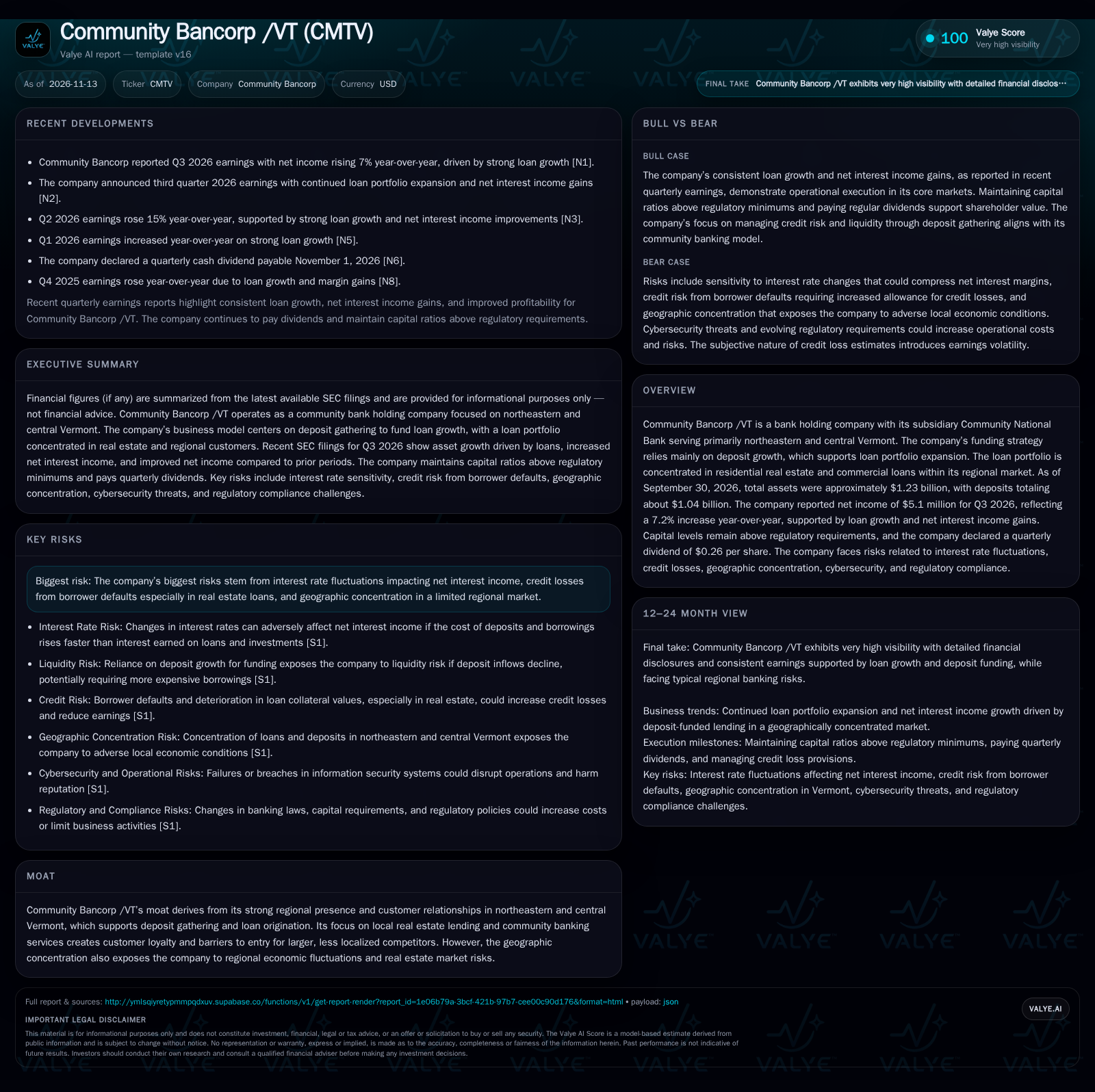
Community Bancorp /VT continues to grow earnings through deposit-funded loan expansion in northeastern and central Vermont. Net income rose 7.2% in Q3 2026, with capital ratios above regulatory minimums and regular dividends declared. Yet, rising credit loss provisions and regional concentration highlight ongoing risks tied to local economic cycles and interest rate shifts. Watch for loan quality, deposit stability, and net interest margin trends as signals of future performance. [S2]
Community Bancorp /VT, a regional banking operator focused on northeastern and central Vermont, has posted another quarter of earnings growth propelled by its traditional deposit-funded lending model. While the bank’s balance sheet and capital levels appear healthy, the sharp uptick in credit loss provisions and the concentration of risk in a specific geography underscore the double-edged nature of its community banking niche.
Recent Performance: Loan Growth, Earnings, and Credit Risk Trends
As of September 30, 2026, Community Bancorp /VT reported total assets of approximately $1.23 billion and deposits of about $1.04 billion, reflecting the centrality of its deposit-driven funding model [S2]. The loan portfolio expanded by $56.8 million year-to-date, primarily in residential and commercial lending, supporting a 5.4% year-over-year increase in total interest income for Q3 2026 [S2]. Net income for Q3 reached $5.1 million, up 7.2% from the prior year, while the company’s capital ratios remained above regulatory minimums and a quarterly dividend of $0.26 per share was declared [S2]. However, credit loss expense surged 82.9% year-over-year in Q3, reflecting additional provisions for impaired commercial loans [S2]. Investment securities available-for-sale declined by $31.4 million, suggesting a strategic shift to fund higher-yielding loans [S2].
How Community Bancorp Generates Value: Deposit Funding and Lending Margins
Community Bancorp’s core economics stem from the classic community bank model: gathering local deposits to fund loans, with the spread between interest earned on loans and paid on deposits (net interest margin) as the primary profit engine. The bank’s geographic and product concentration—mainly residential and commercial real estate loans in Vermont—means its lending yields are influenced by local demand and property values. The balance sheet reveals substantial operating leverage: incremental deposit growth can be deployed into new loans with limited additional fixed cost, potentially amplifying profits in periods of expanding loan demand.
However, this model is sensitive to interest rate cycles. Rising rates can boost asset yields, but if deposit costs rise faster or loan demand softens, net interest margins may contract. The recent decrease in total interest expense, attributed partially to payoff of long-term borrowings, temporarily aided margins [S2]. Yet, as credit loss provisions increase, a larger share of lending income is absorbed by risk costs, introducing earnings volatility. The reduction in investment securities—often more liquid but lower-yielding than loans—signals a tilt toward higher asset yields but also greater credit risk. Community banks typically operate with modest capital buffers; thus, any deterioration in credit quality or liquidity could quickly pressure both earnings and regulatory capital ratios.
Regional Focus: Local Moat and Its Limitations
Community Bancorp’s competitive edge is rooted in its deep relationships and reputation in northeastern and central Vermont. This local focus fosters customer loyalty and provides barriers to entry for larger, non-local banks that may lack community ties or the ability to tailor products to local needs. The company’s deposit franchise is a source of stable, low-cost funding, and its real estate lending expertise aligns with the needs of its market.
However, this same regional concentration is a vulnerability. The bank is highly exposed to local economic cycles, demographic shifts, and real estate market movements. Larger regional and national banks, as well as digital-only lenders, could compete on price, technology, or product breadth, especially if consumer preferences shift away from branch-centric models. The absence of scale-driven diversification means that adverse events (such as sector-specific downturns or weather-related disasters) could disproportionately affect loan performance and deposit stability.
What Could Drive Outperformance: Sustained Loan Growth and Credit Containment
Community Bancorp could deliver above-peer returns if it continues to grow its loan book while keeping credit losses in check. In this scenario, stable or growing deposits fund new lending at attractive spreads, and asset yields remain elevated relative to funding costs.
Upside confirmation would come from continued year-over-year net income growth, stable or improving net interest margins, and a reversal or stabilization of rising credit loss provisions—even as the loan portfolio expands. Evidence of successful risk management, such as declining nonperforming loans or stable allowance for credit losses as a percentage of total loans, would further support this scenario.
Likely Trajectory: Moderating Growth Amid Rising Risk Costs
The most plausible path for Community Bancorp is continued, but decelerating, earnings growth as loan expansion slows and credit costs rise. The bank is likely to maintain its deposit base and capital ratios above regulatory minimums, but recent trends suggest that incremental loan growth may come with higher risk. As interest rates stabilize or decline, loan yields could compress, while the cost of attracting and retaining deposits may rise, pressuring net interest income.
This scenario would be confirmed if year-over-year earnings growth persists but at a reduced pace, credit loss provisions stabilize at a higher baseline, and nonperforming loans remain manageable. Dividend continuity and steady book value growth would indicate that the bank is absorbing rising risk costs without threatening capital. Conversely, a sharp uptick in loan delinquencies or a need to further reduce investment securities to fund loans could signal mounting pressures.
Adverse Cycle: Local Economic Downturn and Credit Deterioration
A negative scenario would unfold if the Vermont economy weakens—through job losses, real estate downturns, or sector-specific shocks—leading to rising borrower defaults and collateral impairments. Given Community Bancorp’s geographic and asset concentration, even a localized recession could have outsized effects. In this case, credit loss provisions could escalate further, eroding earnings and potentially forcing the bank to curtail lending, sell securities, or even raise capital.
Downside confirmation would be visible in sequential increases in nonperforming assets, a rising allowance for credit losses as a percentage of loans, declining net income (or losses), and potential suspension or reduction of the dividend. Regulatory capital ratios approaching minimum thresholds would be a clear warning sign, as would any signs of deposit outflows or increased reliance on higher-cost wholesale funding.
Benchmarks That Will Test Community Bancorp’s Regional Banking Thesis
Quarterly trends in the allowance for credit losses as a percentage of total loans—if disclosed—would reveal credit risk trajectory and management’s risk appetite.
Year-over-year growth in nonperforming loans or assets would indicate whether credit deterioration is accelerating or contained.
Net interest margin trends, especially in relation to changes in deposit costs and loan yields, will show how well the bank is managing interest rate risk.
Deposit growth or attrition rates, particularly amid competition and changing customer behavior, will test the resilience of the funding model.
Loan portfolio mix—shifts between residential, commercial, and other segments—could reveal changing risk exposures or market opportunities.
Book value per share growth and dividend continuity will reflect the underlying health and capital-returns capacity of the business.
Any changes in regulatory capital ratios, particularly if they begin to approach minimum requirements, would signal rising balance sheet stress.
Disclosure of cyber or operational incidents, or increased compliance costs, would highlight non-financial risks that could become material.
Disclaimer: This is research-only, informational analysis and not investment advice. It may include AI-generated interpretation and general industry context. Always verify important details using primary sources.

Comments