
TON Strategy: Toncoin Treasury Leverage, Social Commerce Ambitions, and the Challenge of Sustainable Yield
TON Strategy has rapidly transformed into a major Toncoin treasury and staking operator while layering in fee-based social commerce and crowdfunding businesses. With 4.2% of total Toncoin supply staked and a multi-segment revenue model, its future will hinge on digital asset yield sustainability, competitive positioning in emerging Web3 commerce, and the company’s ability to navigate regulation and profitability headwinds.
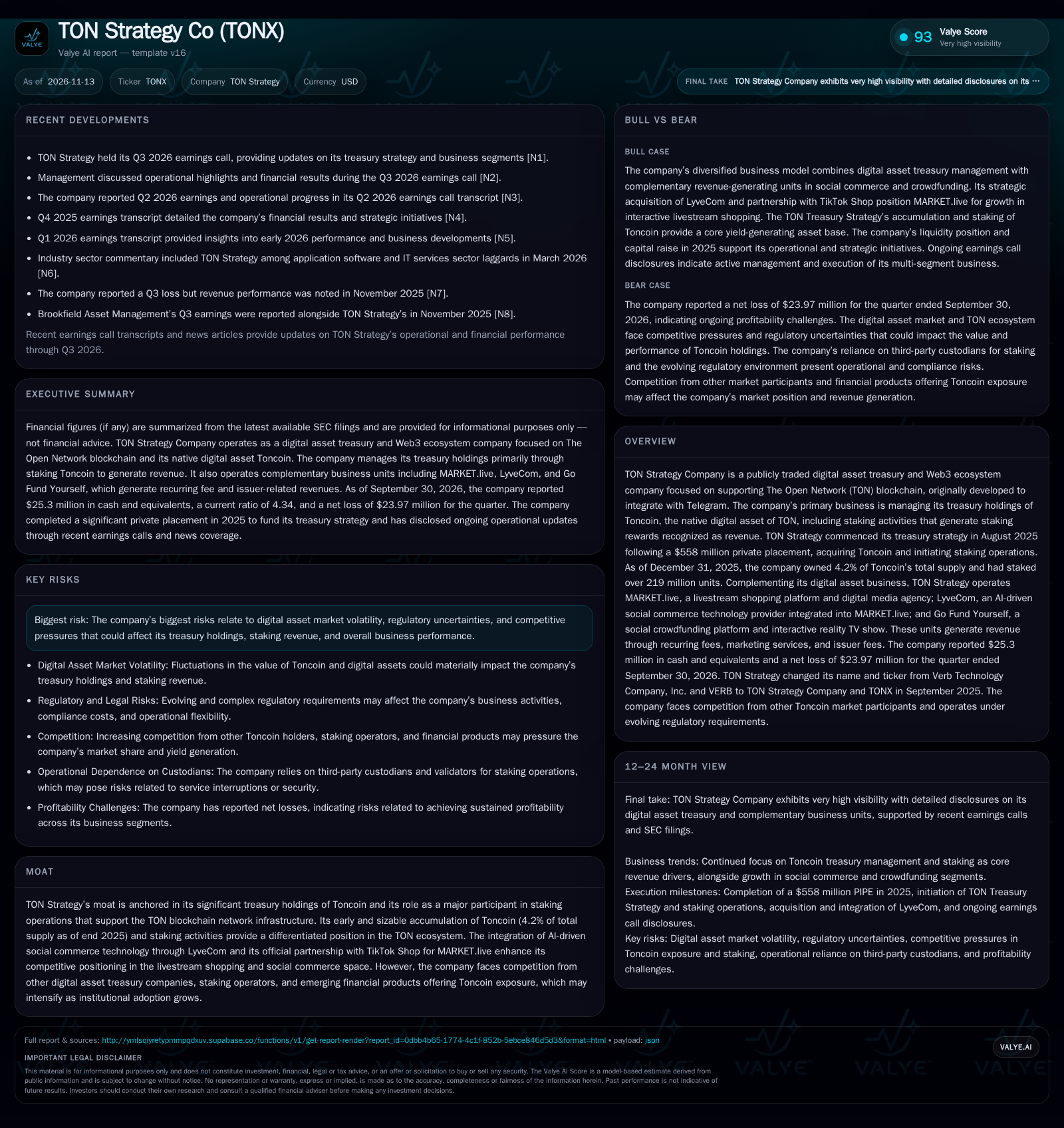
TON Strategy holds a significant 4.2% of Toncoin’s supply and generates core revenue from staking operations, supported by a $558 million PIPE completed in 2025. It is diversifying with MARKET.live (livestream shopping), LyveCom (AI social commerce tech), and Go Fund Yourself (crowdfunding/reality TV), but faces persistent net losses, regulatory uncertainty, and intensifying competition from other Toncoin investment products and staking operators. The critical question is whether staking rewards and ecosystem expansion can offset volatility and operating costs to deliver sustainable value. [S1] [S2]
TON Strategy Company has staked out a unique position in the Web3 landscape, combining a large treasury of Toncoin and active staking operations with a portfolio of digital commerce and crowdfunding businesses. Backed by a transformative $558 million capital raise in 2025, the company now owns over 4% of Toncoin’s supply, making it a pivotal player in the TON blockchain’s security and economics. Yet, persistent net losses and a rapidly evolving competitive and regulatory environment raise the stakes for whether TON Strategy can convert its asset base and technology investments into lasting economic value—or if volatility and operating costs will continue to erode returns.
Staking Scale, Diversification Moves, and Persistent Losses Define the Present
TON Strategy’s most material current fact is its ownership of 4.2% of the total Toncoin supply, with 219.7 million units staked as of year-end 2025—making it a systemically relevant participant in the TON blockchain’s validator ecosystem. This scale positions the company to earn a significant share of ongoing staking rewards and potentially influence network security and governance. [S1]
The company’s digital asset accumulation was funded by a $558 million private investment in public equity (PIPE) in August 2025, which enabled the rapid build-out of its treasury and staking strategy. [S1]
The company reported a current ratio of 4.34 for the period. [S2]
Beyond its Toncoin-centric core, TON Strategy operates MARKET.live (a livestream shopping and digital media agency), LyveCom (acquired in 2025 to enhance AI social commerce capabilities), and Go Fund Yourself (a crowdfunding and interactive content platform), each generating fee-based revenue but not yet offsetting the company’s overall losses. [S1]
Treasury Yield Mechanics and the Search for Operating Leverage
TON Strategy’s principal economic engine is the accumulation and staking of Toncoin. Staking rewards are recognized as revenue under ASC 606 when earned, and the company’s outsized holdings theoretically allow for substantial recurring yield, depending on network participation rates and Toncoin price. However, the business model is fundamentally exposed to digital asset volatility: a drop in Toncoin value or reduced staking yields could quickly erode both revenue and the balance-sheet base.
The economics of staking are attractive when yields are high and asset values are stable or rising. Fixed costs of custody (outsourced to BitGo and Blockchain.com) and validator pool participation are relatively low compared to the scale of assets staked, creating potential for operating leverage if staking rewards remain robust. However, the lack of direct control over custodial and network risks introduces vulnerabilities.
The complementary business units—MARKET.live, LyveCom, and Go Fund Yourself—operate on fee-for-service and platform participation models. MARKET.live generates recurring fees from social commerce services (store setup, creative production, influencer management), while LyveCom enhances AI-driven omnichannel capabilities. Go Fund Yourself earns issuer fees from crowdfunding campaigns and related content production. While these segments provide diversification, their cost structures (technology investment, marketing, talent) are likely to be high relative to early revenue, especially as social commerce and crowdfunding adoption curves are still developing.
The company reported cash and liquidity metrics for the period; these figures do not by themselves establish operating runway, investment capacity, financial flexibility, or financing capacity. [S2]
Differentiation Anchored in Scale—But Moat Faces Erosion from New Entrants
TON Strategy’s competitive position in the TON ecosystem is currently defined by its sheer scale: owning 4.2% of Toncoin’s supply and operating as a major staker. This early and concentrated exposure gives the company visibility and influence within the network, as well as a large share of staking rewards. However, barriers to entry are falling as more institutional and retail products emerge to provide Toncoin exposure, including funds, trusts, and other treasury operators. [S1]
In the social commerce segment, MARKET.live and LyveCom’s integration and TikTok Shop partnership offer a differentiated technology and distribution platform. Yet these advantages may prove transitory as larger e-commerce players, payment platforms, and digital agencies move aggressively into livestream shopping and AI-driven commerce. The Go Fund Yourself unit competes in a crowded crowdfunding and content arena, where platform scale, network effects, and regulatory agility are critical.
A key competitive question is whether TON Strategy can convert its treasury scale into network effects (e.g., preferential validator status, ecosystem partnerships) or whether its market share will gradually dilute as new entrants, staking pools, and synthetic Toncoin products gain traction. In the commerce segments, sustainable differentiation will likely depend on proprietary technology, creator/influencer relationships, and the ability to drive measurable transaction volume for clients.
If Toncoin Yield Remains Attractive and Web3 Commerce Scales, Multi-Segment Leverage Emerges
A favorable outcome for TON Strategy would see Toncoin price stability or appreciation, sustained high staking yields, and the company leveraging its early-mover scale to capture a disproportionate share of rewards. This would provide a stable and growing revenue base while enabling reinvestment in MARKET.live and LyveCom to accelerate adoption of AI-driven social commerce among brands and creators.
If MARKET.live achieves meaningful transaction volume and fee-based revenue—potentially aided by its TikTok Shop partnership—and Go Fund Yourself scales issuer and content fees, the company could realize operating leverage across business units. This scenario is further supported if regulatory clarity emerges around digital asset treasury operations, reducing compliance friction and attracting institutional clients or partners.
Evidence that would confirm this scenario includes sequential growth in staking rewards and digital commerce revenue, improving operating margins, successful client case studies in livestream shopping, and stable or rising Toncoin valuations. Announcements of new enterprise partnerships or expanded influencer networks would also signal traction.
Digital Asset Volatility and Incremental Commerce Growth Shape a Mixed Outcome
The most likely path is one of continued volatility: Toncoin’s value and network yields fluctuate, resulting in variable revenue from staking. The commerce and crowdfunding units grow, but at a rate insufficient to offset ongoing technology, talent, and compliance costs. As competition from new Toncoin investment products and staking operators intensifies, the company’s share of network rewards may gradually decrease, pressuring margins.
The company maintains reported liquidity position in the near term but remains unprofitable, periodically evaluating cost reductions or additional capital raises. Regulatory uncertainty persists, occasionally requiring operational adjustments or limiting market expansion.
Evidence confirming this scenario would include a continued pattern of net losses, modest but positive revenue growth in commerce units, and Toncoin holdings remaining a large but not expanding share of total supply. Falsification would require either a decisive shift to profitability or a sharp contraction in core asset values or business unit contributions.
Asset Price Declines, Regulatory Friction, and Execution Stumbles Amplify Losses
In a negative scenario, a significant decline in Toncoin’s value or network staking yields would sharply reduce both the company’s balance-sheet strength and its primary revenue stream. Should regulatory bodies impose new restrictions or costly compliance requirements on digital asset treasuries or staking operations, the company could face higher operating costs, asset write-downs, or even forced divestitures.
Intensifying competition—particularly from major financial institutions or blockchain-native funds—could lead to market share loss in both staking and social commerce. If MARKET.live and LyveCom fail to gain traction, and Go Fund Yourself struggles to attract issuers or viewers, diversification may become a cost center rather than a growth engine.
Evidence supporting this downside would include declining Toncoin prices or staking rates, regulatory actions targeting digital asset treasuries, shrinking share of network rewards, and deteriorating financial metrics (shrinking cash balance, accelerating losses, reduced customer acquisition).
Milestones and Metrics That Will Determine TON Strategy’s Staying Power
Toncoin price trends and network staking yield rates—both directly impact the company’s core revenue and balance sheet.
Sequential growth or decline in staking rewards revenue as reported under ASC 606.
Changes in the company’s percentage ownership of Toncoin supply—an increase would suggest consolidation, while dilution would signal rising competition.
Revenue and gross margin trends for MARKET.live and LyveCom, if disclosed, to assess whether social commerce is scaling toward profitability.
Issuer and content fee revenue growth from Go Fund Yourself, and evidence of successful campaign outcomes or audience engagement.
Regulatory developments affecting staking, digital asset treasury operations, or tokenized financial products in major jurisdictions.
Liquidity and cash burn rate—the pace at which the company draws down its cash and equivalents in the face of ongoing net losses.
Announcements of new enterprise or influencer partnerships, which could validate the company’s commerce platform strategy.
Disclaimer: This is research-only, informational analysis and not investment advice. It may include AI-generated interpretation and general industry context. Always verify important details using primary sources.

Comments