
Cineverse Corp.: Scaling Niche Streaming Amid Liquidity Strain and Platform Dependence
Cineverse leverages a vast content library and proprietary streaming technology to reach global audiences across enthusiast channels, but faces liquidity pressures and must prove its ability to translate scale into durable profitability within a fiercely competitive OTT landscape.
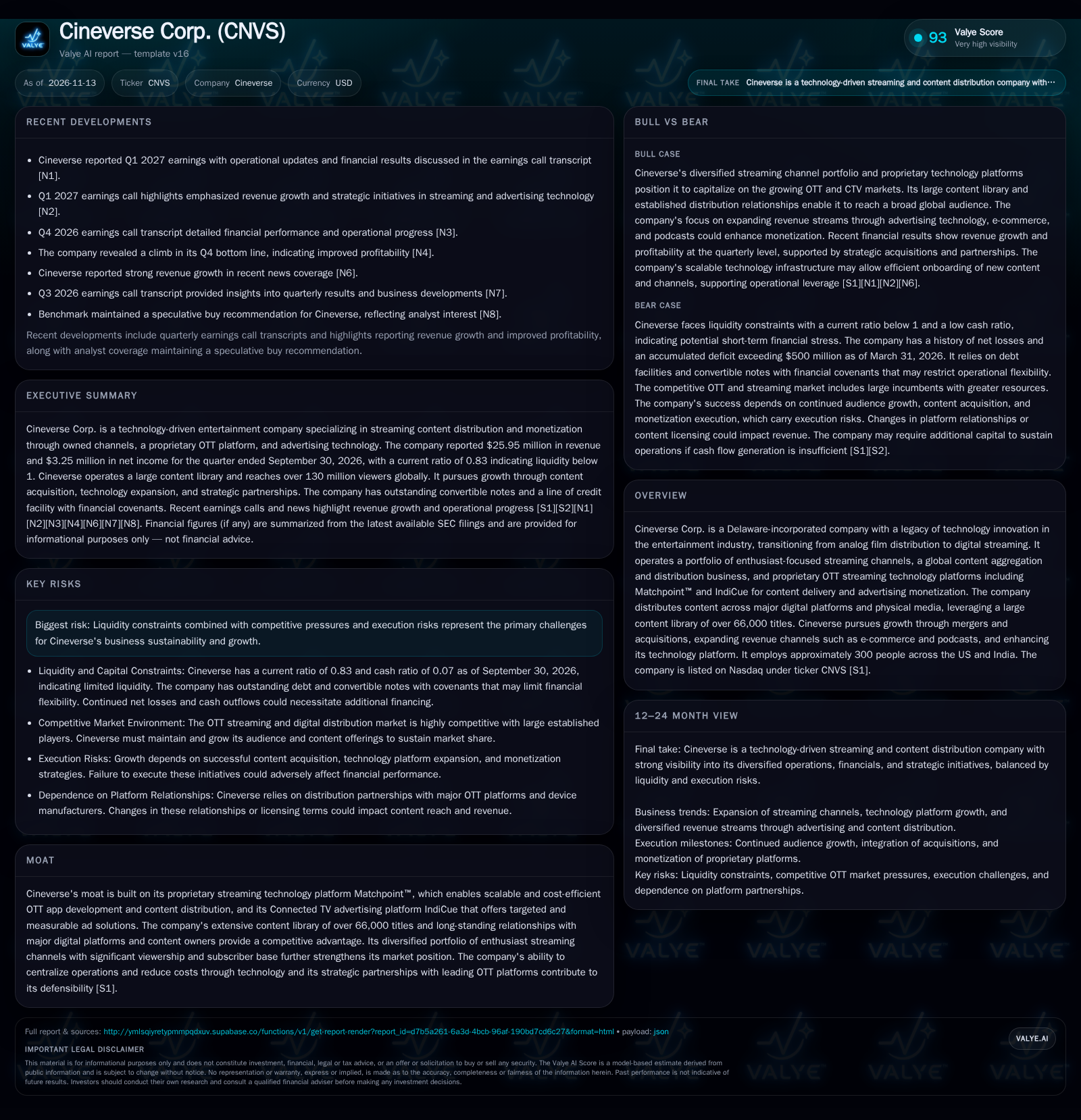
Cineverse reported $25.95 million in quarterly revenue and $3.25 million in net income, driven by a portfolio of genre-focused streaming channels and proprietary OTT technology. Despite a content library exceeding 66,000 titles and reach to over 130 million viewers, the company’s liquidity profile is challenging, with a current ratio of 0.83 and significant reliance on debt and convertible notes. Future performance depends on Cineverse’s ability to monetize its audience, maintain platform relationships, and manage capital constraints in the evolving streaming market [S1] [S2].
Cineverse Corp. stands at a crossroads familiar to mid-scale digital media platforms: its proprietary OTT technology and deep content library have enabled it to build a diverse ecosystem of enthusiast streaming channels, reaching over 130 million viewers globally. Recent profitability and revenue growth are promising signals, yet the company’s liquidity ratios and reliance on external financing suggest a business model still searching for operational self-sufficiency. The central question is whether Cineverse can convert scale and technology into durable cash flows before capital constraints or competitive pressure force a strategic pivot.
Recent Profitability and Persistent Liquidity Headwinds
Cineverse reported revenue of $25.95 million and net income of $3.25 million for the quarter ended September 30, 2026, which marks a period of operational profitability [S2]. Despite this improvement, the company’s balance sheet reveals ongoing liquidity pressure, with cash and equivalents at $4.3 million and a current ratio of 0.83—both below typical comfort thresholds for a content-driven business [S2]. The company also carries $9.4 million in borrowings on its credit facility and issued $13 million in convertible notes at a 9% rate earlier in 2026, indicating reliance on debt and equity-linked capital to bridge funding needs [S1] [S2]. Benchmark’s speculative buy rating signals some market optimism, but also acknowledges risk [N8]. These facts collectively highlight a business with growing revenue and audience scale, yet whose short-term financial resilience remains in question.
How Cineverse’s Platform Model Seeks Scale and Margin
Cineverse’s economics are anchored in a multi-pronged approach: direct-to-consumer streaming channels (SVOD, AVOD, TVOD), third-party content distribution, and technology licensing via its Matchpoint™ OTT platform. Revenue mix likely includes advertising (via IndiCue), subscriptions, transactional fees, and licensing, though the precise contribution of each is not disclosed. The fixed cost base is substantial—content rights, technology infrastructure, and a global team of over 300 employees—suggesting high operating leverage if audience and monetization scale. Variable costs are tied to content acquisition, bandwidth, and revenue-sharing with distribution partners.
Capital requirements are persistent: Cineverse must invest in content acquisition and platform enhancements to remain relevant, while also servicing debt and convertible note obligations. The company’s technology assets may provide margin leverage if SaaS and ad-tech revenues grow faster than content costs. However, the economics of streaming remain volatile—subscription ARPU, ad fill rates, and churn are all subject to competitive pricing and shifting consumer preferences. The liquidity constraint adds urgency to the need for positive free cash flow generation.
Defending Niche Streaming Against Platform Giants and Aggregators
Cineverse competes in the saturated OTT and streaming sector, facing both direct-to-consumer behemoths (such as Netflix, Disney+, and Amazon Prime Video) and niche streaming specialists. Its competitive advantages rest on proprietary technology (Matchpoint™ for app development and IndiCue for targeted CTV/DOOH ads), a large and diversified content library, and established relationships with major distribution platforms [S1]. The focus on enthusiast verticals (anime, horror, faith, sports, etc.) allows Cineverse to target underserved audiences, potentially reducing direct competition with generalist services.
However, barriers to entry in digital distribution are falling, and content owners increasingly seek direct platform relationships, threatening aggregator economics. Cineverse’s dependence on licensing deals and third-party platforms introduces revenue volatility if terms change or if distribution partners prioritize their own original content. The company’s ability to maintain differentiated content, effective technology, and loyal audiences will determine whether it can withstand broader industry consolidation and the rising cost of customer acquisition.
When Platform Leverage and Content Breadth Drive Durable Cash Flow
The most favorable outcome for Cineverse is one in which its technology platforms achieve broad adoption—attracting new streaming partners, boosting SaaS and ad-tech revenue, and reducing marginal onboarding costs. If the company successfully leverages its 66,000-title library and enthusiast channels to drive both subscriber growth and high-margin advertising partnerships, operating leverage can transform modest top-line growth into accelerating free cash flow.
Key confirming evidence would include: sustained sequential growth in SVOD subscribers and ARPU, rising ad-tech revenue (particularly from IndiCue’s CTV/DOOH solutions), and a shift to positive operating cash flow. Additional signs would be successful integration of accretive M&A, new content or technology partnerships with major distribution platforms, and a current ratio moving toward or above 1.0, indicating improved liquidity. Falsification would come from continued reliance on debt/equity issuance to fund operations, stagnation in subscriber or ad revenue metrics, or loss of key platform partnerships.
Steady Content Expansion Amid Capital and Competitive Friction
The most plausible path is one of continued incremental growth in both audience and revenue, but with persistent capital constraints and competitive headwinds. Cineverse likely adds new content and channels, modestly expands its reach, and maintains profitability at the net income line, but does not generate sufficient free cash flow to fully self-fund growth initiatives. The company may be forced to selectively prioritize higher-margin channels or technology investments, and could intermittently tap capital markets to support working capital and content acquisition.
Confirmation would come from sequential revenue growth, stable (if modest) profitability, and evidence of cost discipline—such as improving gross margin or reduced SG&A as a percentage of sales. Falsification would be signaled by a deterioration in liquidity ratios, covenant breaches, or an inability to maintain content acquisition pace, leading to subscriber or viewership erosion.
Liquidity Shortfall or Platform Disruption Forces Strategic Retrenchment
The adverse case is defined by a combination of tightening liquidity and/or adverse changes in distribution partnerships. If cash burn persists and Cineverse cannot access additional capital on favorable terms, it may be forced to curtail content acquisition, reduce platform investment, or divest non-core assets. Alternatively, if one or more major digital distribution partners alter their licensing or revenue-sharing terms, or if content owners pull material titles, Cineverse’s revenue base could contract rapidly.
Downside evidence would include: declining current and cash ratios, missed debt covenants, material layoffs or cost cuts, or the announcement of asset sales outside of accretive M&A. Further confirmation would be a reduction in channel count, subscriber losses, or the loss of key platform relationships. Falsification would require evidence of successful refinancing, covenant waivers, or new high-value partnerships offsetting the liquidity or partnership pressure.
Milestones That Will Determine Cineverse’s Ability to Convert Scale Into Sustainable Value
Sequential growth in SVOD subscribers and ARPU, if disclosed, would provide direct evidence of demand and pricing power.
Quarterly ad-tech revenue from IndiCue, especially CTV/DOOH segments, would clarify the scalability and margin potential of Cineverse’s proprietary platforms.
Operating cash flow trends—particularly the shift from net income to positive free cash flow—are essential to test whether reported profitability translates to financial resilience.
Announcements of new or renewed major distribution platform partnerships, or material changes in licensing terms, could materially affect both reach and revenue visibility.
Evidence of successful integration of acquired content or technology assets would help validate the accretive M&A strategy.
Churn rates and retention on enthusiast channels, if disclosed, would illuminate the stickiness of Cineverse’s niche audiences.
Any changes to content library size or quality, such as new exclusive rights or loss of major titles, would impact the company’s long-term competitive position.
Disclaimer: This is research-only, informational analysis and not investment advice. It may include AI-generated interpretation and general industry context. Always verify important details using primary sources.

Comments