
Katapult Holdings: Scaling Lease-to-Own Through Technology, Mergers, and the Challenge of Debt-Fueled Expansion
Katapult Holdings is driving growth in the U.S. lease-to-own market for nonprime consumers with proprietary underwriting and multi-channel merchant partnerships. As the company pursues major mergers to expand its omni-channel reach, it faces the dual challenge of integration risk and substantial indebtedness, all while navigating economic headwinds impacting its customer base.
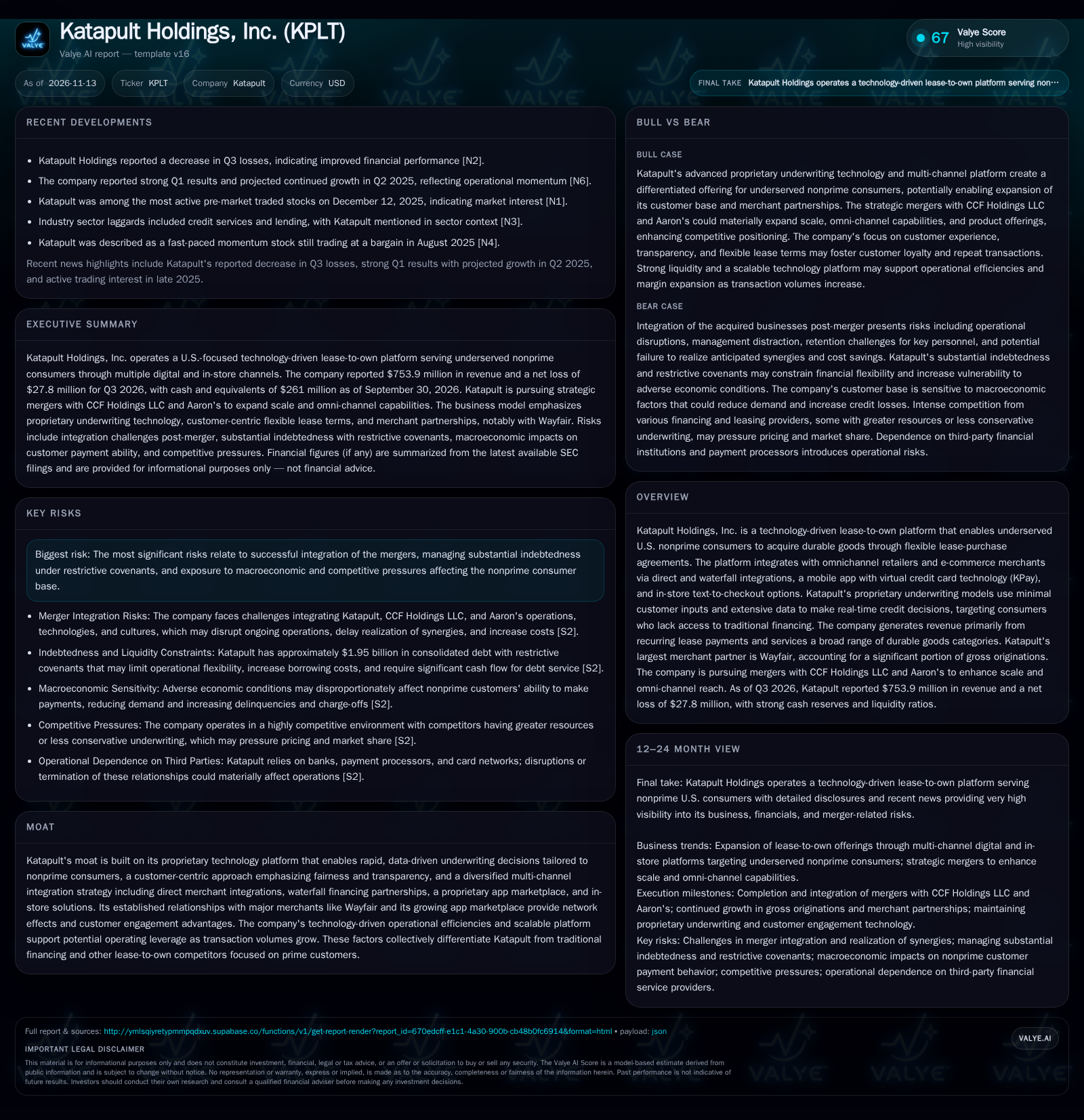
Katapult Holdings is a technology-centric lease-to-own platform serving nonprime U.S. consumers, reporting $753.9 million in revenue and a net loss of $27.8 million for Q3 2026. The company is actively pursuing mergers with CCF Holdings and Aaron's to boost scale and omni-channel capabilities, but faces significant integration, debt, and macroeconomic risks. Its moat centers on proprietary underwriting and deep merchant partnerships, notably with Wayfair, yet long-term success depends on executing integration and managing financial leverage while maintaining growth momentum. [S2]
Katapult Holdings sits at a strategic crossroads in the U.S. lease-to-own industry. By fusing proprietary technology for real-time underwriting with a broad suite of merchant integration options, Katapult has carved out a differentiated niche serving nonprime consumers—those underserved by traditional credit systems. The company’s recent financial results show both scale and persistent losses, while its ambitious plan to merge with CCF Holdings and Aaron's could redefine its reach and relevance. Yet, this expansion is shadowed by nearly $2 billion in debt and the perennial risk that economic shifts could hit its customer base hardest. The next chapters for Katapult will hinge on whether technology, scale, and disciplined execution can overcome the inherent volatility and integration risks that characterize this business model. [S2]
Recent Performance and Strategic Moves: Growth, Losses, and Merger Ambitions
Katapult Holdings reported $753.9 million in revenue and a net loss of $27.8 million for Q3 2026, indicating ongoing growth but continued challenges in achieving profitability at scale. The company reported cash and liquidity metrics for the period; these figures do not by themselves establish operating runway, investment capacity, financial flexibility, or financing capacity. Katapult’s largest merchant partner remains Wayfair, highlighting both a source of transaction volume and a customer concentration risk. Critically, the company is pursuing mergers with CCF Holdings LLC and Aaron's, signaling a strategic bet on consolidation to increase scale, diversify revenue streams, and expand omni-channel capabilities. Recent news also points to improved operational performance, with Q3 losses narrowing and earlier quarters reflecting momentum. [S2] [N2] [N6]
Lease-to-Own Platform Economics: Balancing Recurring Revenue with Credit Risk and Operating Leverage
Katapult’s core business model generates revenue from recurring lease payments, enabling nonprime consumers to acquire durable goods through flexible, technology-enabled lease-purchase agreements. The company’s proprietary underwriting models enable real-time credit decisions with minimal customer input, potentially reducing friction and expanding its addressable market. The economics of lease-to-own are inherently volume-driven, as higher transaction throughput can drive operating leverage, particularly given the largely fixed cost base associated with technology infrastructure and underwriting systems.
However, profitability depends on the delicate balance between lease payment volume, customer credit performance, and the cost of capital. Credit losses, charge-offs, and merchandise recovery costs are significant variables, particularly given the nonprime profile of Katapult’s customer base. The company’s dependence on third-party banks and payment processors introduces another cost and risk layer. As Katapult pursues scale through mergers, integration costs and potential synergies (such as shared technology, expanded merchant networks, and unified servicing platforms) will be critical in determining whether the combined entity can achieve sustainable positive margins. Capital needs remain high, both for funding lease originations and for servicing substantial debt obligations. [S2]
Defending Share in a Fragmented, Resource-Intensive Market
Katapult operates in a highly competitive sector, with rivals ranging from traditional lease-to-own providers and fintech lenders to buy-now-pay-later (BNPL) platforms and large specialty retailers with in-house financing. Its competitive edge rests on proprietary, data-driven underwriting and a multi-channel integration strategy, offering both digital and in-store options via direct merchant integrations, a proprietary app, and text-to-checkout. The relationship with major merchants, especially Wayfair, supports transaction flow and may provide network effects.
However, larger competitors may have access to lower-cost capital, broader merchant networks, and less conservative underwriting standards, potentially enabling more aggressive pricing or risk-taking. The planned mergers with CCF Holdings and Aaron’s could strengthen Katapult’s position by increasing scale, expanding product breadth, and reducing merchant concentration. Yet, the success of this strategy depends on effective integration and the ability to maintain underwriting discipline while scaling originations. Katapult’s focus on nonprime consumers is both a moat and a vulnerability: while it serves an underserved segment, these customers are more sensitive to economic downturns and may be targeted by new entrants with innovative credit models.
How Integration and Technology-Driven Scale Could Unlock Margin Expansion
A favorable outcome for Katapult would see the successful completion and integration of the CCF Holdings and Aaron's mergers, resulting in a larger, more diversified platform with enhanced omni-channel reach and merchant partnerships. If Katapult can realize operational synergies—such as reducing duplicative costs, cross-selling across a broader customer base, and leveraging unified technology for underwriting and servicing—the company could drive margin expansion as transaction volumes grow.
Confirmation of this scenario would come from sustained growth in gross originations across a more diverse set of merchants, declining operating expenses as a percentage of revenue, and improving net income or positive free cash flow. Additional signs would include successful retention of key merchant relationships post-merger, evidence of improved customer retention and repeat business, and a stable or declining credit loss ratio. Faster-than-expected adoption of Katapult’s app-based and virtual card solutions could further boost engagement and transaction frequency.
Executing Amid Integration Complexity and Persistent Margin Pressure
The most plausible trajectory for Katapult is a period of operational complexity as it works to integrate CCF Holdings and Aaron’s while maintaining growth in its legacy business. Revenue is likely to continue growing, driven by merchant partnerships and an expanding nonprime customer base. However, margin pressure may persist due to integration costs, continued credit losses associated with the customer profile, and the need to service substantial debt.
Confirmation of this scenario would include steady, but not dramatic, increases in revenue and gross originations, with net losses narrowing only gradually. Integration milestones may be met on schedule, but cost synergies could take longer to materialize, and competitive pressures may limit pricing power. The company would need to demonstrate disciplined underwriting to avoid elevated credit losses, while also successfully retaining and expanding merchant relationships. If disclosed, metrics such as customer acquisition cost, repeat customer rates, and operational expense ratios would help test the durability of the business model in this middle path.
Integration Failure, Credit Deterioration, and Debt Constraints Derail Progress
A negative scenario would see Katapult struggling to integrate CCF Holdings and Aaron’s, leading to operational disruptions, loss of key personnel, and failure to realize anticipated synergies. Merchant and customer attrition could accelerate, particularly if integration distracts management or causes service lapses. Rising credit losses—due to either deteriorating macroeconomic conditions or lax underwriting—would further erode profitability.
Signs of this scenario would include missed integration milestones, rising credit loss ratios, increasing net losses, negative free cash flow, or covenant breaches. Loss or weakening of major merchant partnerships, such as with Wayfair, would further undermine revenue visibility and network effects.
Milestones and Metrics That Will Determine Katapult’s Long-Term Success
Progress on closing and integrating the CCF Holdings and Aaron’s mergers, including timeline adherence and any announced synergy realization.
Gross originations growth by channel (e.g., new vs. legacy merchants, in-store vs. digital), if disclosed.
Merchant concentration trends, specifically the share of revenue and originations from Wayfair and the top five partners.
Credit loss rates, delinquency ratios, and merchandise recovery costs as indicators of underwriting discipline and economic sensitivity.
Operating expense as a percentage of revenue, especially post-integration, to gauge operating leverage and synergy capture.
Debt service coverage, covenant compliance, and any changes in borrowing costs or liquidity position.
Customer repeat rate and retention statistics, if disclosed, as signals of platform engagement and lifetime value.
Adoption and transaction volume through Katapult’s mobile app and virtual card (KPay), if disclosed, to assess digital channel traction.
Disclaimer: This is research-only, informational analysis and not investment advice. It may include AI-generated interpretation and general industry context. Always verify important details using primary sources.

Comments