
Soren Acquisition Corp.: SPAC Structure, Management Experience, and the Race to Healthcare Consolidation
With $258 million in trust and an experienced SPAC management team, Soren Acquisition Corp. is positioned to pursue a sizable healthcare transaction—but faces the classic SPAC tightrope of deal selection, dilution, and execution risk as the 2028 deadline approaches.
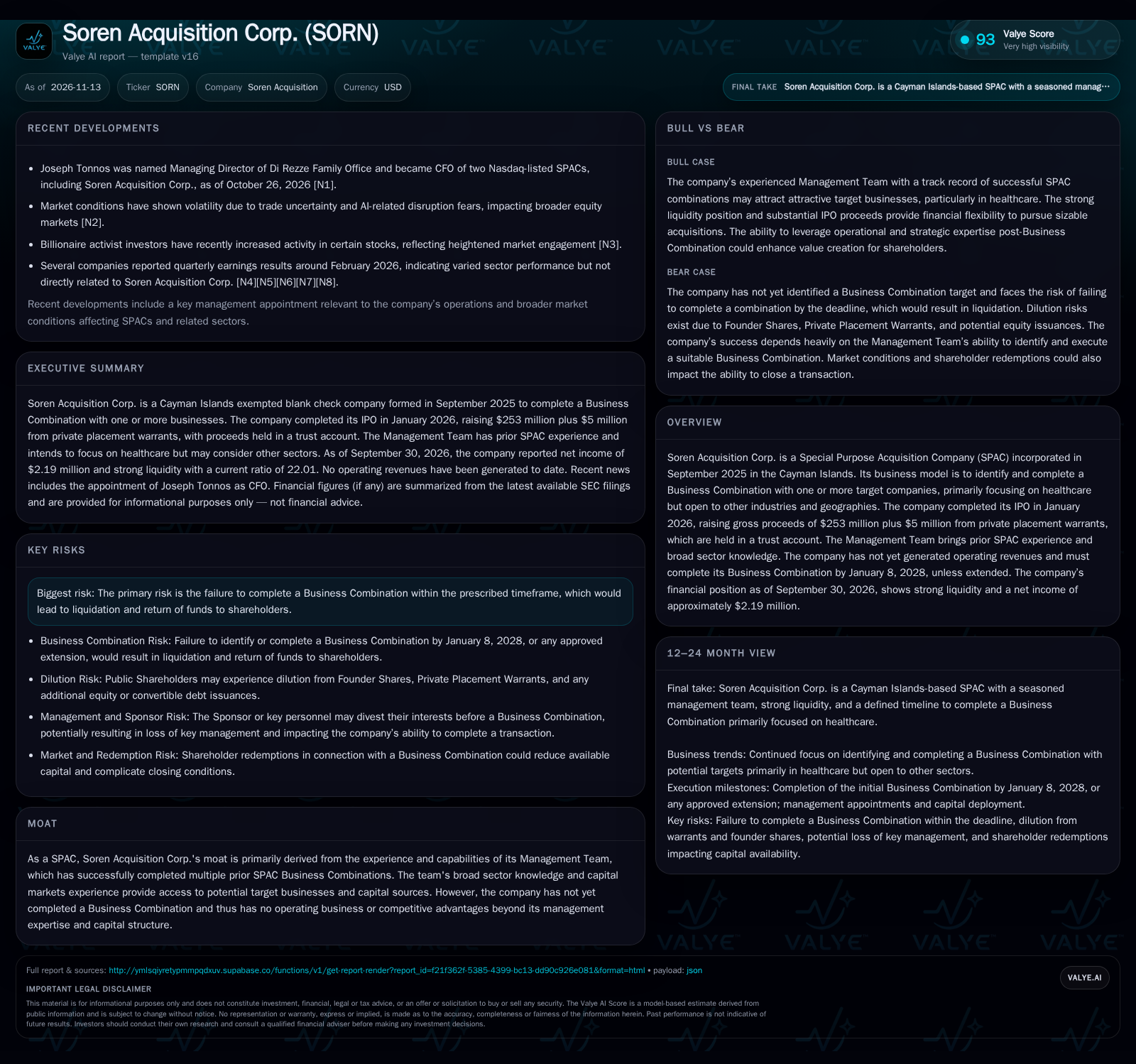
Soren Acquisition Corp. is a recently formed SPAC with $258 million in proceeds held in trust, led by a team with a track record of closing SPAC deals. It has not yet identified a target, but intends to focus on healthcare. The company’s economics, like all SPACs, hinge on sourcing and executing a value-creating business combination before January 2028. Dilution and redemption risks, as well as the competitive market for attractive targets, are central factors shaping both upside and downside scenarios. [S2]
Soren Acquisition Corp. enters the crowded SPAC landscape with $258 million in trust and a management team touting multiple successful de-SPACs. The company’s explicit focus on healthcare, combined with the flexibility to pursue other sectors, sets the stage for a potentially high-impact acquisition. However, the structural realities of dilution, a fixed timeline, and a competitive market for attractive targets mean that value creation is far from assured. As the 2028 deadline looms, Soren’s ability to source, negotiate, and close a transformative deal will define its trajectory and the outcomes for public shareholders.
IPO Proceeds, Management Track Record, and the Countdown to Business Combination
Soren Acquisition Corp. completed its IPO on January 8, 2026, raising $253 million through the sale of 25.3 million units at $10.00 each, with an additional $5 million from private placement warrants sold to the sponsor. All proceeds have been placed in a trust account, in line with standard SPAC structure, and the company currently reports a current ratio of 22.01, reflecting high liquidity as of September 30, 2026. The management team, led by CEO Arghavan Di Rezze and CFO Jamie Weber, brings a history of closing four prior SPAC business combinations. As of the latest SEC filings, Soren has not yet identified a business combination target, and generated no operating revenues to date. The company must complete its initial business combination by January 8, 2028, or risk liquidation and the return of funds to shareholders. [S2]
SPAC Economics: Dilution, Redemption, and the Quest for Value Creation
The core SPAC business model is transactional—Soren’s economics are driven by the successful identification, negotiation, and consummation of a business combination. Until such a transaction is completed, the company generates only nominal interest income on trust assets and incurs operating expenses related to deal sourcing and compliance. Upon deal execution, the economics pivot to the target’s fundamentals, but the path is shaped by several value-dilutive mechanisms.
Founder shares and private placement warrants are designed to reward sponsors and insiders, but dilute public shareholders post-merger. If redemptions are high (i.e., public shareholders opt to redeem their shares instead of participating in the combined entity), the deal's cash proceeds may shrink, affecting both deal feasibility and the post-merger capital structure. The ability to secure PIPE (private investment in public equity) funding or renegotiate terms with targets becomes critical in such cases.
Operating leverage and capital requirements will depend entirely on the characteristics of the eventual target. If Soren acquires a capital-light, high-margin healthcare services business, the combined company could benefit from strong free cash flow and scalability. Conversely, a capital-intensive acquisition—such as a device manufacturer or biotech with clinical-stage assets—could require significant follow-on funding and face execution risk. Until the target is known, the economics remain highly contingent and scenario-dependent.
How Sponsor Experience and Healthcare Focus Shape Competitive Dynamics
In the SPAC ecosystem, competitive advantage is largely a function of sponsor credibility, network access, and speed to close, rather than traditional operating moats. Soren’s management and advisors bring experience from four prior SPAC combinations, which could help in sourcing proprietary deal flow and instilling confidence in potential targets. This track record may also appeal to PIPE investors or institutional partners, especially when negotiating with healthcare companies seeking access to public-market capital.
However, the market for attractive healthcare targets is crowded, with both strategic acquirers and other SPACs competing for the same pool of mature, scalable businesses. Many targets are now attuned to SPAC mechanics—demanding higher valuations, tighter deal protections, and sometimes seeking alternative routes to public markets. Soren’s flexibility to pivot outside of healthcare (if a compelling opportunity arises) is a potential advantage, but it also means the company lacks a guaranteed proprietary pipeline.
Substitution risk is high: targets can pursue traditional IPOs, direct listings, or strategic sales. Public shareholders may also compare Soren’s eventual deal terms and dilution profile with those of competing SPACs, creating pressure to deliver a transaction that is not merely accretive on paper, but sustainable in the public markets.
Catalysts for Outperformance: Securing a Differentiated Healthcare Asset
The most favorable scenario for Soren is the successful execution of a business combination with an established, high-growth healthcare company that values public listing and brings a robust management team. This could occur if Soren leverages its sponsor network to identify a target before competitors, negotiates favorable terms, and minimizes redemptions through effective investor marketing and deal structure.
Evidence for this scenario would include the announcement of a signed letter of intent or definitive agreement with a healthcare target that meets or exceeds the minimum trust value threshold, strong PIPE participation to backstop redemptions, and positive commentary from both target management and institutional investors. Low redemption rates and a post-deal share price trading at or above the $10 trust value would further validate the quality of the transaction.
Falsification would come from a lack of deal progress, failure to secure a credible target, or an announced transaction that is met with high redemptions and poor market reception.
Most Likely Outcome: A Conventional SPAC Timeline with Standard Risks
The most probable outcome is that Soren continues to evaluate targets through late 2026 and into 2027, eventually announcing a business combination with a mid-sized healthcare company or adjacent sector player. Given current SPAC market dynamics, it is likely that negotiations will be protracted as both sides seek to optimize valuation and deal structure.
The deal may attract significant shareholder redemptions, particularly if the target’s growth profile or path to profitability is not compelling, or if overall SPAC sentiment remains cautious. Soren may need to supplement trust proceeds with PIPE financing or adjust transaction terms to ensure sufficient capital at closing. Public shareholders could experience moderate dilution, with the post-merger entity trading near the $10 trust value unless the target demonstrates rapid, visible progress post-close.
This scenario would be confirmed by a deal announcement within the next 12-18 months, moderate but not catastrophic redemptions, and a post-close share price that is stable but not materially above trust value. Falsification would involve either a failure to secure any deal, or a transaction that triggers mass redemptions and a loss of Nasdaq listing.
Deal Failure, High Redemptions, or Sponsor Turnover Could Trigger Liquidation
The primary downside scenario is that Soren is unable to identify or negotiate a business combination before the January 2028 deadline, resulting in liquidation and a return of trust proceeds to shareholders. This could stem from a lack of compelling targets, unfavorable market conditions, or sponsor/management turnover.
Alternatively, Soren could announce a business combination, but encounter overwhelming shareholder redemptions, insufficient PIPE or external financing, or regulatory complications, causing the deal to collapse. In such cases, the company could also lose its Nasdaq listing if it fails to meet the required timelines or capitalization thresholds.
Confirmation of this scenario would include repeated extensions of the deal deadline, lack of credible deal news, sponsor resignations or sales of sponsor interests, and escalating redemptions in the lead-up to any shareholder vote. Falsification would require clear, positive progress on a transaction and strong signals of post-deal support from the market and institutional investors.
Milestones and Metrics That Will Shape Soren Acquisition Corp.’s Outcome
Announcement of a definitive agreement or letter of intent for a business combination, including sector, size, and terms.
Level of shareholder redemptions at the time of deal vote—low redemptions would indicate confidence in the transaction.
PIPE or alternative financing commitments to supplement trust proceeds, if disclosed.
Changes in sponsor or management team composition, particularly if the sponsor explores a sale of its interests.
Progress toward meeting Nasdaq’s 36-month deadline for business combinations to avoid delisting.
Post-merger share price performance relative to trust value, as a proxy for market confidence.
Disclosure of any extension requests, amendments to the trust agreement, or liquidation warnings.
Details on target company fundamentals—revenue, growth, capital needs, and management team strength—if and when a deal is announced.
Disclaimer: This is research-only, informational analysis and not investment advice. It may include AI-generated interpretation and general industry context. Always verify important details using primary sources.

Comments