
Allarity Therapeutics: Patent-Backed Precision Oncology Ambitions Confront Funding and Listing Pressures
Allarity Therapeutics is progressing its lead drug Stenoparib in clinical trials and expanding its proprietary DRP diagnostic platform, with recent patent wins and its first commercial CLIA services deal.
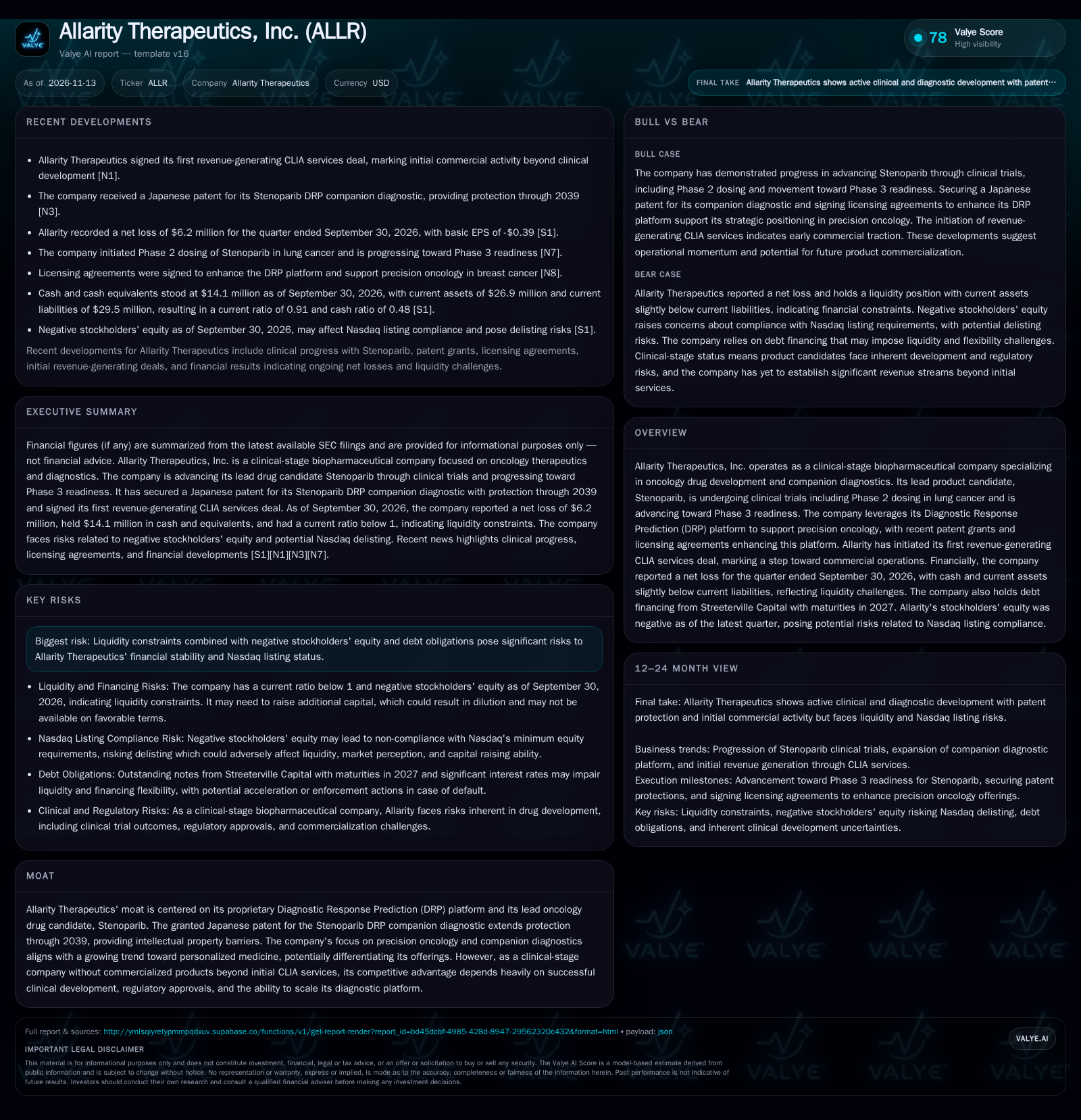
Allarity Therapeutics is progressing its lead drug Stenoparib in clinical trials and expanding its proprietary DRP diagnostic platform, with recent patent wins and its first commercial CLIA services deal. [S1] [N1] [N3] [N7]
Allarity Therapeutics stands at a pivotal juncture, balancing scientific progress with acute financial pressures. The company’s Stenoparib program—a DNA damage response inhibitor targeting oncology indications—has reached Phase 2 dosing in lung cancer and is progressing toward Phase 3, supported by a proprietary companion diagnostic platform now protected by a Japanese patent through 2039. The coming quarters will test whether Allarity can convert its innovation assets and IP into sustainable value before financial pressures force a strategic reset. [S1] [N1] [N3] [N7]
Patent Protection, Initial Revenues, and Financial Strain Define the Present
Allarity Therapeutics is advancing its lead drug candidate, Stenoparib, through Phase 2 clinical trials in lung cancer, with preparations underway for Phase 3. The company’s Diagnostic Response Prediction (DRP) companion diagnostic platform has secured a Japanese patent valid through 2039, enhancing its intellectual property position in precision oncology. Commercial momentum is nascent, evidenced by the first revenue-generating CLIA services deal, which marks a transition from pure R&D to initial market-facing operations. However, the company’s financial position is fragile: as of September 30, 2026, Allarity reported a net loss of $6.2 million, cash and equivalents of $14.1 million, current assets of $26.9 million against current liabilities of $29.5 million (current ratio 0.91), and negative stockholders’ equity, raising the specter of Nasdaq delisting. [S1] [N1] [N3] [N7]
How Allarity’s Model Could Scale: Precision Oncology Economics and Capital Needs
Allarity’s business model aspires to blend proprietary drug development with companion diagnostics, targeting a precision medicine value proposition. The economics of this approach are fundamentally high-risk, high-reward: if clinical validation occurs, the Stenoparib-DRP combination could command premium pricing in oncology, especially if the diagnostic enables payer adoption and targeted patient selection. Early CLIA services revenue indicates the potential for fee-for-service diagnostic income, though volumes and pricing have not been disclosed.
Fixed costs are dominated by R&D, clinical trial execution, regulatory submissions, and platform development, while variable costs may rise with commercialization, especially if the company pursues direct sales. Capital needs are substantial for a clinical-stage biotech, as late-stage trials and regulatory processes are both expensive and lengthy. Operating leverage could materialize if Stenoparib achieves approval and the DRP platform is adopted broadly, but until then, cash burn is structurally high and dependent on external financing. The outstanding $20 million in notes due 2027 adds to required outflows, with interest rates of 9% and 5% further eroding available cash. [S1]
The interplay between diagnostic and therapeutic components in Allarity’s model introduces unique operational dynamics. The companion diagnostic’s success is not only dependent on clinical validation but also on integration into healthcare provider workflows and payer reimbursement frameworks. Adoption hurdles can arise if the diagnostic is perceived as complex or if its predictive value is not sufficiently differentiated from existing biomarkers. Consequently, the company’s ability to educate clinicians and negotiate with payers will be critical to unlocking the full economic potential of the DRP platform. Additionally, the timing of diagnostic commercialization relative to drug approval can influence revenue streams and capital efficiency, as early diagnostic adoption may help offset drug development costs if managed effectively.
Capital allocation decisions will significantly impact Allarity’s runway and strategic flexibility. Prioritizing resources toward pivotal clinical trials versus expanding diagnostic service capabilities requires balancing near-term revenue generation against long-term drug approval prospects. If diagnostic services scale sufficiently, they could provide a non-dilutive funding source that mitigates reliance on equity raises, but this depends on achieving meaningful volume and reimbursement levels. Conversely, underinvestment in clinical development risks delaying drug approval and diminishing overall enterprise value. Therefore, a phased capital deployment strategy that dynamically adjusts to clinical and commercial signals would be prudent to optimize resource utilization amid constrained liquidity.
Intellectual Property and Platform Play: Differentiation and Counterforces in Oncology
Allarity’s competitive positioning relies on two pillars: its proprietary Stenoparib program and the DRP companion diagnostic platform. The Japanese patent for the Stenoparib DRP diagnostic offers a long runway for exclusivity in a key market, potentially deterring direct competition and supporting premium pricing. Licensing agreements to enhance the DRP platform broaden its relevance to additional indications such as breast cancer, and align Allarity with the broader movement toward precision oncology.
However, the company faces substantial counterforces. The oncology drug development landscape is crowded, with large pharmaceutical incumbents, emerging biotechs, and academic spinouts all pursuing DNA damage response and synthetic lethality strategies. Companion diagnostics, while increasingly demanded by payers and regulators, require robust validation and can face adoption barriers if not integrated into clinical workflows. Without approved products or established commercial relationships, Allarity’s current moat is theoretical and contingent on clinical and regulatory success.
The patent landscape and licensing strategy surrounding the DRP platform also influence competitive dynamics. Broad and enforceable patents can create barriers for competitors attempting to develop similar companion diagnostics, but the value of such protection depends on the scope of claims and the ability to defend them against challenges. Licensing partnerships may extend the platform’s reach into additional tumor types, but they also introduce dependency on third parties for commercialization success. Furthermore, the platform’s adaptability to emerging biomarkers and evolving standards of care will be essential to maintain relevance in a rapidly advancing field. Continuous innovation and patent filings will be necessary to sustain differentiation and counter competitive encroachment.
If Stenoparib and DRP Achieve Clinical and Commercial Validation
The most favorable outcome for Allarity would see positive Phase 2 results for Stenoparib in lung cancer, leading to expedited Phase 3 enrollment and eventual regulatory approval. If the DRP companion diagnostic demonstrates predictive accuracy and facilitates payer reimbursement, the combined offering could accelerate market adoption and could support premium pricing.
Evidence that would confirm this scenario includes: robust clinical efficacy and safety data; rapid progression to Phase 3; expanded licensing or partnership agreements for the DRP platform; and a sustained ramp in CLIA services revenue. Additional non-dilutive funding—such as grants, milestone payments, or upfront licensing fees—would further validate commercial interest and reduce financing risk.
Navigating Clinical Uncertainties and Funding Pressures Without Near-Term Breakthroughs
The most plausible trajectory is one of continued clinical progress, but at a pace constrained by capital availability and operational bandwidth. Stenoparib’s trials may generate mixed or incremental results, requiring further studies before regulatory submission. The DRP platform could attract additional licensing interest but may not achieve meaningful commercial scale in the near term.
In this scenario, Allarity would likely need to secure new funding—potentially through equity, convertible debt, or strategic partnerships—to bridge to major inflection points. Nasdaq compliance issues could be addressed via financial restructuring, reverse splits, or capital raises, but with dilution risk to current shareholders. Confirmation would come from modest clinical milestones, additional small-scale revenue deals, and periodic financing announcements. Falsification would be a failure to secure needed funding or a material regulatory setback.
When Financial and Regulatory Headwinds Overwhelm Clinical Progress
The adverse scenario would see Allarity unable to raise sufficient capital before cash runs out, forcing the company to halt or slow clinical programs, default on debt, or lose Nasdaq listing status. Negative or inconclusive clinical trial results would exacerbate these pressures, reducing the likelihood of partnership or acquisition interest.
This scenario would be confirmed by missed debt payments, notice of delisting from Nasdaq, workforce reductions, or public statements about strategic alternatives (such as asset sales or bankruptcy). A lack of new licensing deals or clinical progress updates would also signal distress.
Milestones That Will Determine Whether Innovation or Capital Constraints Prevail
Progression of Stenoparib into and through Phase 3 trials, with clear efficacy and safety readouts, would be decisive for the company’s clinical credibility.
Demonstrated ability to secure additional non-dilutive funding—such as grants, licensing upfronts, or milestone payments—would materially reduce financial risk.
The pace and scale of revenue growth from CLIA services and DRP platform deals, if disclosed, would help test early commercial adoption.
Updates on Nasdaq listing status, including any notifications of non-compliance or remediation plans, will be crucial for shareholder value.
Expansion of the DRP platform through additional patents, clinical partnerships, or indication breadth would demonstrate platform leverage.
Any new strategic partnerships, co-development arrangements, or acquisition interest from larger biopharma would validate both assets and IP.
Disclaimer: This is research-only, informational analysis and not investment advice. It may include AI-generated interpretation and general industry context. Always verify important details using primary sources.

Comments