
TuHURA Biosciences: Regulatory Milestones, Early Clinical Signals, and the Challenge of Surviving to Pivotal Data
TuHURA Biosciences has achieved notable regulatory progress and early clinical responses in cancer immunotherapy, but faces acute funding and operational risks as it advances late-stage trials for its lead assets. The company’s ability to navigate financial constraints and deliver pivotal efficacy data will determine whether its pipeline can translate into durable value.
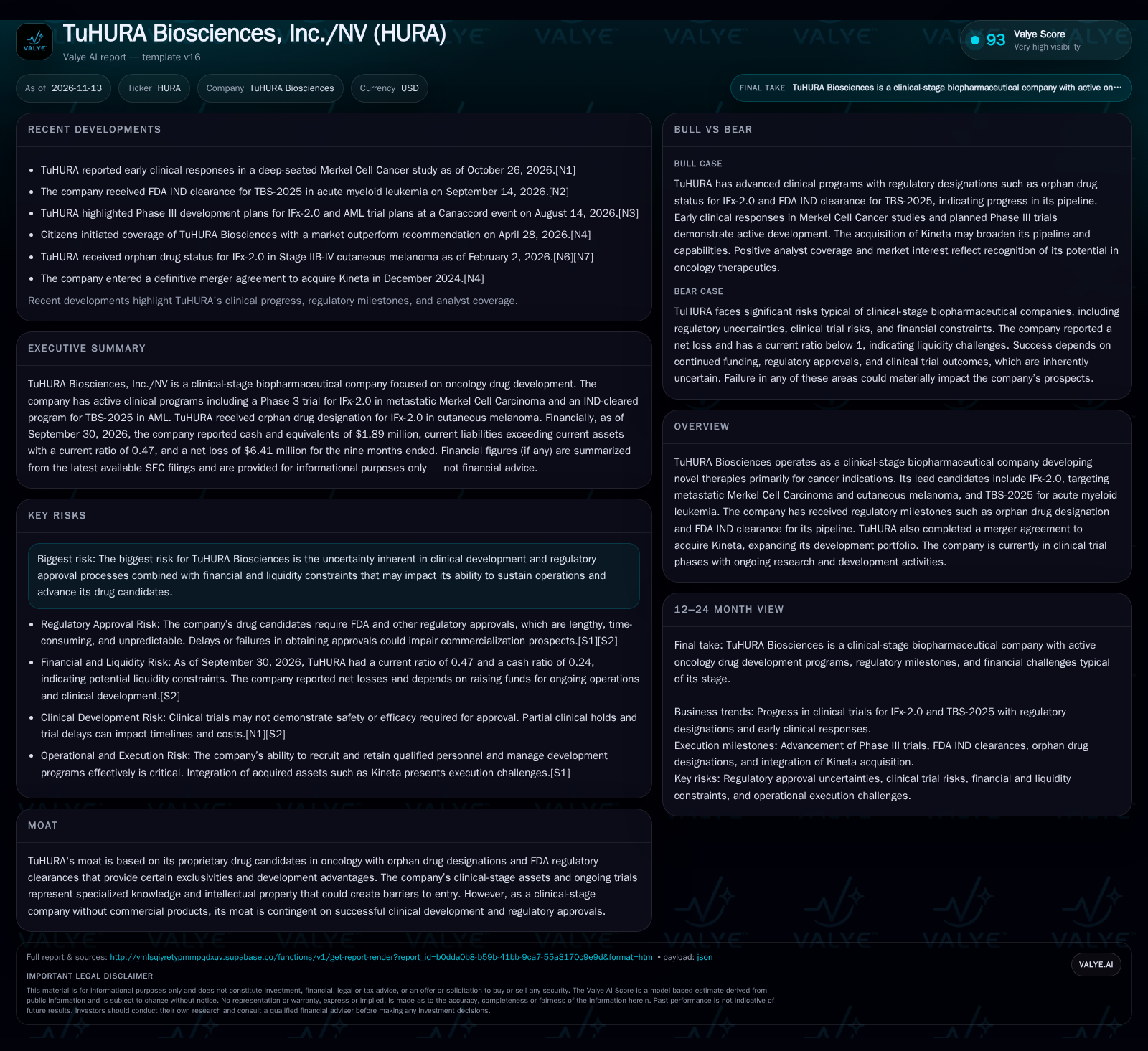
TuHURA Biosciences has advanced IFx-2.0 into a Phase 3 trial for Merkel Cell Carcinoma and secured orphan drug designation for cutaneous melanoma, with early clinical responses reported. The next inflection point hinges on clinical trial outcomes and near-term financing.
TuHURA Biosciences is positioning itself as a next-generation oncology innovator, with a focus on immune-modulating therapies for high-need cancer indications. The company’s recent regulatory wins—including FDA orphan drug status for IFx-2.0 and IND clearance for TBS-2025—underscore meaningful pipeline momentum.
Regulatory Achievements and Financial Strain Shape the Near-Term Outlook
TuHURA Biosciences has achieved several value-creating regulatory milestones in 2026. IFx-2.0, its lead candidate, received FDA orphan drug designation for Stage IIB-IV cutaneous melanoma in February, and has entered a Phase 3 trial for metastatic Merkel Cell Carcinoma after the lifting of a partial clinical hold. Early clinical responses were reported in a deep-seated Merkel Cell Cancer study in October, suggesting initial biological activity. Meanwhile, TBS-2025 received FDA IND clearance for acute myeloid leukemia. However, these advances are set against a challenging financial backdrop: as of September 30, 2026, the company reported cash and equivalents of $1.89 million, current liabilities of $7.76 million, and a current ratio of 0.47. Net losses totaled $6.41 million for the nine-month period, underscoring the urgent need for additional funding to support ongoing clinical operations. [N1] [N2] [N6] [N7] [S2]
Pipeline Progress, Fixed Costs, and the Funding Treadmill
As a clinical-stage biotech, TuHURA’s business model is characterized by high fixed R&D expenditures, low current revenue, and a heavy reliance on external capital to fund operations through value-creating milestones. The company’s economics are driven almost entirely by the progression of its pipeline: success in late-stage trials could unlock lucrative licensing deals, partnerships, or eventual commercialization, especially given orphan drug exclusivities that may provide seven years of market protection in the U.S. if approved. However, until pivotal data readouts, the company generates no product revenue and must regularly raise funds to cover trial costs, personnel, and G&A. The financial structure means operating leverage is negative until a licensing or approval event, at which point margins could rapidly expand if the company can commercialize or out-license a successful drug.
The capital-intensive nature of clinical-stage biotechnology firms like TuHURA necessitates a finely tuned balance between cash burn and milestone-driven financing. Given the extended timelines typical of oncology trials, the company must maintain reported liquidity position not only to complete pivotal studies but also to manage the iterative regulatory interactions and potential trial amendments that often arise. The timing and structure of financing rounds can materially affect shareholder dilution and operational flexibility; thus, strategic capital raises aligned with positive clinical readouts or regulatory endorsements can optimize valuation. Additionally, the company’s ability to leverage non-dilutive funding sources such as grants, collaborations, or milestone-based partnerships could mitigate financing risks and extend the operational runway without immediate equity issuance.
Orphan Indications and Proprietary Platform: Barriers and Vulnerabilities
TuHURA’s core competitive asset is its proprietary immunotherapy approach, targeting rare and aggressive cancers with high unmet need. Orphan drug designation for IFx-2.0 in melanoma provides regulatory exclusivity, potential tax credits, and expedited review, while IND clearance for TBS-2025 positions the company in the AML space—a field with significant innovation but also intense competition from both large pharma and other biotechs. The company’s moat is predicated on successful clinical validation and regulatory approval: if IFx-2.0 demonstrates compelling efficacy and a manageable safety profile in Phase 3, the orphan indication could limit direct competition and could support premium pricing. However, the lack of commercial products, ongoing financial strain, and the possibility of rapid advances by better-capitalized competitors or new entrants in immuno-oncology represent real vulnerabilities. Switching costs for prescribers and payers are low until clinical superiority is proven and reimbursement established.
TuHURA’s focus on orphan indications inherently provides a strategic advantage by reducing competitive density and enabling regulatory incentives. However, the immuno-oncology landscape is rapidly evolving, with numerous entrants pursuing similar mechanisms of action or targeting overlapping patient populations. The company’s proprietary platform must therefore demonstrate not only efficacy but also a differentiated safety or convenience profile to secure a durable market position. Furthermore, payers and health technology assessment bodies increasingly demand robust pharmacoeconomic evidence, especially for high-cost orphan therapies. TuHURA’s future commercial success will depend on its ability to generate compelling clinical and real-world data that justify premium pricing and reimbursement, which is conditional on the eventual demonstration of meaningful clinical benefit and manageable toxicity.
Breakthrough Data and Strategic Funding Catalyze Value Creation
If TuHURA’s Phase 3 trial for IFx-2.0 generates statistically significant efficacy and a favorable safety profile in metastatic Merkel Cell Carcinoma, the company could rapidly shift from a speculative asset to a partner of choice for larger pharma. Orphan drug status would help accelerate the regulatory pathway and could support premium pricing. Early clinical responses already reported provide a basis for optimism, but durable and replicable results in a larger cohort would be required for inflection. Simultaneously, positive interim data could enable non-dilutive funding (e.g., partnerships, grants) or more favorable equity raises. Pipeline expansion into AML with TBS-2025, if early efficacy is shown, could further diversify risk. Confirmation would come from positive top-line Phase 3 data, partnership announcements with upfront payments, or a substantial capital raise on improved terms. Falsification would involve trial setbacks, inability to raise funds, or inconclusive efficacy signals.
Incremental Clinical Progress Amid Serial Dilution and Execution Risk
The most plausible path for TuHURA involves steady enrollment and data accrual in its Phase 3 and AML trials, punctuated by periodic capital raises to maintain operations. Modest but positive clinical data could keep the pipeline alive, but likely at the cost of substantial shareholder dilution given the company’s weak balance sheet and negative cash flow. Regulatory exclusivities and the rarity of target indications may support continued interest, but without clear breakthrough efficacy or a strategic partner, TuHURA could remain in a cycle of incremental progress and funding risk. This scenario would be confirmed by continued trial updates, bridge financings, and no major clinical failures, while falsification would involve a halt in trial progress or an inability to secure necessary capital.
Clinical Setbacks or Capital Shortfalls Force Restructuring or Asset Sales
The adverse scenario for TuHURA would be triggered by negative or inconclusive results in the IFx-2.0 Phase 3 trial, safety issues, or regulatory setbacks that undermine the value of its lead assets.Given the company’s reported current ratio and limited cash, any delay or failure could quickly exhaust financial resources, forcing TuHURA to halt trials, pursue asset sales, or restructure. The risk is amplified by the absence of commercial revenue and limited ability to secure non-dilutive funding at this stage. Downside confirmation would include trial terminations, going concern warnings, workforce reductions, or announcements of strategic alternatives. Falsification would require timely positive data, new funding, or partnership inflows that extend the runway.
Milestones That Will Define TuHURA’s Clinical and Financial Trajectory
Interim and final efficacy results from the Phase 3 trial of IFx-2.0 in metastatic Merkel Cell Carcinoma—top-line data would serve as the most important value inflection point.
Updates on patient enrollment rates and trial timelines for both IFx-2.0 and TBS-2025—slower-than-expected enrollment could signal operational or recruitment challenges.
Announcements of new financing rounds, strategic partnerships, or non-dilutive funding sources, which would directly impact runway and ability to continue development.
Any clinical hold, delay, or safety-related setback in ongoing trials, as these would threaten both pipeline value and operational continuity.
Cash burn rates and updated balance sheet disclosures—if disclosed, quarterly updates on cash and equivalents versus liabilities would help gauge near-term solvency risk.
Progression of TBS-2025 into active clinical trials for AML and any early efficacy or safety signals reported.
Changes in regulatory status, such as additional orphan drug designations or fast track/priority review assignments, which could accelerate development or enhance asset value.
External clinical or commercial developments in Merkel Cell Carcinoma or AML that could shift the competitive landscape or alter the perceived value of TuHURA’s pipeline.
Disclaimer: This is research-only, informational analysis and not investment advice. It may include AI-generated interpretation and general industry context. Always verify important details using primary sources.

Comments