
Fathom Holdings: Strategic Uncertainty and Structural Shifts Under Financial Pressure
Its agent-centric, technology-enabled brokerage model is being tested by industry commission upheaval, declining agent count, and a need for capital structure reset.
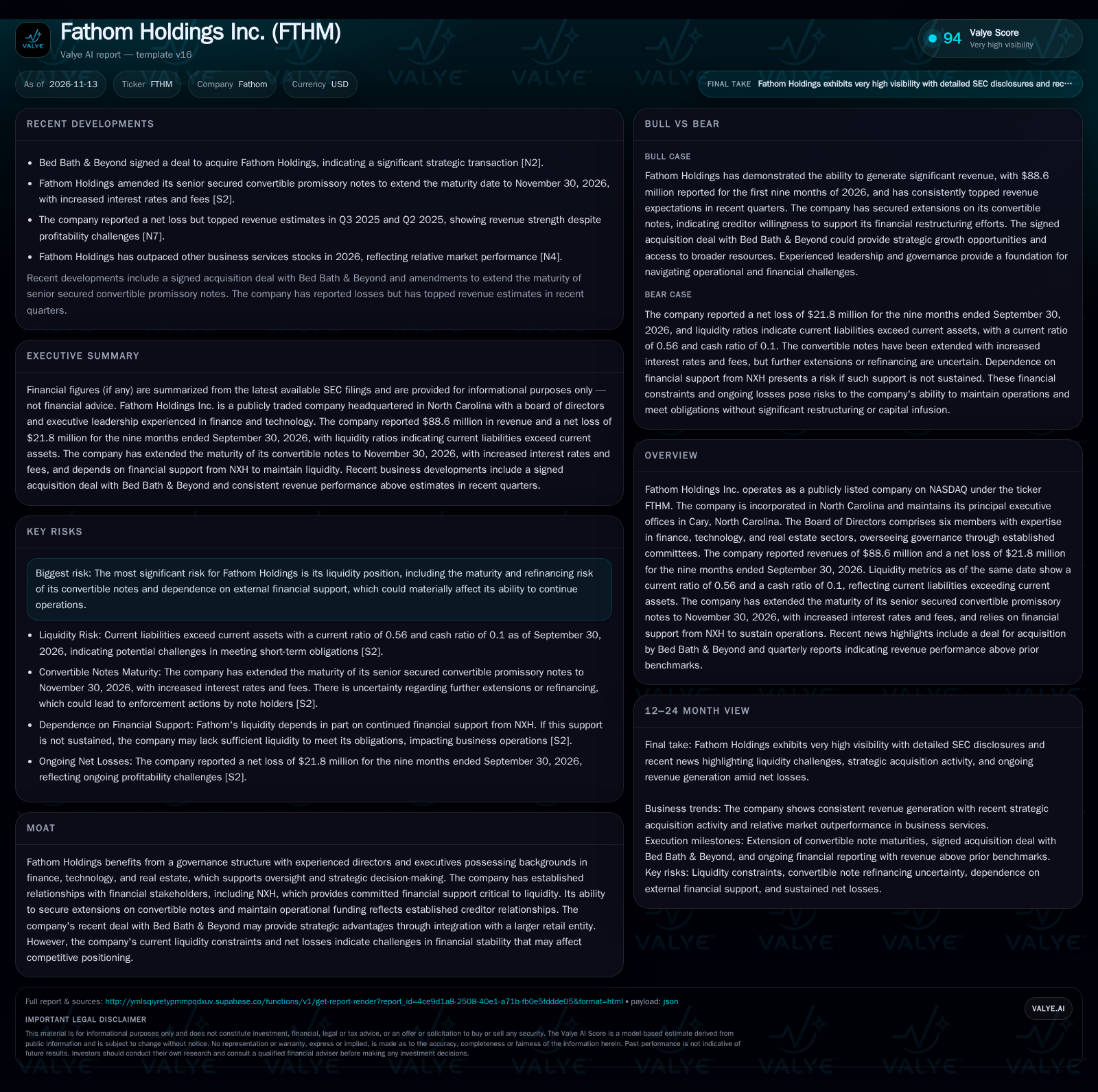
The company has extended convertible note maturities and relies on external financial support, while a pending acquisition by Bed Bath & Beyond adds strategic uncertainty. Its flat-fee, tech-forward brokerage model faces both industry disruption from commission litigation and internal challenges with a sharply reduced agent base. Near-term outcomes hinge on debt resolution, acquisition progress, and the ability to stabilize or grow core operations in a shifting real estate landscape. [S2] [N2]
The company's technology-driven, agent-centric brokerage model—once positioned as a disruptor in the residential real estate sector—is now being tested by both external forces, such as sweeping changes to industry commission structures, and internal pressures including a sharp contraction in its agent base. The next phase for Fathom will depend on its ability to navigate these financial, operational, and industry headwinds while executing a potential transition under new ownership.
Liquidity Strain, Agent Contraction, and Strategic Inflection Define 2026
As of September 30, 2026, Fathom Holdings reported $88.6 million in revenue but a net loss of $21.8 million for the first nine months of the year, continuing a trend of unprofitable operations [S2]. [S2] In response, Fathom has negotiated extensions on its senior secured convertible notes to November 30, 2026, albeit at higher interest rates and fees, but future refinancing is uncertain and enforcement risk remains [S2]. Compounding these financial pressures, the company’s agent count declined by approximately 51% year-over-year, from 13,931 to 6,801 agents, following a strategic rationalization of its agent base [S2]. Finally, a signed acquisition deal with Bed Bath & Beyond adds a new layer of strategic uncertainty and potential transformation [N2].
Tech-Enabled Brokerage Model: Flat Fees, Agent Incentives, and Scale Dependencies
Fathom’s core business economics are anchored in a low-overhead, technology-enabled real estate brokerage model that charges agents a flat fee per transaction rather than a percentage-based commission. This structure is designed to attract agents seeking higher take-home pay, leveraging proprietary software (the intelliAgent platform) and support tools to both lower costs and increase agent productivity. The model’s unit economics rely on transaction volume and agent scale to absorb fixed technology and support costs, with incremental margins improving as more transactions pass through the platform.
The sharp reduction in agent count in 2026 poses a direct challenge to this model, as fewer agents and transactions threaten both top-line growth and the realization of operating leverage. Additionally, Fathom operates mortgage and title segments, aiming for cross-sell opportunities and incremental revenue per transaction. However, ongoing net losses and negative cash flow suggest that current volumes are insufficient to cover overhead and debt service, especially given the increased interest burden from recent note amendments [S2].
The capital structure is under acute stress, with near-term maturities on convertible notes and a reliance on external support from NXH. The company reported profitability for the period.
Industry Commission Upheaval, Brokerage Substitutes, and the Battle for Agent Loyalty
Fathom operates in a highly competitive residential real estate services industry, facing pressure from traditional brokerages, discount and flat-fee competitors, tech-enabled platforms, and direct-to-consumer real estate models. The recent litigation and settlement involving the National Association of Realtors (NAR) has upended the traditional commission structure, with new rules prohibiting standard compensation offers on MLS and requiring written buyer-agent agreements [S2].
Fathom’s flat-fee model, which allows agents to negotiate their own commissions, is potentially advantaged in this environment, as it is less tied to legacy commission splits and may appeal to agents seeking flexibility. However, the company’s steep agent contraction suggests challenges in either value proposition, retention, or recruitment. Larger, capitalized platforms may be better positioned to weather industry disruption and invest in technology, marketing, and agent incentives.
Substitutes—including iBuyers, online-only brokerages, and evolving fintech-enabled real estate solutions—continue to pressure margins and agent loyalty. Fathom’s ability to differentiate through technology, training, and the agent experience is critical, but will require investment and a compelling growth narrative amid financial constraints.
Acquisition Closes and Commission Disruption Unlocks Margin Rebound
The most favorable path for Fathom involves a successful closing of the Bed Bath & Beyond acquisition, which could recapitalize the company, reduce debt load, and provide access to a broader customer base or cross-selling opportunities [N2]. If the industry’s commission rule changes accelerate agent migration toward flexible, agent-centric brokerages, Fathom’s flat-fee model could see renewed interest, reversing the agent count decline and driving transaction volume growth.
Margin expansion may follow if scale is restored and integration synergies are realized, particularly if Fathom leverages Bed Bath & Beyond’s brand or resources to enhance technology and marketing. Confirmation of this scenario would include: definitive closing of the acquisition, stabilization or growth in agent headcount, improvement in transaction volumes, and a return to positive operating cash flow. Evidence that would falsify this path includes acquisition delays, further agent attrition, or ongoing net losses with no improvement in capital structure.
Operational Compression Continues Amid Financial Restructuring and Industry Flux
The most plausible near-term scenario is one of continued operational and financial compression: Fathom maintains revenue but remains unprofitable, with agent headcount stabilizing at a lower base. The company continues to rely on external support (such as NXH) and seeks further debt restructuring or bridge financing, while awaiting regulatory or market clarity around the Bed Bath & Beyond deal.
Industry commission changes create both opportunity and risk, but Fathom’s ability to capitalize is muted by resource constraints and competitive recruitment. The mortgage and title segments provide some diversification, but are unlikely to offset weak brokerage performance if agent and transaction counts remain depressed.
Evidence supporting this scenario would include continued net losses, flat or slightly improving agent numbers, ongoing debt amendments, and delayed or incremental acquisition progress. Evidence that would falsify it includes a sudden influx of new agents, a material improvement in profitability, or a definitive acquisition close with immediate operational impact.
Debt Maturity and Liquidity Shortfall Trigger Restructuring or Distressed Sale
In the adverse scenario, Fathom fails to secure additional capital or further debt extensions, leading to a liquidity crisis as note maturities approach and cash reserves remain depleted [S2]. Continued net losses and agent attrition reduce revenue further, making the business unsustainable without a significant capital injection or asset sale.
If the Bed Bath & Beyond acquisition is delayed, renegotiated, or abandoned, Fathom could be forced into a distressed sale, formal restructuring, or even bankruptcy if creditors pursue enforcement. Industry disruption may accelerate agent flight to better-capitalized competitors, compounding the revenue decline.
Confirmation of this scenario would include: missed debt payments, public disclosure of going-concern issues, rapid declines in agent and transaction volume, or withdrawal of acquisition offers. Falsification would require a clear, timely capital solution or a major operational rebound.
Concrete Signs That Will Clarify Fathom’s Trajectory in a Shifting Landscape
Closing status and terms of the Bed Bath & Beyond acquisition, including any announced integration plans or capital commitments.
Monthly or quarterly agent headcount trends, as further declines or stabilization will directly impact revenue potential and market positioning.
Transaction volume and revenue per agent, if disclosed, to assess whether operational leverage and productivity are improving.
Updates on convertible note refinancing, extensions, or any new debt or equity capital raised to address the looming maturity.
Changes in cash and equivalents on the balance sheet, as persistent low levels heighten liquidity risk.
Disclosure of customer churn or retention in mortgage and title segments, which may indicate cross-sell effectiveness or segment resilience.
Industry-wide shifts in commission practices and any evidence that Fathom is capturing market share from traditional models.
Management commentary or strategic updates regarding cost structure adjustments, technology investment priorities, or new agent incentives.
Disclaimer: This is research-only, informational analysis and not investment advice. It may include AI-generated interpretation and general industry context. Always verify important details using primary sources.

Comments