
CV Sciences: Brand Diversification and Regulatory Inflection in Hemp-Derived Wellness
CV Sciences, Inc. leverages its leading +PlusCBD™ brand and recent expansion into plant-based foods to diversify revenue streams. However, the company confronts a pivotal regulatory shift with stricter THC limits looming, reported liquidity position, and intense market fragmentation, forcing a delicate balance between innovation, compliance, and operational viability.
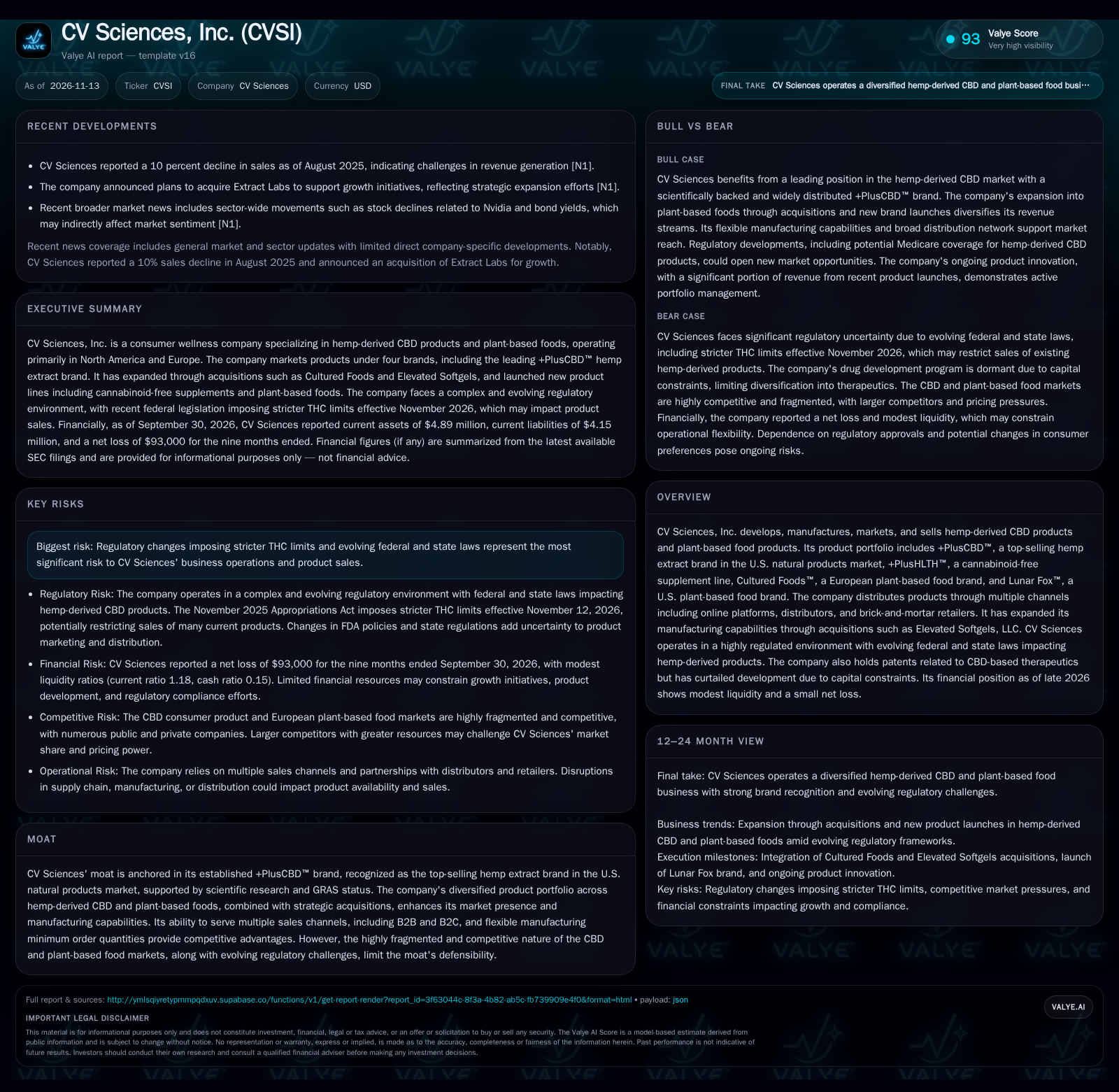
CV Sciences, Inc. is navigating a complex phase: it remains a top player in hemp-derived CBD with +PlusCBD™ and has broadened its portfolio through acquisitions and new plant-based brands. Yet, the company faces near-term regulatory headwinds as new federal THC limits take effect, alongside ongoing financial constraints and competitive pressures in both CBD and plant-based food sectors. The next year will test whether its innovation and brand leverage can offset these risks and catalyze sustainable growth. [S2]
CV Sciences, Inc. stands at a crossroads defined by both opportunity and constraint. With +PlusCBD™ consolidating its leadership in U.S. hemp-derived wellness and a series of acquisitions propelling the company into plant-based foods, CV Sciences is actively reshaping its portfolio to capture evolving consumer preferences. Yet, the impending implementation of stricter federal THC limits and modest financial resources pose immediate risks to its core business and innovation agenda. The company’s performance in the coming quarters will reveal whether its diversified strategy and brand equity can counterbalance intensifying compliance obligations and competitive dynamics. [S2]
Stricter THC Limits and Portfolio Expansion Define Current Operating Reality
The most material current fact is the imminent regulatory change: the November 2025 Appropriations Act sets stricter THC limits on hemp-derived products, effective November 12, 2026. This change could directly impact the composition and legality of CV Sciences’ signature +PlusCBD™ line, potentially requiring costly reformulations or risking product delistings if compliance cannot be achieved. [S2]
Simultaneously, CV Sciences has actively broadened its portfolio—notably, 39% of 2025 net revenue was generated by products launched since January 2023, underscoring a rapid innovation cadence. The acquisition of Cultured Foods (plant-based, shelf-stable foods in Europe) and the launch of Lunar Fox (U.S. plant-based foods) mark a deliberate push to diversify beyond CBD-centric offerings. [S2]
On the financial front, as of September 30, 2026, the company reported current assets of $4.89 million, current liabilities of $4.15 million, and a small net loss of $93,000 for the first nine months of the year. The company reported cash and liquidity metrics for the period; these figures do not by themselves establish operating runway, investment capacity, financial flexibility, or financing capacity. [S2]
Revenue Streams, Cost Structures, and the Economics of Innovation
CV Sciences’ revenue is generated through a mix of legacy and newly launched products in hemp-derived supplements, cannabinoid-free wellness, and plant-based foods, with distribution spanning online, B2B, and approximately 2,500 physical retail locations. The core +PlusCBD™ brand likely enjoys higher gross margins due to premium positioning, scientific substantiation, and established brand equity, though pricing power may be constrained by market fragmentation and competitive discounting.
The addition of Cultured Foods and Lunar Fox introduces new volume and product-mix dynamics. Plant-based, shelf-stable foods typically operate on lower margins than branded nutraceuticals but offer greater scale potential and lower regulatory friction. These segments may dilute blended margins but could stabilize revenue against CBD-specific headwinds.
Operating leverage is mixed: manufacturing acquisitions like Elevated Softgels provide some fixed-cost absorption and the flexibility to serve B2B partners with lower minimum order quantities, a potentially valuable niche versus larger, less agile competitors. However, innovation—39 new products since 2023—demands ongoing investment in R&D, marketing, and compliance, pressuring operating expenses. Capital needs are moderate but persistent, with reported cash balance constraining the pace and scope of future launches or regulatory adaptation. [S2]
Fragmented Markets, Brand Leverage, and Flexible Manufacturing: Where CV Sciences Stands
CV Sciences competes in two highly fragmented arenas: U.S. hemp-derived CBD products and European/U.S. plant-based foods. In the CBD space, the +PlusCBD™ brand’s top-selling status in the natural products channel confers some first-mover and trust advantages, supported by clinical research and GRAS status. This could foster consumer loyalty and retailer preference—key switching-cost mechanisms if regulatory clarity persists.
However, the CBD category is crowded with both public and private firms, many with deeper pockets, broader portfolios, or direct-to-consumer muscle. Retailers can easily substitute competing brands if regulatory or pricing disadvantages emerge.
The plant-based food segment, while offering diversification, is equally fragmented and subject to rapidly shifting consumer trends. Cultured Foods and Lunar Fox must carve out a differentiated niche—whether through clean-label positioning, taste, or distribution breadth. The recent acquisition of Elevated Softgels gives CV Sciences flexibility in B2B manufacturing, allowing it to serve smaller supplement brands that larger contract manufacturers may overlook.
Sustainable competitive advantage will likely depend on the company’s ability to continuously innovate, maintain regulatory compliance, and leverage its distribution relationships—while avoiding margin erosion in the face of commodity-like competition.
Unlocking Growth Through Regulatory Tailwinds and Product Innovation
The most favorable scenario for CV Sciences is a convergence of regulatory and commercial catalysts. If the federal government follows through on the Executive Order to reschedule marijuana and facilitate access to hemp-derived cannabinoids—and if Medicare or other major payors begin covering hemp-derived CBD products—CV Sciences could see a dramatic expansion of its total addressable market. This would validate the clinical research behind +PlusCBD™ and allow the brand to move beyond niche wellness into mainstream, reimbursed healthcare.
Meanwhile, if the company’s rapid innovation pace (39% of 2025 revenue from new products) yields breakout successes in either plant-based foods or cannabinoid-free supplements, the revenue mix could shift toward higher-growth categories less exposed to CBD-specific regulatory risk.
Confirmation of this scenario would require: (1) clear regulatory guidance allowing continued sale of +PlusCBD™ products post-2026, (2) evidence of Medicare or private insurance reimbursement for CBD, (3) accelerating sales growth in recently launched brands (Cultured Foods, Lunar Fox, +PlusHLTH™), and (4) improved profitability or margin expansion from manufacturing synergies or operating leverage.
Maintaining Share in a Tightening Regulatory and Competitive Landscape
The most plausible path is one in which CV Sciences manages to comply with new THC regulations—possibly by reformulating products or shifting emphasis to compliant SKUs—while maintaining its core +PlusCBD™ franchise and capturing modest growth in plant-based and cannabinoid-free lines. Revenue growth may be muted as the company offsets potential declines in legacy CBD SKUs with incremental gains from new products.
Operational discipline will be critical: the company must balance innovation investments with cash preservation, manage working capital tightly, and avoid major supply chain or compliance disruptions. Competitive pressures are likely to persist, making it difficult to achieve meaningful price increases or margin expansion.
Evidence supporting this scenario would include: (1) stable or slightly growing revenue despite regulatory headwinds, (2) continued product launches with measurable shelf gains at retail, (3) modest improvements in net income or cash flow, and (4) no major loss of key distribution relationships.
Regulatory Shock and Financial Strain Create a Downward Spiral
In the adverse scenario, the November 2026 THC limits prove highly disruptive, forcing CV Sciences to withdraw or reformulate a significant portion of its +PlusCBD™ line at substantial cost. If reformulation is not feasible or erodes consumer trust, sales could drop sharply, with knock-on effects for cash flow and retailer relationships.
Simultaneously, if new product launches in plant-based foods and supplements fail to gain traction—due to poor differentiation, execution missteps, or competitive responses—the company’s diversification efforts may not offset core declines.
Financial strain could be exacerbated by reported liquidity position: with only $611,000 in cash and a current ratio barely above 1.0, CV Sciences has little margin for error. Inability to bridge to profitability or secure additional capital could force retrenchment, asset sales, or even restructuring.
Confirmation would come from: (1) sharp revenue declines post-November 2026, (2) significant write-downs or inventory obsolescence, (3) negative operating cash flow, and (4) loss of major retail partners or B2B customers.
Testing the Thesis: What Will Prove CV Sciences’ Resilience or Vulnerability?
The proportion of revenue and gross profit from SKUs that remain compliant with new federal THC limits after November 2026.
Sales growth rates by brand, especially for Cultured Foods, Lunar Fox, and +PlusHLTH™—a useful metric would be quarterly revenue for each new line (if disclosed).
Updates on the regulatory status of hemp-derived CBD, including any new federal guidance or indications of Medicare/private insurance coverage.
Gross margin trends by product category, especially as new plant-based foods scale up.
Retention of distribution relationships—measured by the number of brick-and-mortar locations carrying key brands and any changes in the top three customer concentration (if disclosed).
Cost and operational impact of product reformulations or SKUs discontinued in response to regulatory changes.
Evidence of successful integration and margin contribution from recent acquisitions (Elevated Softgels, Extract Labs)—if disclosed, segment-specific profitability would help test synergy claims.
Disclaimer: This is research-only, informational analysis and not investment advice. It may include AI-generated interpretation and general industry context. Always verify important details using primary sources.

Comments