
Karbon Capital Partners Corp.: SPAC Structure, Blank-Check Uncertainty, and the Search for a Business Combination
Karbon Capital Partners Corp. (KBON) is a recently listed special purpose acquisition company (SPAC) that has not yet identified a target business. With net proceeds from a substantial IPO and a narrow current asset buffer, its future hinges entirely on the successful execution of a merger or acquisition—primarily within energy infrastructure, technology, or security. The scenario analysis revolves around deal sourcing, sponsor incentives, and the risks inherent to prolonged deal timelines and limited disclosure.
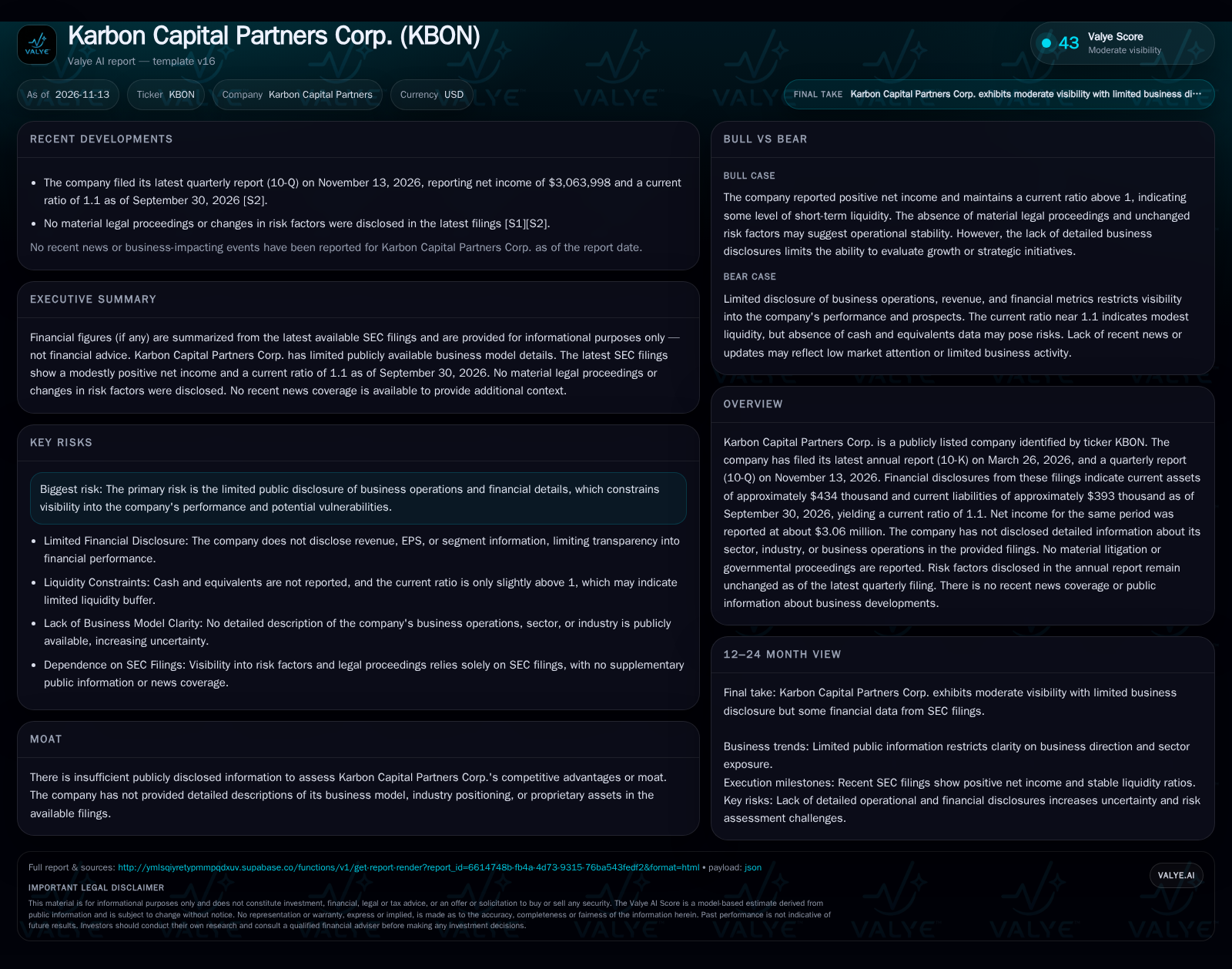
Karbon Capital Partners Corp. is a blank-check company that raised $345 million in an IPO and has yet to announce a business combination. Its current financial disclosures show a modest net income and a current ratio of 1.1, but no operational or revenue details. The company's future value depends on its ability to identify and execute a value-accretive acquisition, particularly in the power generation, energy infrastructure, or energy technology sectors. Prolonged deal delays, lack of disclosure, or failure to secure a suitable target are the primary risks.
Karbon Capital Partners Corp. (KBON) stands as a textbook example of a blank-check or special purpose acquisition company (SPAC) at its pre-deal stage: flush with IPO proceeds, but offering minimal insight into its future operating profile. Having raised $345 million in December 2025, Karbon is now in the high-stakes process of searching for an acquisition in energy infrastructure, technology, or security. With no operating business, revenue, or sector exposure disclosed, the company’s future hinges on the quality and timing of its eventual deal. Investors face a landscape defined by opacity, sponsor incentives, and the ticking clock of SPAC timelines.
Recent IPO, Clean Slate, and a Narrow Liquidity Buffer
Karbon Capital Partners Corp. completed its IPO on December 12, 2025, raising $345 million by selling 34.5 million units at $10 each, with each unit comprising one Class A share and a fraction of a redeemable warrant [S1]. As of September 30, 2026, the company reported current assets of $433,856 against current liabilities of $392,800, yielding a current ratio of 1.1. Net income for the period was $3,063,998, but no revenue or business segment information has been disclosed [S2]. There are no material legal or regulatory proceedings reported, and risk factors remain unchanged. The absence of operational detail means investors are dependent on the company’s ability to identify and execute a suitable business combination, with the current asset buffer suggesting limited flexibility for ongoing expenses if the search is prolonged.
SPAC Economics: Cash in Trust, Sponsor Incentives, and the Deal Imperative
As a SPAC, Karbon Capital Partners’ economic model is contingent on sourcing and consummating a merger or acquisition—typically referred to as a 'de-SPAC' transaction. The company’s $345 million in gross IPO proceeds are largely held in trust, intended to fund the future acquisition and provide redemption options to shareholders who may opt out. Sponsor economics are structured around ownership of founder shares and warrants, which only become valuable if a deal is completed and the post-combination entity performs well.
The absence of operating revenue means ongoing administrative and search expenses must be covered by relatively limited non-trust assets, as evidenced by the modest current asset buffer. If the SPAC fails to close a deal within the prescribed timeframe (usually 18-24 months post-IPO, unless extended), it must return funds to shareholders, and sponsor capital is at risk. This dynamic creates pressure to find a target, but also the risk of suboptimal deal-making if timelines are tight. The economics for public shareholders depend on the quality of the acquisition, redemption rates, and the eventual valuation of the combined entity.
Deal-Making in a Crowded SPAC Universe: Where Karbon Must Differentiate
Karbon Capital Partners is one of many SPACs seeking targets in the energy infrastructure and technology sectors—a space crowded with both blank-check competitors and traditional private equity or corporate acquirers. The company’s stated sector focus positions it in a competitive field where attractive targets are often courted by multiple suitors, driving up valuations and compressing the potential for outsized returns.
Without a disclosed management track record or unique sourcing advantage, Karbon’s ability to stand out may hinge on sponsor relationships, credibility with target company founders, and the willingness to structure flexible or creative deal terms. SPACs with deep sector expertise, operating partnerships, or differentiated capital structures may have an edge. Substitutes for a SPAC deal include traditional IPOs, direct listings, or private equity exits—each with their own trade-offs in terms of speed, certainty, and dilution. In this environment, Karbon’s competitive position is unproven until a target is announced and the rationale for the transaction is revealed.
A Value-Accretive Acquisition Could Unlock Significant Upside
The most favorable scenario for Karbon Capital Partners would involve identifying and negotiating a merger with a high-growth, underappreciated company in the energy or infrastructure technology space. If the target has strong fundamentals, secular tailwinds, and a clear public market narrative, the resulting business combination could deliver material upside for both public shareholders and sponsors.
Evidence that would confirm this scenario includes the announcement of a well-regarded target with a compelling growth profile, clear disclosure of pro forma financials, and minimal shareholder redemptions at the time of the merger vote. Additional confirmation would come from positive market reaction, the ability to attract PIPE (private investment in public equity) investors, and the post-deal entity trading above the $10 unit price. Conversely, delays in announcing a target or the selection of a business with weak growth prospects would undermine this scenario.
Likely Path: Extended Search and Modest Deal Terms
Given the crowded SPAC landscape and the late stage of the current SPAC cycle, the most plausible outcome is that Karbon will take much of its allowed timeline to identify a target—likely in an energy-adjacent sector but possibly outside its initial stated focus if suitable targets prove elusive. Deal terms may be less favorable than those achieved by earlier SPACs due to heightened competition for targets and increased scrutiny from public market investors.
Confirmation of this scenario would include the announcement of a target after a protracted search period, with moderate redemption rates and a post-deal share price near or slightly below the $10 redemption threshold. Falsification would occur if Karbon either quickly announces a high-quality target or fails to announce any deal and liquidates, returning funds to shareholders.
Deal Failure or Suboptimal Acquisition Could Destroy Shareholder Value
The primary risk for Karbon Capital Partners is that the search for a suitable acquisition either fails outright (resulting in liquidation) or culminates in a value-destructive deal. If the company is unable to secure a credible target before its deadline, it must return most of the trust proceeds to shareholders, leaving sponsors with sunk costs and public investors with only nominal interest income.
Alternatively, if Karbon executes a merger with a target of questionable quality, faces high redemption rates, or fails to secure PIPE financing, the post-merger entity could trade below the original unit price, eroding shareholder value. Signs of this scenario would include delays in deal announcements, vague or unfavorable deal terms, high redemption rates, or a post-combination entity that struggles to meet disclosed projections.
Milestones and Disclosures That Will Define Karbon’s Prospects
Announcement of a definitive merger agreement or letter of intent with a specific target—this is the single most material inflection point for the SPAC thesis.
Disclosure of pro forma financials and operating metrics for the proposed target, if provided, would allow for evaluation of growth prospects and valuation.
Levels of shareholder redemption at the time of the merger vote—high redemptions may signal weak confidence and reduce capital available for the combined entity.
PIPE (private investment in public equity) participation and pricing, if any, would indicate outside investor validation of the deal.
Sponsor and management alignment, including any additional capital commitments or changes to promote structure, would help assess incentives and risk sharing.
Regulatory or shareholder approval progress—delays or obstacles could threaten deal completion.
Cash burn rate and use of non-trust assets during the search period, if disclosed, would inform on sustainability and financial discipline.
Any extension of the SPAC timeline or changes to the trust structure would signal deal-making challenges or evolving sponsor strategy.
Disclaimer: This is research-only, informational analysis and not investment advice. It may include AI-generated interpretation and general industry context. Always verify important details using primary sources.

Comments