
enCore Energy: Advancing U.S. Uranium Production with ISR Technology and Scale Validation
enCore Energy operates fully licensed ISR uranium extraction plants in Texas and holds multi-year sales contracts, but remains an exploration-stage issuer without proven reserves. Its phased growth, joint ventures, and baseload contracting offer a path to scale—yet the economics hinge on commercial execution, regulatory stability, and the ability to convert resources into profitable, long-term supply.
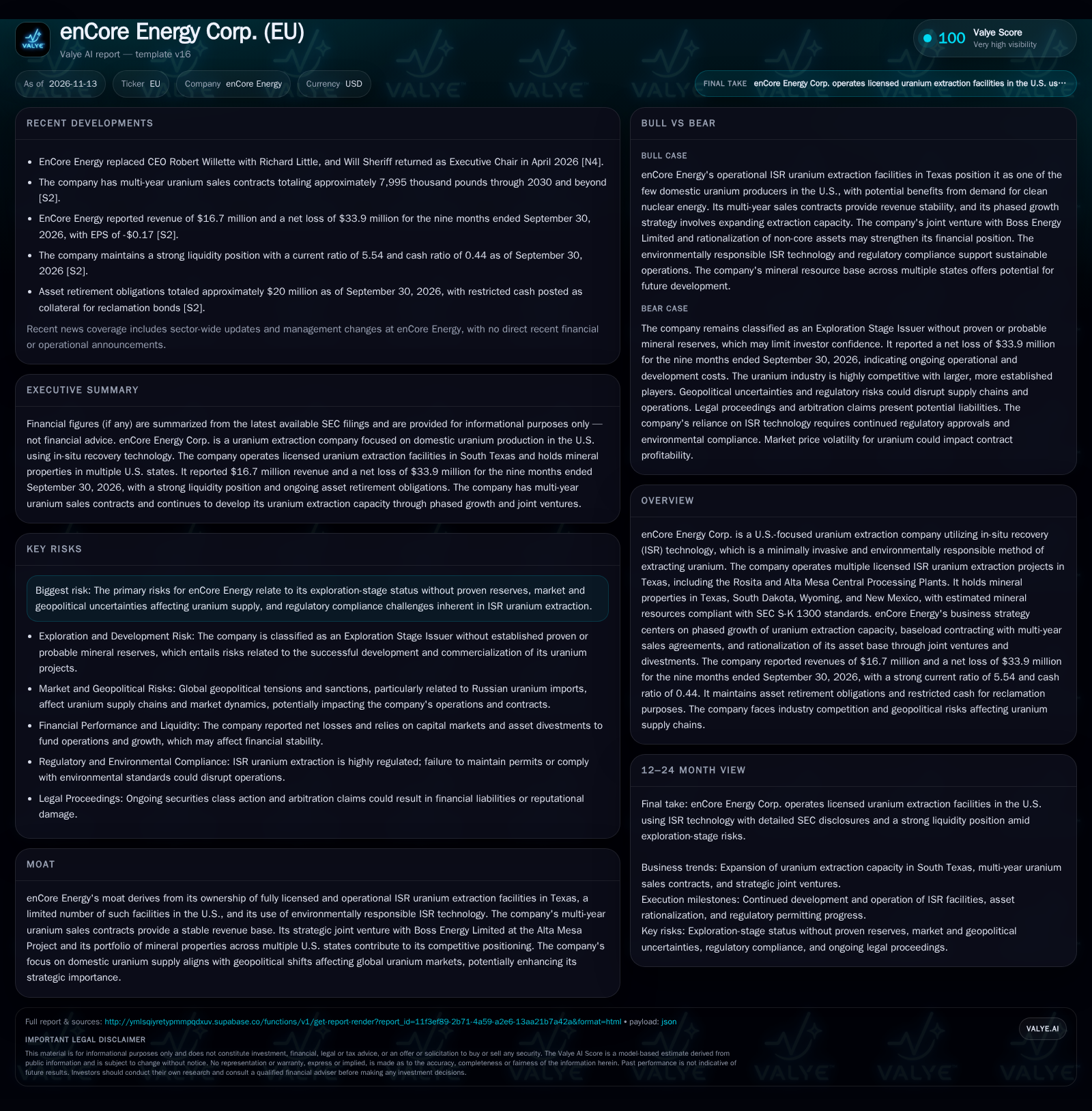
enCore Energy is a U.S.-focused uranium extractor using in-situ recovery, with licensed facilities operating in Texas and a portfolio of multi-year uranium sales contracts. While its assets and partnerships position it for growth, the company remains at the exploration stage with no proven reserves, reporting a net loss for 2026 year-to-date. The thesis turns on whether enCore can translate resource estimates into sustainable, profitable production while navigating regulatory, market, and operational risks. [S1] [S2]
enCore Energy stands at the nexus of U.S. nuclear supply chain ambitions and the realities of uranium project development. With fully licensed in-situ recovery (ISR) facilities in Texas and a baseload of multi-year uranium sales contracts, the company is one of the few domestic players positioned to capitalize on geopolitical and clean-energy tailwinds. However, its exploration-stage status—meaning no proven or probable reserves—raises fundamental questions about scalability, sustainable margins, and the reliability of future cash flows. The next phase depends on enCore’s ability to bridge the gap from resource potential to commercial certainty, while managing regulatory, market, and operational risks.
Current Position: Licensed Sites, Contract Portfolio, and Exploration Limitations
enCore Energy operates two fully licensed and operational ISR uranium processing plants in South Texas—the Rosita and Alta Mesa Central Processing Plants—supported by a portfolio of mineral properties across Texas, South Dakota, Wyoming, and New Mexico. As of September 30, 2026, the company reported $16.7 million in revenue and a net loss of $33.9 million for the first nine months, maintaining a current ratio of 5.54 and a cash ratio of 0.44. enCore holds multi-year uranium sales contracts totaling approximately 7,995 thousand pounds through 2030 and beyond, providing a possible foundation for revenue visibility if operational ramp-up is successful. However, the company remains classified as an Exploration Stage Issuer under SEC S-K 1300, as it has not established proven or probable mineral reserves through pre-feasibility or feasibility studies. This status introduces significant uncertainty about the scalability and commercial reliability of its resource base. [S1] [S2]
Evaluating ISR Economics: Revenue Streams, Cost Dynamics, and Margin Improvement Prospects
enCore’s economic model is built around in-situ recovery (ISR) of uranium, which is generally less capital-intensive and more environmentally benign than conventional mining. ISR leverages a lixiviant of oxygen and sodium bicarbonate to extract uranium from permeable sandstone formations, minimizing surface disruption and reducing upfront infrastructure costs. Variable costs are driven by wellfield drilling, chemical reagents, energy, and labor, while fixed costs reflect plant maintenance, regulatory compliance, and asset retirement obligations.
The company’s reported revenue of $16.7 million against a net loss of $33.9 million suggests that current production, even with licensed plants, is not yet at economic scale or is being offset by significant development and overhead costs. Multi-year sales contracts could provide price and volume stability, but without established reserves and demonstrated wellfield performance, contract fulfillment and margin realization remain uncertain. Asset retirement obligations of approximately $20 million and restricted cash for reclamation further weigh on free cash flow. enCore’s phased growth strategy—expanding wellfields and processing throughput as demand and capital permit—offers operating leverage if resource conversion and cost discipline can be achieved. [S2]
Capital needs will likely remain high as the company seeks to delineate resources, develop additional wellfields, and maintain regulatory compliance. Access to external financing or further asset rationalization (such as joint ventures) may be necessary to bridge the gap to sustained positive margins.
Establishing a U.S. Uranium Presence: Strategic Strengths, Market Risks, and ISR’s Impact
enCore’s core advantage lies in its status as one of the few operators of fully licensed ISR uranium extraction plants in the United States, a country seeking to secure domestic nuclear fuel supply amid geopolitical disruptions. The use of ISR technology positions the company as a lower-cost, environmentally responsible alternative to conventional mining, which could attract utility customers seeking stable, ESG-compliant sources.
However, enCore faces significant counterforces. The uranium industry is dominated by larger, established producers—both domestic and international—with greater financial resources, proven reserves, and established customer relationships. The company’s exploration-stage classification means it must compete for capital and contracts without the certainty provided by proven reserves or a demonstrated long-term production track record.
Potential substitutes include imported uranium (subject to regulatory and geopolitical risk), as well as new supply from other ISR projects or advanced nuclear fuel cycles. Regulatory delays, environmental scrutiny, and community opposition could also impede expansion. While enCore’s joint venture strategy (e.g., the 30% sale of Alta Mesa to Boss Energy Limited) may help spread risk and unlock capital, it also dilutes direct exposure to future upside from these assets.
Unlocking Full Potential: Transitioning Resources into Proven Reserves
The favorable scenario for enCore hinges on successfully converting its measured, indicated, and inferred uranium resources into proven and probable reserves through pre-feasibility or feasibility studies. Achieving reserve status would provide the technical and economic validation needed to underpin long-term contracts, unlock lower-cost capital, and support sustained production ramp-up.
If the company demonstrates reliable, scalable wellfield performance at Rosita and Alta Mesa, meets or exceeds contract deliveries, and achieves positive operating cash flow, its market credibility and valuation could improve materially. Additional upside could come from rising uranium prices, regulatory incentives for domestic production, or further successful joint ventures that de-risk asset development while preserving operational control.
Confirmation would require: public release of feasibility studies upgrading resources to reserves; evidence of multi-year production at or above guidance; positive operating margins; and new contract wins or extensions with major utilities based on demonstrated performance. Conversely, delays in reserve conversion, persistent production shortfalls, or inability to achieve contracting milestones would challenge this scenario.
Expected Developments: Gradual Wellfield Expansion, Contract Delivery, and Cash Flow Considerations
The most likely outcome is that enCore continues to expand wellfield capacity at its Texas facilities, incrementally increasing uranium output while working to demonstrate technical and commercial viability. Revenues from existing sales contracts may help offset operating costs, but persistent net losses are probable until production scales materially and/or costs are further rationalized.
The company may pursue additional joint ventures or asset sales to fund ongoing development and manage risk. Regulatory compliance and environmental stewardship will remain central to maintaining licenses and community support. enCore’s exploration-stage status may persist for several years if reserve conversion remains slow, limiting access to lower-cost capital and constraining broader market acceptance.
This scenario would be confirmed by steady, but modest, increases in annual uranium output, continued reporting of net losses or breakeven results, and a gradual build-out of wellfields and processing infrastructure. Falsification would come from a step-change in reserves, a sharp inflection to profitability, or a material regulatory or operational setback.
Risks to Growth: Regulatory, Operational, and Market Challenges to Resource Conversion
The adverse scenario involves enCore being unable to convert its resource base into proven reserves or reliable long-term production. Regulatory setbacks—such as permitting delays, environmental non-compliance, or community opposition—could halt expansion or even curtail existing operations. Operational difficulties (e.g., wellfield underperformance, cost overruns, or technical failures) could lead to persistent cash burn and erode management’s ability to fulfill multi-year contracts.
Market risks include a sustained decline in uranium prices, weakening demand from utilities, or a reversal of current geopolitical tailwinds favoring domestic supply. Legal proceedings, while not currently deemed probable or estimable, could crystallize into material financial liabilities. Asset retirement obligations and restricted cash requirements could further pressure liquidity if cash inflows disappoint.
This scenario would be confirmed by missed contract deliveries, significant regulatory actions, rising net losses without offsetting capital inflows, or a forced sale of core assets under distressed conditions. Conversely, successful permitting, cost containment, and incremental production growth would challenge the downside thesis.
Factors That Will Confirm enCore’s Viability or Indicate Emerging Difficulties
Progress in upgrading mineral resources to proven and probable reserves through published pre-feasibility or feasibility studies—if disclosed—would be a critical indicator of commercial viability.
Annual uranium production volumes from the Rosita and Alta Mesa plants, and whether they meet or exceed internal and contractual targets.
Updates on contract fulfillment rates, including any disclosures of delivery shortfalls, renegotiations, or new long-term contract awards.
Cash flow from operations and the trajectory of net losses or movement toward profitability as production scales.
Changes in asset retirement obligations or restricted cash requirements, reflecting regulatory actions, reclamation progress, or unforeseen liabilities.
Outcomes of ongoing legal proceedings or new litigation/arbitration developments that could impact financial or reputational standing.
Further joint venture transactions, asset sales, or capital raises that alter the company’s funding profile or operational control.
Regulatory or permitting milestones at new or existing projects, especially any delays, denials, or new compliance requirements.
Disclaimer: This is research-only, informational analysis and not investment advice. It may include AI-generated interpretation and general industry context. Always verify important details using primary sources.

Comments