
MariMed’s Vertically Integrated Cannabis Model: Brand Expansion, Capital Constraints, and Regulatory Crosswinds
MariMed operates with vertically integrated facilities and proprietary brands across multiple U.S.
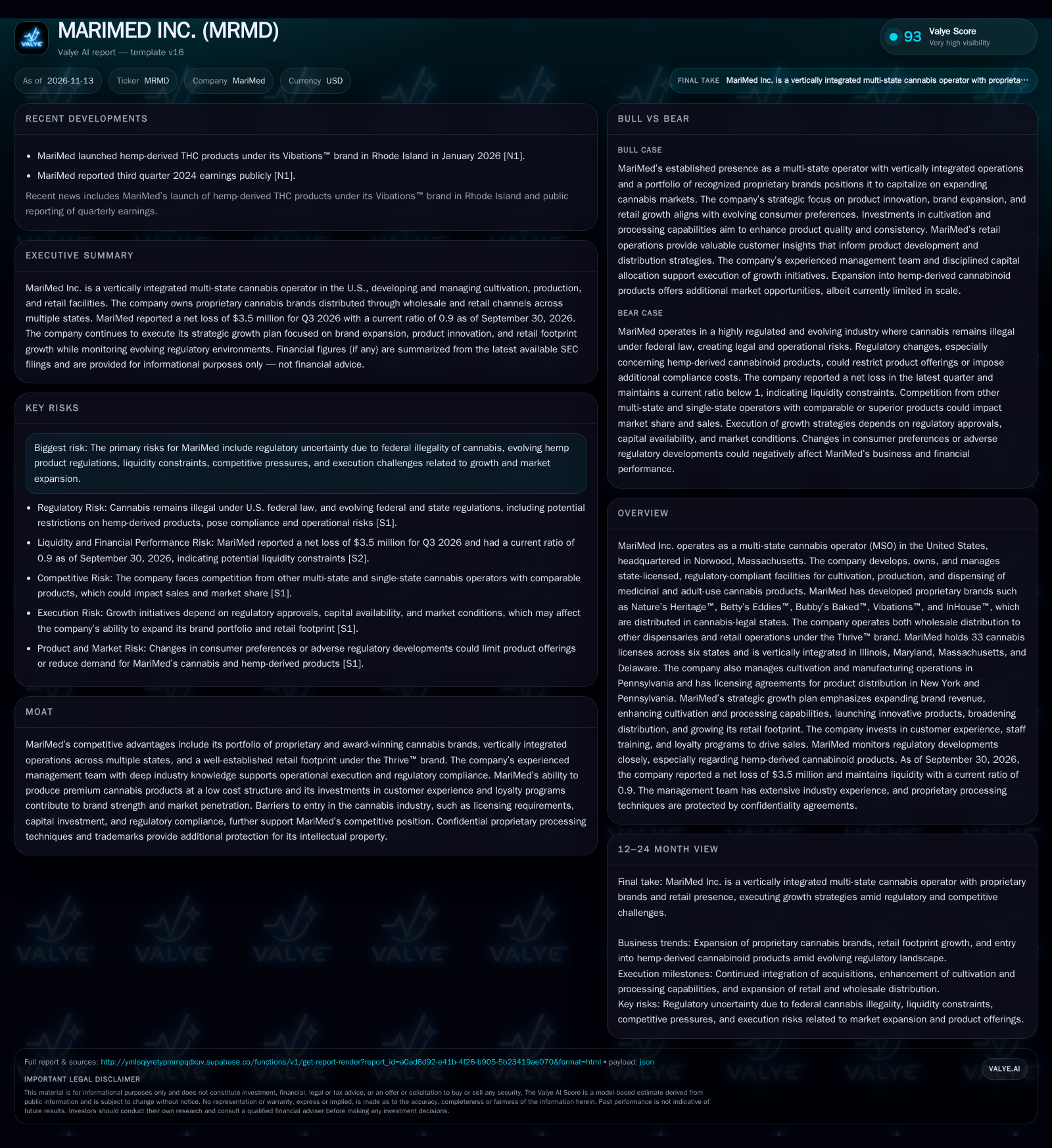
MariMed operates with vertically integrated facilities and proprietary brands across multiple U.S. cannabis markets, pursuing expansion in both retail and wholesale channels. The company reported a net loss of $3.5 million for Q3 2026 and a current ratio of 0.9, reflecting ongoing liquidity pressures. While brand and footprint growth remain strategic priorities, execution depends on regulatory outcomes and capital access in a competitive, evolving landscape. [S1] [S2]
With cannabis still illegal at the federal level and hemp-derived products facing regulatory scrutiny, MariMed’s strategy of expanding brand reach and retail footprint is both an opportunity and a challenge. The company’s path forward will depend on its ability to manage capital needs, navigate evolving regulations, and outcompete rivals in a maturing, highly regulated market. [S1] [S2]
Net Losses and Liquidity Pressures Underscore MariMed’s Strategic Crossroads
MariMed reported a net loss of $3.5 million for the quarter ended September 30, 2026, with basic and diluted earnings per share of -$0.01. The company held $6.6 million in cash and equivalents, current assets of $61.4 million, and current liabilities of $67.9 million, resulting in a current ratio of 0.9 and a cash ratio of 0.1. [S2]
Vertically integrated operations across Illinois, Maryland, Massachusetts, and Delaware, combined with a portfolio of proprietary brands (e.g., Nature’s Heritage™, Betty’s Eddies™), form the backbone of MariMed’s strategy. The company operates both wholesale and retail channels, including its own Thrive™ dispensaries, and holds 33 cannabis licenses across six states. [S1]
MariMed’s recent expansion into hemp-derived cannabinoid products in 2025 leverages existing brands and distribution, but this segment is still a small contributor and faces regulatory uncertainties. The company’s management team, comprising industry veterans, continues to focus on product innovation and retail footprint growth as core strategies. [S1]
How MariMed’s Vertically Integrated Model Shapes Economics and Capital Needs
MariMed’s business model relies on controlling the value chain from cultivation through manufacturing to retail and wholesale distribution. Vertical integration theoretically allows for capture of higher margins by reducing third-party costs and enabling quality control, but it also increases fixed costs and capital requirements, particularly for facility buildouts and regulatory compliance.
Revenue is generated through a mix of direct retail sales (higher gross margin potential), wholesale distribution to third-party dispensaries (typically lower margin but higher volume), and, to a limited extent, licensing and partnerships in states where direct operation is not feasible. The company’s proprietary branded products offer a path to premium pricing, but pricing power in cannabis remains limited by regulatory price ceilings and intense competition from both local and national operators.
Operating leverage is a double-edged sword: as retail and wholesale volumes scale, fixed costs can be spread over more revenue, but underperformance or regulatory setbacks can quickly pressure margins and cash flow. MariMed’s expansion into hemp-derived products could diversify revenue streams, but the economics of this segment are volatile due to uncertain regulation and commoditizing price trends.
Brand Portfolio and Multi-State Footprint: Competitive Advantages and Their Limits
MariMed’s core competitive advantage is its portfolio of recognized proprietary brands, which have won awards and enjoy shelf presence in hundreds of dispensaries. This brand equity, coupled with vertical integration in key states, allows for some control over supply, quality, and customer experience. Proprietary processing and manufacturing techniques, protected by confidentiality agreements, may enable product differentiation, but the sustainability of these advantages depends on continued innovation and operational discipline. [S1]
The company’s retail operations under the Thrive™ brand provide direct access to consumers and valuable data for product development. However, MariMed faces intense competition from other multi-state operators (MSOs) with comparable or greater scale, as well as from single-state operators who may have deeper local market knowledge and cost advantages.
Barriers to entry in cannabis—such as state licensing, regulatory compliance, and capital intensity—are significant, but not insurmountable for well-funded rivals. The commoditization of certain cannabis products and price competition, especially in mature markets, can erode margins and threaten brand premium. Additionally, MariMed’s expansion into hemp-derived cannabinoid products exposes it to a broader set of competitors, including established consumer packaged goods (CPG) companies if regulatory barriers fall.
Unlocking Value: What a Successful Brand-Led Expansion Could Look Like
If MariMed can leverage its proprietary brands and vertically integrated infrastructure to drive higher retail and wholesale volumes, the company could achieve meaningful operating leverage. A favorable regulatory shift—such as federal legalization or relaxed banking restrictions—would likely lower compliance costs, open new markets, and facilitate capital access, providing tailwinds for expansion.
A scenario in which MariMed successfully launches innovative products, expands its retail network, and deepens penetration of existing markets could result in margin expansion, improved cash flow, and a reversal of recent net losses. The hemp-derived segment, if regulatory clarity emerges, could become a growth engine by accessing mainstream CPG channels.
Evidence confirming this upside would include accelerating same-store sales growth, higher branded product penetration in third-party dispensaries, improved gross margins, and a return to sustained positive net income. Announcements of new retail openings, successful product launches, or partnerships expanding distribution would further validate this scenario.
A Maturing Competitive Landscape Requires Operational Discipline
The most plausible path for MariMed is incremental growth driven by continued execution in core vertically integrated markets, modest retail expansion, and selective product innovation. The company may maintain its position as a recognized MSO, but faces persistent margin pressure from price competition, rising input costs, and regulatory compliance burden.
The wholesale and retail mix may allow for some stabilization of revenues, but the company is likely to experience lumpy growth due to state-level regulatory changes and shifting consumer preferences. The hemp-derived product segment may remain a small, experimental part of the business unless regulatory clarity or a breakthrough in consumer adoption occurs.
Evidence confirming this scenario would be continued modest revenue growth, stable or slightly improving gross margins, but ongoing net losses or limited profitability.
Liquidity Crunch and Regulatory Headwinds: The Adverse Chain of Events
Should regulatory developments turn adverse—such as tighter restrictions on hemp-derived cannabinoids, unfavorable tax policy, or delayed federal reform—MariMed could face shrinking addressable markets or increased compliance costs. In a scenario where retail and wholesale volumes stagnate or decline, fixed costs from vertical integration would become a drag on profitability.
With a current ratio below 1.0 and reported cash balance, a sustained period of operational underperformance could force MariMed to curtail growth initiatives, sell assets, or raise dilutive capital. Intensifying competition from larger MSOs or aggressive local players could further erode market share and pricing power.
Evidence confirming the downside would include further deterioration of the current ratio and cash position, declining same-store sales, store closures, or discontinued product lines. Regulatory actions that restrict product offerings or impose significant new compliance costs would also accelerate downside risks.
Testing MariMed’s Strategy: What Will Determine Brand-Led Growth and Resilience?
Quarterly changes in net cash from operations, especially in relation to planned capital expenditures and expansion projects, would help assess potential financial flexibility.
Gross margin trends by segment (retail, wholesale, hemp-derived products), if disclosed, would clarify the impact of vertical integration and brand strength on profitability.
Same-store sales growth and retail traffic metrics at Thrive™ dispensaries would provide insight into consumer demand and brand loyalty.
Regulatory developments at both the federal and state levels—particularly regarding cannabis rescheduling, banking access, and hemp-derived product restrictions—could materially alter the addressable market and compliance costs.
Market share estimates in core states (if disclosed) or relative performance versus key MSO and single-state operator peers would help gauge competitive positioning.
Expansion rate of proprietary brand penetration into third-party dispensaries and new retail locations would be a leading indicator for top-line growth.
Any changes in management’s approach to capital allocation, such as new equity or debt raises, asset divestitures, or a shift to asset-light partnerships, would signal responses to liquidity pressures.
Updates on product innovation pipelines—such as new SKUs, formulations, or category launches—would help test the company’s ability to differentiate and capture premium pricing.
Disclaimer: This is research-only, informational analysis and not investment advice. It may include AI-generated interpretation and general industry context. Always verify important details using primary sources.

Comments