
Zhibao Technology: Capital Structure Reset and Operating Uncertainty Under Liquidity Strains
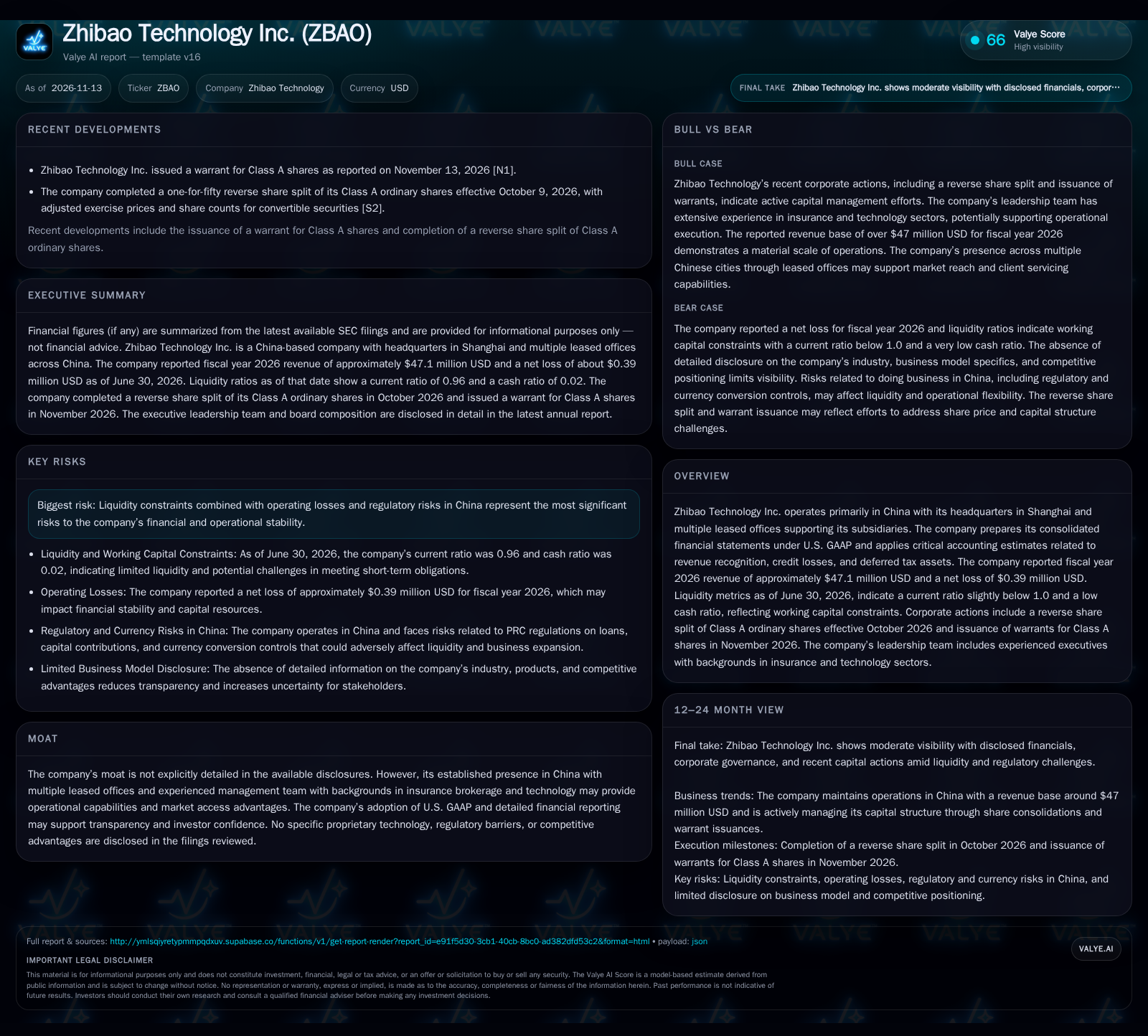
Zhibao Technology Inc.—a Shanghai-based company with $47.1 million in annual revenue—faces acute working capital pressure, prompting a reverse share split and warrant issuance. With limited disclosure on its industry or business model, the fundamental drivers of its revenue, margin structure, and competitive stance remain opaque. The company’s next phase hinges on its ability to stabilize operations and clarify its strategic direction.
Recent actions—a one-for-fifty reverse share split and new warrant issuance—signal urgent capital management. The company’s sector, product mix, and competitive context are undisclosed, leaving its long-term economics and market position uncertain. The core question is whether Zhibao can resolve liquidity strains and articulate a sustainable business model.
Zhibao Technology Inc. stands at a crossroads: despite achieving over $47 million in annual revenue, the company is weighed down by operating losses and an acute liquidity crunch, as confirmed by a sub-1.0 current ratio and scant cash reserves. Recent measures—a reverse share split and the issuance of new warrants—signal both urgency and complexity in capital management, but they do not resolve the central opacity in Zhibao’s business model or competitive context. The company’s ability to clarify its market position and navigate regulatory headwinds will be decisive in determining whether it can convert scale into sustainable value.
Recent Financial Results and Capital Moves Shape Current Conditions
Zhibao Technology Inc. reported $47.1 million in revenue for the fiscal year ending June 30, 2026, but the company posted a net loss of $0.39 million, highlighting ongoing profitability challenges [S1]. The company reported cash and liquidity metrics for the period; these figures do not by themselves establish operating runway, investment capacity, financial flexibility, or financing capacity. [S1] In response, the company undertook a one-for-fifty reverse share split in October 2026, adjusting convertible security terms and exercising price points to shore up its capital structure [S2]. The subsequent issuance of a warrant for Class A shares in November 2026 further suggests the need for flexible financing or equity-linked capital [N1]. Collectively, these moves reflect a company in the throes of balance sheet management, with immediate attention on solvency and share price stabilization rather than organic growth or operational leverage.
Revenue Scale, Losses, and Structural Unknowns Explored
While Zhibao Technology reported $47.1 million in annual revenue, the lack of disclosure on its industry, product mix, or customer base leaves the economic engine of the business ambiguous [S1]. The posted net loss of $0.39 million signals that either gross margins are thin, operating expenses are elevated, or both. With current liabilities exceeding current assets, the company’s working capital position is precarious, potentially forcing it to rely on short-term financing or frequent capital raises.
If Zhibao operates in a technology or insurance-adjacent sector as suggested by management backgrounds, its economics may hinge on transaction volume, service fees, or SaaS-style recurring revenue. However, without confirmation, it is unclear whether revenue is stable, lumpy, or vulnerable to customer churn. The reverse share split and warrant issuance point to ongoing capital needs, possibly for debt repayment, operational continuity, or regulatory compliance. The absence of free cash flow or segment reporting makes it impossible to gauge fixed versus variable cost structure or potential for operating leverage. Until the company discloses its business model mechanics, the durability and scalability of its revenue base remain speculative.
Limited Market Differentiation Clouds Competitive Standing
Zhibao Technology’s competitive stance is difficult to assess due to the absence of detail on its sector, core products, or customer segments. The company’s footprint—multiple leased offices across Chinese cities—implies some degree of operational reach, but this does not confer a clear competitive advantage without additional context [S1]. If Zhibao operates in a crowded technology or insurance services market, barriers to entry may be low and pricing power limited, especially in China’s highly competitive digital and financial services sectors.
The management team’s experience in insurance and technology may offer network benefits or domain expertise, but without evidence of proprietary technology, regulatory licenses, or exclusive partnerships, sustainable differentiation is unproven. The company’s adoption of U.S. GAAP and transparent financial reporting could appeal to foreign investors, yet it does not substitute for a clear commercial moat. In the absence of disclosed product stickiness or switching frictions, Zhibao may be exposed to customer attrition and margin pressure from better-capitalized or more specialized peers.
Conditions Needed for Zhibao to Achieve Sustainable Growth
The most constructive scenario for Zhibao Technology involves the company clarifying its business model, demonstrating operating leverage, and securing access to non-dilutive capital. If management can articulate a clear value proposition—whether in digital insurance, fintech, or another scalable vertical—and show evidence of recurring revenue or high-margin services, investor confidence could rebound. The company reported profitability for the period.
Confirmation of this scenario would require new disclosures: segment-level financials, customer retention rates, gross margin improvements, or evidence of a differentiated technology platform. Signs of regulatory compliance or strategic partnerships in China’s evolving financial and technology landscape would further validate the thesis. Absent these, the upside remains theoretical.
Medium-Term Outlook Characterized by Operational Uncertainty and Funding Constraints
The most plausible near-term outcome for Zhibao Technology is continued operational ambiguity and working capital strain. The company is likely to remain focused on short-term liquidity—through further equity-linked instruments or internal cost controls—while it seeks to stabilize its revenue base. Unless there is a step-change in transparency or a strategic transaction, Zhibao may struggle to attract long-term capital or command a valuation premium.
This scenario would be confirmed by ongoing small net losses, limited organic cash generation, and additional dilutive financings or capital structure adjustments. The absence of new business disclosures, customer wins, or margin expansion would reinforce the view that Zhibao remains in a holding pattern, with neither a clear path to growth nor imminent insolvency.
Worsening Liquidity Pressures and Potential Value Erosion Without Improvement
The adverse scenario for Zhibao Technology is one in which liquidity deteriorates further, forcing the company into increasingly dilutive or distressed capital actions. If operating losses widen or regulatory/currency constraints tighten in China, Zhibao may be unable to meet short-term obligations—raising the risk of payment defaults, asset sales, or delisting.
Indicators would include a further decline in the current ratio, negative operating cash flow, delays in supplier payments, or emergency debt/equity raises on unfavorable terms. A lack of progress on business model clarity or evidence of customer attrition would exacerbate downside risks. If Zhibao cannot demonstrate a credible turnaround or attract strategic capital, shareholder value could erode rapidly.
Key Milestones That Will Determine Zhibao’s Ability to Reset Its Course
Disclosure of business segment breakdowns, product lines, or customer concentration—if provided—would help to clarify the company’s core economic drivers.
Updates on gross margin trends or operating expense controls would be critical to assess whether Zhibao can achieve profitability.
Any new credit facility, capital raise, or non-dilutive financing event would signal the company’s ability to manage liquidity beyond short-term fixes.
Evidence of recurring or multi-year contracts, customer retention rates, or backlog (if disclosed) would indicate revenue stability.
Regulatory developments in China affecting foreign-listed companies or capital controls could materially alter Zhibao’s operational flexibility.
Announcements of strategic partnerships, technology launches, or entry into new verticals would test the company’s ability to differentiate.
Board or management changes—particularly in finance or strategy roles—would be notable for signaling a shift in operational priorities.
Sustained improvement or further deterioration in the current and cash ratios over the next two quarters would serve as a near-term solvency barometer.
Disclaimer: This is research-only, informational analysis and not investment advice. It may include AI-generated interpretation and general industry context. Always verify important details using primary sources.

Comments