
Intuitive Machines: Advancing Lunar Infrastructure and Securing Sustainable Revenue
Intuitive Machines is scaling a vertically integrated lunar and cislunar infrastructure model, leveraging recent acquisitions and government contracts. The company’s ability to transition from milestone-driven project revenue to recurring service streams—and to integrate its expanded international footprint—will define its long-term value creation.
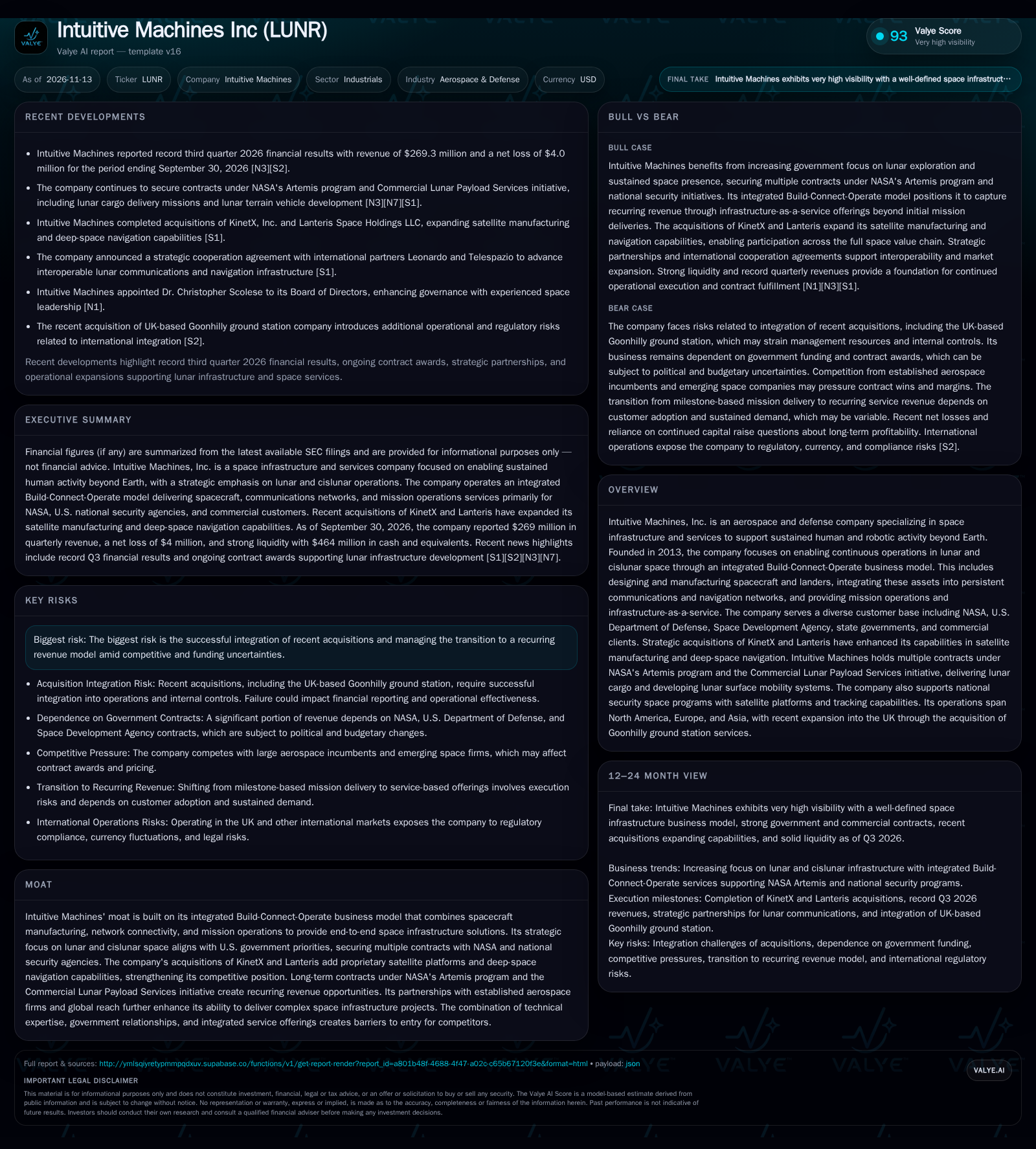
Intuitive Machines combines spacecraft manufacturing, communications networks, and mission operations to support lunar and cislunar activities. The company posted $269 million in Q3 2026 revenue with a modest net loss, reflecting strong contract momentum but ongoing investment needs. Recent acquisitions broaden its technology base and market reach, but integration and the shift to recurring revenues pose execution risks. Long-term success depends on converting NASA and national security relationships into infrastructure-as-a-service contracts and managing the complexity of a global space business. [S1] [S2] [N3] [N7]
Intuitive Machines is positioning itself as an end-to-end provider of lunar and cislunar infrastructure, leveraging a Build-Connect-Operate model that spans spacecraft manufacturing, communications, and mission operations. The company’s financial results for Q3 2026 highlight robust contract flow from NASA and national security agencies, but also ongoing net losses reflecting heavy investment and integration costs related to recent acquisitions. The central question is whether Intuitive Machines can successfully convert its project-based government contracts into recurring, infrastructure-as-a-service revenue streams, while managing the complexity of an expanded international platform. Execution on these fronts will determine whether the company can establish a defensible, cash-generative franchise in the next phase of the space economy.
Acquisitions, Contract Wins, and Financial Performance: Where Intuitive Machines Stands Today
Intuitive Machines reported $269.3 million in revenue for Q3 2026, with a net loss of $4.0 million and $463.8 million in cash and equivalents as of September 30, 2026. This marks record quarterly revenue, underpinned by ongoing contract activity with NASA’s Artemis program, the Commercial Lunar Payload Services (CLPS) initiative, and U.S. national security agencies. The company completed the acquisitions of KinetX (deep-space navigation) and Lanteris (satellite manufacturing), and expanded into the UK with the purchase of Goonhilly, a ground station operator. These moves broaden Intuitive Machines’ technical capabilities and market reach, but also introduce integration and international regulatory risks. [S1] [S2] [N3] [N7]
The company’s customer base is anchored by NASA, the U.S. Department of Defense, and the Space Development Agency, but also includes commercial clients such as Columbia Sportswear and Nokia. The ongoing transition from milestone-based project revenue to recurring service-based revenue remains a pivotal strategic question. [S1] [S2]
How the Build-Connect-Operate Model Could Reshape Space Infrastructure Economics
Intuitive Machines’ business model is designed to capture value across the lunar and cislunar value chain. The 'Build' segment includes high-complexity, high-ticket projects—spacecraft, landers, satellites, and propulsion systems—that are typically sold through milestone-based contracts, especially to government customers. These contracts provide near-term revenue but carry project risk and can be lumpy, with limited recurring component unless follow-on service agreements are embedded.
The 'Connect' and 'Operate' components are intended to create stickier, higher-margin revenue streams, such as communications, navigation, and infrastructure-as-a-service. If fully realized, this model could provide multi-year recurring cash flow, with lower incremental costs once the capital-intensive network is deployed. However, the upfront capital requirements for infrastructure deployment are significant, and the transition to a recurring revenue model depends on customer adoption of subscription or usage-based services.
Recent acquisitions expand the company’s addressable market and add technical depth, but also increase fixed costs (integration, international compliance, expanded R&D) and operational complexity. The potential for operating leverage exists if the company can scale service offerings over a growing installed base, but this is contingent on successful integration and demand for ongoing services beyond initial mission delivery.
Strategic Positioning: Differentiation, Moat, and the Challenge from Incumbents
Intuitive Machines’ competitive positioning rests on its end-to-end integration and early-mover status in lunar infrastructure. Its close alignment with NASA’s Artemis and CLPS programs, as well as national security projects, provides credibility and reference customers in a sector where government trust is paramount. The acquisitions of KinetX and Lanteris add proprietary satellite platforms and deep-space navigation capabilities, further differentiating its technical stack.
However, the company faces competition from established aerospace incumbents (such as Lockheed Martin and Northrop Grumman in the U.S.), as well as emerging commercial space players with deep pockets and established launch/spacecraft capabilities. The move to international operations increases exposure to European and Asian aerospace contractors, whose local relationships and regulatory familiarity may provide defensive advantages.
Switching costs may be high for mission-critical lunar infrastructure, particularly if Intuitive Machines can establish its communications and navigation services as potentially leading standards. The question is whether the company can convert technical integration into durable customer lock-in, or whether government and commercial buyers will continue to run competitive procurements for each mission phase.
Unlocking Recurring Revenue: What Would Signal a Durable Infrastructure Franchise
The most favorable scenario for Intuitive Machines is one where its Build-Connect-Operate model moves beyond project-based revenue and achieves meaningful penetration of recurring, infrastructure-as-a-service contracts. This would likely require NASA, national security agencies, and commercial customers to adopt multi-year data, communications, or navigation subscriptions, leveraging the company’s installed lunar and cislunar assets.
Evidence supporting this scenario would include multi-year service agreements with government agencies for lunar communications or navigation, public customer renewals/extensions, and a growing mix of recurring over milestone revenue reported in financials. Additional contract wins for follow-on lunar infrastructure (as opposed to one-off deliveries) and international adoption of its networked services would further validate the model. Margin expansion and improved cash flow conversion would confirm the economics of scale and operating leverage.
Balancing Contract Momentum with Integration and Execution Risk
The most plausible near-term outcome is continued growth in milestone-based project revenue from NASA, Department of Defense, and allied commercial customers, with incremental contributions from the newly acquired KinetX, Lanteris, and Goonhilly operations. While the company may announce pilot recurring-service contracts, the majority of revenue is likely to remain tied to discrete mission milestones and hardware delivery, at least through the next few reporting cycles.
Integration costs and international expansion complexity may weigh on margins and require ongoing investment in internal controls, compliance, and human capital. The mix of revenue may gradually begin to shift toward services if customer adoption materializes, but this transition could be slower and lumpier than bulls expect. Confirmation would come from continued contract momentum, steady growth in backlog, and early signs of recurring revenue in segment disclosures. If integration issues lead to project delays or cost overruns, or if government funding is disrupted, downside risks would become more pronounced.
When Integration and Revenue Quality Risks Eclipse Growth
A negative scenario would see Intuitive Machines struggle to integrate its acquisitions—especially Goonhilly’s international operations—resulting in operational disruption, unexpected costs, or control failures. If the transition to recurring revenue stalls, the company could remain dependent on milestone-based government contracts, which are subject to political and budgetary volatility. Increased competition could erode win rates or force price concessions, especially if incumbent contractors respond aggressively.
Signs of this scenario would include missed project deadlines, margin compression due to overruns or compliance costs, slower-than-expected growth in service revenue, or customer attrition after initial contract completion. Regulatory or legal issues stemming from international expansion could further distract management and impair financial performance.
Milestones That Will Define Intuitive Machines’ Lunar Infrastructure Trajectory
The proportion of recurring (service-based) revenue versus milestone or hardware revenue, if disclosed, would clarify the pace of the business model transition.
Integration progress and cost disclosures for KinetX, Lanteris, and especially Goonhilly will be crucial for evaluating operational execution.
Backlog growth and contract renewal rates for NASA Artemis, CLPS, and national security programs will indicate customer stickiness and future revenue visibility.
Gross margin trends, particularly as service offerings scale, would help test the thesis of operating leverage and higher-margin infrastructure-as-a-service potential.
International regulatory compliance events, legal proceedings, or related cost disclosures could signal friction in the global expansion effort.
New multi-year service contracts or public extensions with government agencies (NASA, DoD, SDA) would validate the Build-Connect-Operate recurring model.
Management commentary or disclosures on capital needs, cash burn, or planned external financing would inform risk around ongoing investment requirements.
Disclaimer: This is research-only, informational analysis and not investment advice. It may include AI-generated interpretation and general industry context. Always verify important details using primary sources.

Comments