
Cibus, Inc.: Gene-Edited Crop Traits, Regulatory Leverage, and the Road to Royalty Revenue
Cibus’s focus on non-transgenic gene editing and rapid trait development positions it for royalty-based income in global agriculture, but persistent losses, regulatory crosscurrents, and execution risks challenge the path to scaling commercial impact.
Cibus, Inc. leverages its Rapid Trait Development System™ (RTDS™) to create gene-edited, non-transgenic crop traits, with initial commercial emphasis on rice herbicide tolerance for the US and Latin America. The company’s ability to convert trait development into recurring royalty income and navigate evolving global regulations remains the central test for its business model [S1] [S2].
Cibus, Inc. stands at the intersection of agricultural innovation and commercial uncertainty. Its proprietary gene-editing platform, RTDS™, offers the promise of rapidly developed, non-transgenic crop traits with broad regulatory acceptance. Yet, the company’s financial statements reveal persistent losses and a cash position that underscores the urgency of converting scientific promise into commercial traction. As regulatory frameworks evolve—especially in the EU—and operational resources are consolidated, Cibus’s future hinges on its ability to drive royalty revenue from its trait pipeline while navigating capital constraints and adoption risks.
Recent Financials and Strategic Consolidation Reshape the Cibus Trajectory
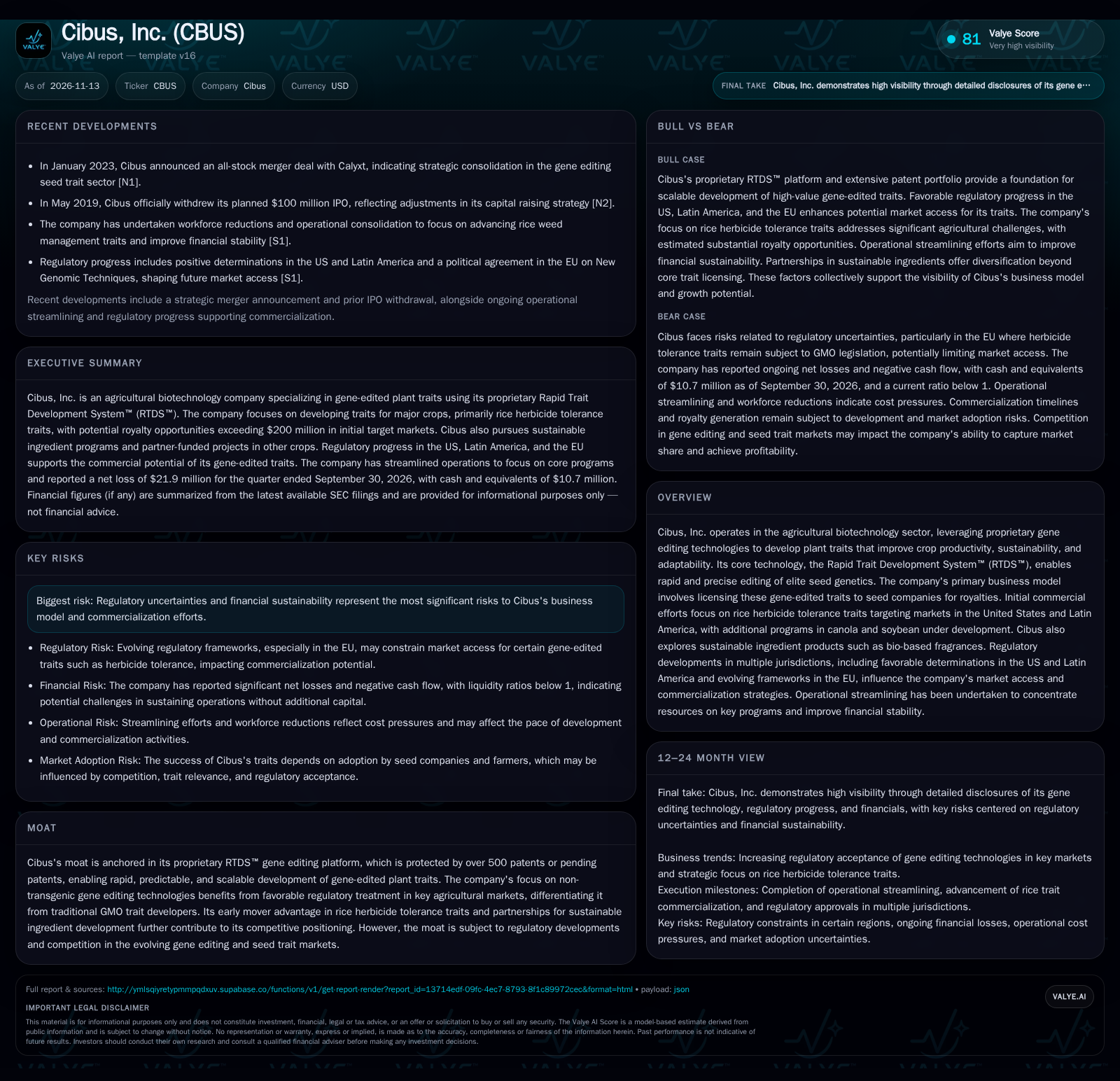
As of September 30, 2026, Cibus reported $10.7 million in cash and equivalents, current assets of $13.25 million, and current liabilities of $13.89 million, translating to a current ratio of 0.95 and a cash ratio of 0.77. The company posted $800,000 in revenue for the quarter, with an operating loss of $12.5 million and a net loss of $21.9 million [S2]. These figures underscore both the early commercial stage and the ongoing capital intensity of the business.
Operationally, Cibus has implemented workforce reductions and consolidated its activities to San Diego, California, sharpening its focus on the commercialization of rice weed management traits [S1]. This streamlining is intended to align resources with programs that have the highest near-term commercial potential, signaling a pivot toward disciplined capital allocation.
Regulatory developments present a mixed but generally positive backdrop: gene-edited, non-transgenic traits developed by Cibus have received favorable treatment in the US, Canada, Ecuador, and parts of Asia. The EU has reached political agreement on a framework for New Genomic Techniques, though herbicide tolerance traits will likely face additional constraints in Europe [S1].
Trait Licensing and the Royalty Model: Economics, Leverage, and Funding Needs
Cibus’s core business model centers on licensing gene-edited crop traits—most notably herbicide tolerance for rice—to major seed companies in exchange for royalties. The company estimates a potential annual addressable royalty pool exceeding $200 million in the US and Latin America for rice herbicide tolerance traits alone [S1]. Because Cibus does not manufacture or sell seeds directly, but rather out-licenses traits, the model is designed for scalability and high operating leverage once traits are widely adopted.
The economics are predicated on achieving broad adoption of its licensed traits through seed company partners. Royalty streams, if realized, would likely be high-margin, recurring, and require relatively low incremental costs to support once the underlying trait is commercialized and integrated into elite seed genetics. However, the upfront costs of R&D, regulatory submissions, and field trials are substantial and fixed, creating a period of negative cash flow and operating losses until meaningful royalty revenue accrues.
Cibus’s current financials reflect this dynamic: quarterly revenue remains modest relative to its operating expenses. The company’s current liabilities exceed its current assets, and the recent operational streamlining suggests a need to extend runway and focus on near-term revenue opportunities. Absent a step-change in royalty inflows or additional capital raised, the business could face further funding pressures [S2].
Partner-funded projects in sustainable ingredients (e.g., lauric oils, bio-based fragrances) provide an additional, albeit less mature, revenue stream and may help offset some R&D costs if partnerships scale.
Technology, Patents, and Regulatory Tailwinds Shape Competitive Posture
Cibus’s competitive advantage is anchored in its proprietary RTDS™ platform, which enables precise, rapid, and non-transgenic gene editing of elite seed varieties. With more than 500 patents or pending patents covering both the platform and specific traits, Cibus has constructed a broad intellectual property moat that could deter direct replication by competitors [S1].
The focus on non-transgenic (gene-edited, not transgenic GMO) traits is strategically important: these are viewed more favorably by regulators in major agricultural markets, reducing time-to-market and regulatory friction compared to traditional GMOs. This regulatory positioning could accelerate adoption by seed companies and farmers, particularly in the US and Latin America.
Competition is intense across the agricultural biotechnology sector, with established seed trait providers, multinational ag-input companies, and emerging gene-editing platforms all vying for market share. Larger incumbents may have advantages in distribution, regulatory navigation, and established customer relationships. The degree to which Cibus’s platform can deliver differentiated traits, secure favorable licensing terms, and maintain regulatory momentum will determine its long-term competitive standing.
Technology substitution risk also exists: alternative gene-editing modalities (e.g., CRISPR-based approaches) and traditional breeding techniques could erode the perceived uniqueness of Cibus’s offerings if regulatory or market sentiment shifts.
Accelerated Trait Adoption and Regulatory Clarity Unlock Royalty Scale
In a favorable scenario, Cibus’s rice herbicide tolerance traits achieve rapid adoption among seed company partners in the US and Latin America, catalyzed by continued regulatory acceptance of non-transgenic gene editing. As these traits are incorporated into elite seed lines and distributed at scale, royalty streams could begin to ramp meaningfully, providing high-margin, recurring revenue that exceeds current operating expenses.
Additional upside would come from successful commercialization of traits in other crops (canola, soybean) and from scaling sustainable ingredient partnerships into material revenue contributors. Regulatory clarity in the EU—particularly if constraints on herbicide tolerance traits are less restrictive than feared—could open a large incremental market.
Confirmation of this scenario would require: (1) announcements of multi-year licensing agreements with major seed companies, (2) reported royalty revenue scaling quarter-over-quarter, (3) regulatory approvals in additional jurisdictions, and (4) evidence of positive operating leverage as fixed costs are amortized over growing revenue.
Gradual Commercial Progress Amid Regulatory and Funding Constraints
The most plausible near-term scenario is one of slow but steady commercial traction. Cibus continues to advance its rice herbicide tolerance program, securing incremental licensing agreements and beginning to recognize modest royalty income. Regulatory environments in the US and Latin America remain supportive, but EU market penetration is delayed or limited due to ongoing constraints on herbicide tolerance traits.
Operating expenses remain high relative to revenue, and the company is compelled to further prioritize programs or seek additional capital to sustain its development pace. Sustainable ingredient partnerships contribute, but are not yet significant drivers of financial results.
Evidence confirming this scenario would include: (1) incremental increases in revenue from trait licensing, (2) continued net losses but with narrowing operating deficits, (3) additional partner-funded projects, and (4) disclosures of further operational streamlining or financing activity.
Commercial Delays and Capital Shortfall Threaten Ongoing Operations
In an adverse scenario, Cibus fails to secure timely or broad adoption of its lead rice herbicide tolerance traits, either due to insufficient performance in field trials, partner reluctance, or regulatory delays—particularly in pivotal markets outside the US. Royalty revenue remains de minimis, and operating losses persist.
The company’s financial runway shortens as cash burn continues, forcing more aggressive cost reductions or dilutive capital raises. If regulatory developments in the EU or other jurisdictions turn negative—such as stricter classification of gene-edited traits as GMOs—market access could be further curtailed.
Evidence of this downside would include: (1) flat or declining revenue, (2) new workforce reductions or R&D program suspensions, (3) negative regulatory developments, and (4) announcements of urgent capital raising or going-concern warnings.
Milestones That Will Define Cibus’s Royalty Conversion and Operating Viability
Quarterly royalty revenue trends by crop and geography—if disclosed—will clarify whether trait adoption is translating into material income.
Updates on multi-year licensing agreements with seed companies, including any disclosed minimum payment terms or volume thresholds, would help assess revenue visibility.
Progress reports on regulatory approvals or setbacks, especially in the EU and major Asian markets, will shape future addressable markets.
Announcements regarding the scale and financial contribution of sustainable ingredient partnerships would provide insight into revenue diversification.
Disclosure of field trial results and trait performance data would help validate the competitive differentiation of Cibus’s offerings.
Any additional workforce or operational restructuring measures would signal management’s assessment of funding sufficiency and near-term priorities.
Communication about intellectual property challenges or successful defense of key patents could impact long-term moat durability.
Disclaimer: This is research-only, informational analysis and not investment advice. It may include AI-generated interpretation and general industry context. Always verify important details using primary sources.

Comments