
Praetorian Acquisition Corp.: SPAC Deadlines, Liquidity Pressures, and the Search for a Value-Accretive Deal
With over $253 million in trust but a working capital deficit and a looming deadline, Praetorian Acquisition Corp. faces a familiar but high-stakes SPAC challenge: execute a credible business combination before early 2028 or liquidate. The experience of its leadership team is a potential asset, yet dilution risk and reliance on additional financing highlight the executional and structural hurdles ahead.
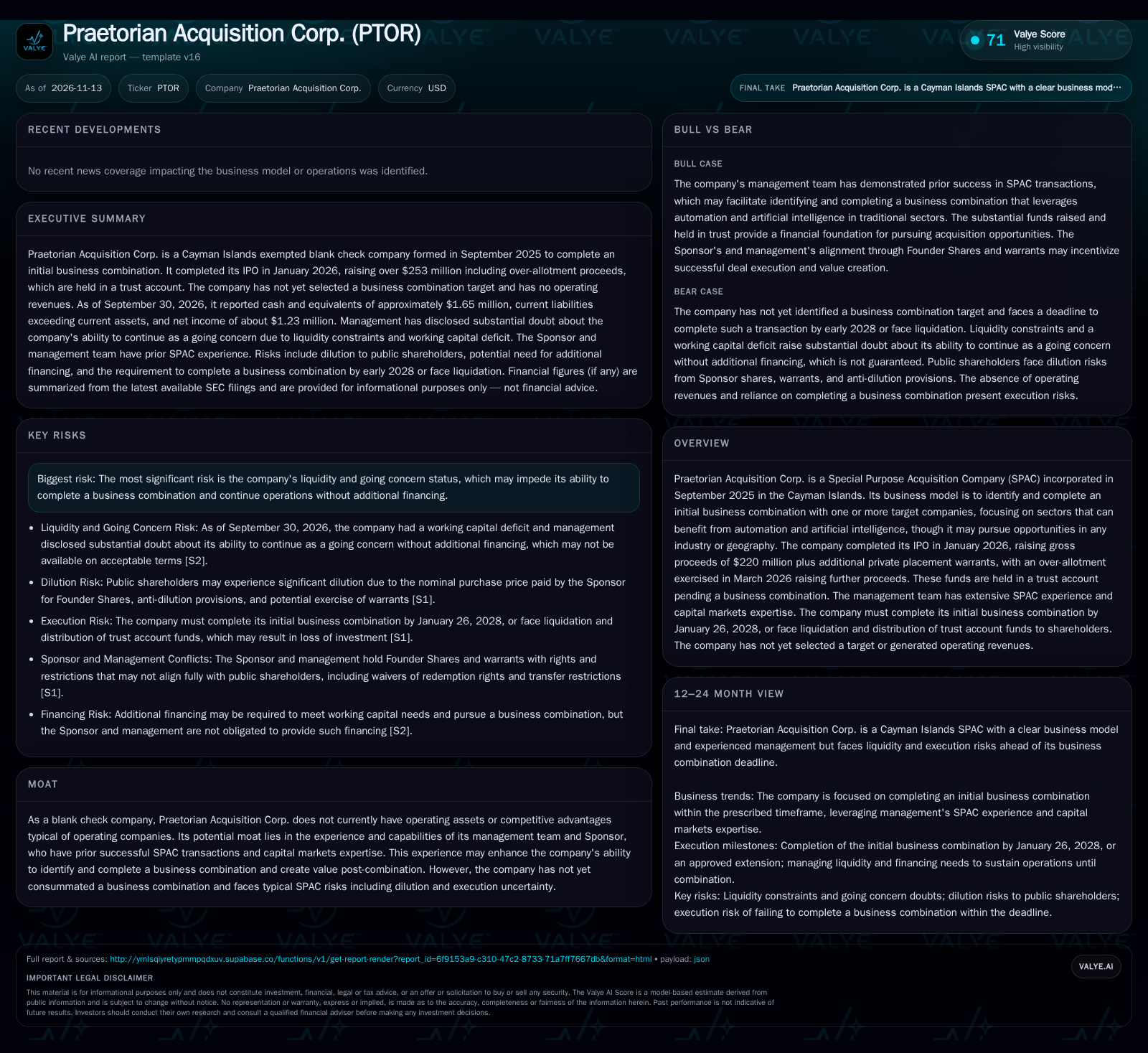
Praetorian Acquisition Corp. is a Cayman Islands SPAC with $253 million in trust, no deal target, and a management team experienced in SPAC transactions. As of September 2026, the company faces a working capital deficit and going concern doubts. It must complete a business combination by January 2028 or liquidate, with dilution and financing risks for public shareholders [S1] [S2].
Praetorian Acquisition Corp. exemplifies the strengths and pitfalls of the modern SPAC structure: a sizeable trust account and an experienced sponsor team, but no operating revenues, a working capital deficit, and a ticking clock. While the management’s prior SPAC success offers hope for a value-accretive deal, the company’s going concern warning, dilution risk, and dependence on additional financing underscore the structural challenges facing shareholders. The next 14 months will determine whether Praetorian can secure a suitable target and deliver value, or if it will join the growing list of SPACs forced to liquidate.
Trust Account Scale, Liquidity Pressures, and the Countdown to Combination
Praetorian Acquisition Corp. raised $253 million through its IPO and over-allotment, with proceeds deposited in a trust account earmarked for a future business combination [S1]. As of September 30, 2026, the company has no operating revenues and has not yet identified a target [S1] [S2]. The latest quarterly report reveals a cash balance of $1.65 million, current assets of $1.81 million, and current liabilities of $2.19 million, resulting in a current ratio of 0.83 and a cash ratio of 0.75 [S2]. Management has openly disclosed substantial doubt about the company’s ability to continue as a going concern within the next year due to this working capital deficit and the uncertainty of securing additional financing [S2]. The company is required to complete a business combination by January 26, 2028—or April 26, 2028, if extended—or else liquidate and return trust proceeds to shareholders [S1].
SPAC Economics: Trust Structure, Incentives, and Dilution Mechanics
Praetorian’s economics are shaped by the typical SPAC model: proceeds from the IPO (and over-allotment) are held in a trust account, intended solely for funding an eventual acquisition. Until a deal is completed, the company earns only limited interest income on the trust assets, while incurring public company and diligence expenses that must be funded from the small pool of non-trust cash. This dynamic creates a race between deal sourcing and cash burn. If a business combination is completed, economics for public shareholders depend on the quality and pricing of the acquired business—but the SPAC structure’s anti-dilution provisions, warrants, and the nominal cost at which Sponsors acquired their Founder Shares mean that public holders risk significant dilution, especially if additional financing (PIPEs, loans, or other capital) is required to close a deal [S1]. If no combination is achieved, the trust is liquidated (minus expenses), and public shareholders receive their pro rata share, typically close to the IPO price. The company’s negative working capital and going concern warning suggest that, absent a near-term deal or capital infusion, the economics could deteriorate further [S2].
Where SPACs Compete: Deal Sourcing, Sponsor Reputation, and Market Cycles
Praetorian’s competitive position depends less on traditional operating moats and more on the ability of its management and Sponsor to source, negotiate, and close a compelling business combination ahead of hundreds of other SPACs and private equity buyers. The management team’s prior SPAC experience may aid in sourcing targets and navigating the regulatory process [S1]. However, in a crowded SPAC market, competition for attractive targets is intense—especially as macroeconomic uncertainty, public market volatility, and regulatory scrutiny have made some targets more hesitant to pursue SPAC mergers. Additionally, the dilution from Founder Shares and warrants is now well understood by sophisticated targets, who may demand more favorable terms or prefer alternative funding routes. Praetorian’s automation and AI sector focus offers a broad mandate, but also places it in a field with many well-capitalized and experienced competitors.
A Value-Enhancing Deal: How the Right Target Could Transform the Equation
The most favorable scenario is that Praetorian leverages its Sponsor’s experience to secure a high-quality automation or AI-driven target that is both ready for public market scrutiny and able to command a reasonable valuation. In this scenario, the trust account is used efficiently, dilution is minimized (possibly through a PIPE or favorable earnout structure), and the post-merger company is positioned for growth and positive investor reception. Evidence that would confirm this thesis includes the announcement of a definitive merger agreement with a credible, growth-oriented target, constructive PIPE participation, and positive pre-close market feedback. If the deal structure limits dilution and the combined entity demonstrates strong operational prospects, the SPAC’s economics could deliver attractive returns for public holders. Falsification would come from a failure to announce a deal, or from a transaction with an overvalued or distressed target, excessive dilution, or weak market support.
Executional Realities: Deal Sourcing, Dilution, and the Clock
The most plausible path is that Praetorian, like many SPACs, faces a protracted search for a suitable target, with the risk of deal terms becoming less favorable as the deadline approaches and liquidity tightens. The company may ultimately announce a business combination, but with significant dilution to public shareholders due to Sponsor economics, warrant exercises, and the potential need for additional financing [S1] [S2]. In this scenario, the market reaction will depend largely on the perceived quality of the target and the terms of the deal. Confirming evidence would include a merger announcement with a mid-tier private company, sizable dilution from warrant exercises or a discounted PIPE, and mixed investor sentiment. Falsification would be a failure to announce a deal, or an extension request without a clear path to combination.
No Combination: Liquidation, Cash Burn, and Shareholder Returns
The adverse scenario is that Praetorian is unable to secure a business combination before the January 2028 deadline, due to a combination of market headwinds, target reluctance, or failure to secure additional financing. In this case, the trust account is liquidated and public shareholders receive their pro rata share (typically close to the original $10/unit), but Sponsor shares and warrants become worthless, and any cash spent outside the trust is lost. Evidence confirming this scenario would include continued lack of deal announcements, SEC filings warning of imminent deadline pressure, or requests for deadline extensions without progress. Further cash burn or the need for bridge financing could also erode what little value remains outside the trust. Falsification would require a credible merger agreement and progress toward closing.
Milestones That Will Define Praetorian’s SPAC Outcome
Announcement of a definitive business combination agreement with a credible target; the identity and sector of the target will be highly material.
Terms of any PIPE (private investment in public equity) or bridge financing, if disclosed; size, pricing, and participation would reveal market confidence and dilution impact.
Level of Sponsor and management participation in any new financing, which could help align incentives and signal commitment.
Changes in the trust account balance, including redemptions or expenses, as reported in future filings.
Any SEC filings or press releases regarding deadline extensions, regulatory delays, or shareholder votes on extension proposals.
The structure and dilution impact of any announced deal—particularly the ratio of public float to Sponsor/founder shares post-combination.
Management turnover or changes to the Sponsor team, which could affect deal sourcing and execution capacity.
If disclosed, the timeline and milestones for closing an announced transaction, including regulatory approvals and shareholder votes.
Disclaimer: This is research-only, informational analysis and not investment advice. It may include AI-generated interpretation and general industry context. Always verify important details using primary sources.

Comments