
Sunshine Biopharma: Generic Expansion, Preclinical Ambition, and the Economics of Canadian Pharma
Sunshine Biopharma leverages an expanding generic drug portfolio and early-stage proprietary R&D to pursue growth in the Canadian pharmaceutical market, but faces persistent profitability challenges, regulatory bottlenecks, and stiff competition shaping the path to sustainable value.
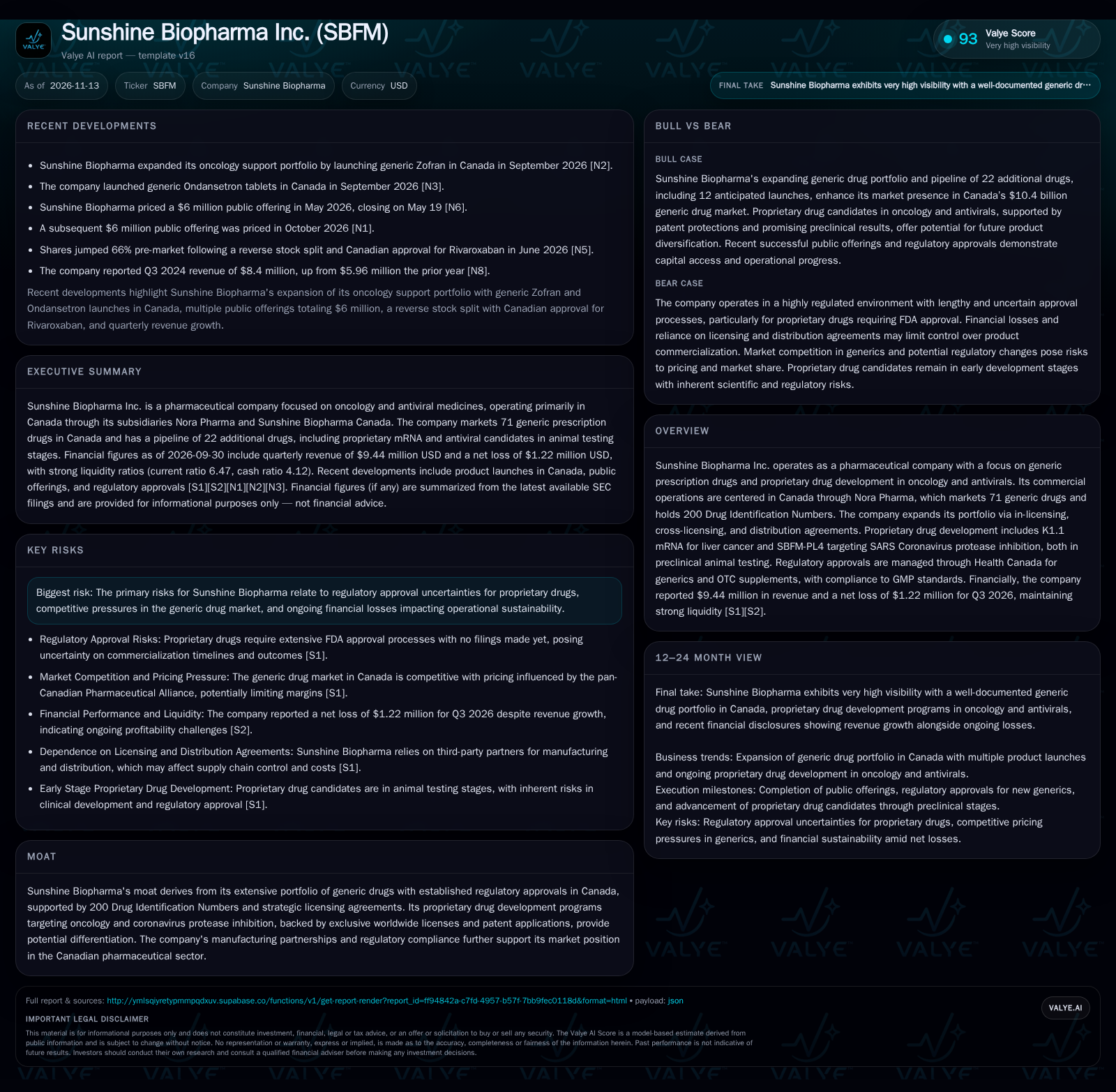
Sunshine Biopharma continues to grow its Canadian generic drug business, launching new oncology support products and maintaining a sizable pipeline, while proprietary mRNA and antiviral assets remain in preclinical stages. Key inflection points include regulatory progress for new launches, pipeline advancement, and the ability to sustain or expand margins in a competitive, price-controlled environment. [S1] [S2] [N1] [N2] [N3]
Sunshine Biopharma straddles the established economics of Canadian generic pharmaceuticals and the riskier promise of proprietary drug innovation. The company’s Nora Pharma subsidiary continues to expand its generics footprint, recently adding oncology support products, while 22 additional drugs in the pipeline and two early-stage proprietary candidates signal ambition for future growth. Yet, persistent net losses and a highly regulated, competitive market underscore the challenge of translating product launches and pipeline breadth into sustained profitability. The coming quarters will test whether the company can achieve scale, secure regulatory milestones, and move beyond generics to realize higher-margin opportunities.
Recent Launches, Cash Infusion, and Pipeline Ambition Shape Sunshine’s 2026 Profile
As of Q3 2026, Sunshine Biopharma reported $9.44 million in quarterly revenue, yet continued to post a net loss of $1.22 million, with basic EPS at -$5.20. The company holds $19.7 million in cash and equivalents, supported by two $6 million public offerings in May and October 2026. Notably, Sunshine launched generic Zofran and Ondansetron tablets in September, expanding its oncology support portfolio in Canada. The company markets 71 generics through Nora Pharma and holds a total of 200 Drug Identification Numbers (DINs), with 22 additional drugs in development—12 of which are targeted for launch in 2026. Proprietary candidates (K1.1 mRNA for liver cancer, SBFM-PL4 for coronavirus protease inhibition) remain in animal testing, highlighting the long lead time to potential commercialization. [S1] [S2] [N1] [N2] [N3] [N6]
How Generics and Early R&D Define the Revenue Model and Cost Structure
Sunshine Biopharma’s current economics are dominated by its generic drug business in Canada, where Nora Pharma acts as a marketing and distribution platform for products acquired via licensing and distribution agreements. Revenue is generated primarily through the sale of these generics, with pricing influenced by the pan-Canadian Pharmaceutical Alliance (pCPA)—a consortium that negotiates drug prices on behalf of public payers, capping margin potential and driving volume-based competition. The company’s 71-marketed generics (with rights to 200 DINs) provide a base of recurring revenue opportunities, but unit margins are typically slim, and the need to share economics with international manufacturing partners (about 75% of products are sourced from India) further compresses profitability. [S1]
Variable costs are tied closely to procurement and distribution, while fixed costs include regulatory compliance, sales infrastructure, and ongoing R&D for both generics and proprietary assets. The company’s ability to achieve operating leverage depends on scaling sales volumes and expanding its portfolio faster than fixed costs rise. The proprietary pipeline—K1.1 mRNA and SBFM-PL4—offers the prospect of higher-margin, differentiated products, but is years from commercialization and currently generates only expense. Frequent recourse to equity offerings (two $6 million rounds in 2026) signals a capital-intensive model with ongoing funding needs until higher-margin products or greater scale are achieved. [S1] [S2] [N1] [N6]
Canada’s Generic Drug Battleground: Pricing Controls, Supply Chains, and the Search for Differentiation
Sunshine operates in a highly competitive Canadian generic drug market, where price is set by collective bargaining (pCPA), and barriers to entry are regulatory rather than brand-driven. The company’s 200 DINs provide broad market access and the ability to launch new products rapidly, but competitors—ranging from multinational generic giants to regional distributors—face similar regulatory hurdles and pricing constraints. In this environment, scale, supply-chain reliability, and breadth of portfolio are primary differentiators, though none confer absolute pricing power.
Reliance on third-party manufacturing, particularly from India, is standard in the industry but exposes Sunshine to geopolitical, quality, and supply chain risks. The proprietary pipeline could provide future differentiation if clinical and regulatory milestones are met, but as of now, Sunshine’s core moat derives from regulatory assets (DINs, established licensing agreements) and execution speed in bringing new generics to market. Larger players with vertically integrated manufacturing or broader international portfolios may be better positioned to absorb pricing shocks or regulatory changes.
Pipeline Execution and Regulatory Wins Could Transform the Margin Profile
If Sunshine successfully launches its 12 targeted new generics in 2026 and maintains regulatory momentum, it could accelerate top-line growth and begin to realize operating leverage as incremental sales outpace fixed cost increases. The proprietary pipeline represents a step-change opportunity: positive preclinical results and subsequent advancement of K1.1 mRNA or SBFM-PL4 into human trials would signal potential for higher-margin, differentiated products that could diversify the company’s revenue base and reduce reliance on low-margin generics.
Confirmation of this scenario would include sustained sequential revenue growth, improved gross and operating margins, evidence of regulatory approvals for new generics, and disclosed progress of proprietary candidates into Phase I/II trials. Additional licensing deals or commercial partnerships for proprietary assets would further validate the company’s R&D strategy and signal potential for future royalty streams or milestone payments.
Expanding Generics Footprint, Persistent Losses, and Slow Proprietary Progress Likely to Persist
The most plausible trajectory is continued expansion of the generics portfolio in Canada, with periodic new launches supporting modest revenue growth. However, persistent net losses are likely in the near term due to ongoing R&D spend, price controls, and the inherent margin compression of the Canadian generics sector. The proprietary pipeline will likely remain a cost center until at least one candidate advances into clinical trials—a process that could take several years given current animal-testing status.
Evidence supporting this scenario would be stable or slightly rising revenues from generics, continued negative EPS, and only incremental updates on proprietary programs. Additional equity raises may be required to fund both working capital and R&D unless the company achieves a significant margin breakthrough or secures external non-dilutive funding.
Regulatory Delays, Supply Chain Disruptions, and Erosion of Generic Margins Could Exacerbate Losses
Adverse outcomes could arise if Sunshine faces regulatory setbacks—such as delays in Health Canada approvals for new generics—or if competitive intensity further erodes pricing and margins. Supply chain disruptions, especially given the company’s dependence on Indian manufacturers, could constrain product availability or increase costs. Should the proprietary pipeline fail to advance or require unexpectedly high investment, cash burn could intensify, forcing further dilution or operational retrenchment.
Indicators of this downside scenario would include stalled or declining revenues, widened operating losses, missed product launch timelines, and negative disclosures regarding supply chain stability or regulatory outcomes. A lack of clinical progress in proprietary assets or difficulty raising new equity on reasonable terms would also foreshadow deeper financial stress.
Milestones to Test Sunshine Biopharma’s Shift from Generics to Innovation
Quarterly revenue growth rates from generics, especially following new product launches, would help test the company’s ability to scale in a price-controlled market.
Gross margin trends, if disclosed, would illuminate whether new launches are improving the overall margin profile or if pricing pressure is eroding profitability.
Progression of proprietary candidates (K1.1 mRNA, SBFM-PL4) from animal testing into preclinical regulatory filings or human trials would validate the innovation thesis.
Regulatory approval timelines and outcomes for the 12 targeted 2026 generic launches will be critical for near-term revenue inflection.
Cash burn and operating expense trends—especially in the context of R&D investment—will clarify the sustainability of current strategy.
Any disclosed supply chain disruptions or cost increases from international manufacturing partners would provide early warning for margin pressure.
Frequency and terms of additional equity offerings or debt financings will signal capital intensity and potential dilution risk.
Updates on Health Canada and FDA regulatory feedback for both generics and proprietary assets would materially affect both risk and upside potential.
Disclaimer: This is research-only, informational analysis and not investment advice. It may include AI-generated interpretation and general industry context. Always verify important details using primary sources.

Comments