
Aethlon Medical: Clinical-Stage Transition, Merger Uncertainty, and the Prospects for Hemopurifier Platform Value
Aethlon Medical’s Hemopurifier technology—targeting unmet needs in oncology and infectious disease—sits at a strategic crossroads as the company pursues clinical validation and regulatory traction while navigating a transformative merger with North Immunology. The outcome will hinge on clinical data, regulatory progress, and the integration of new pipeline assets, with significant dilution and operational shifts ahead.
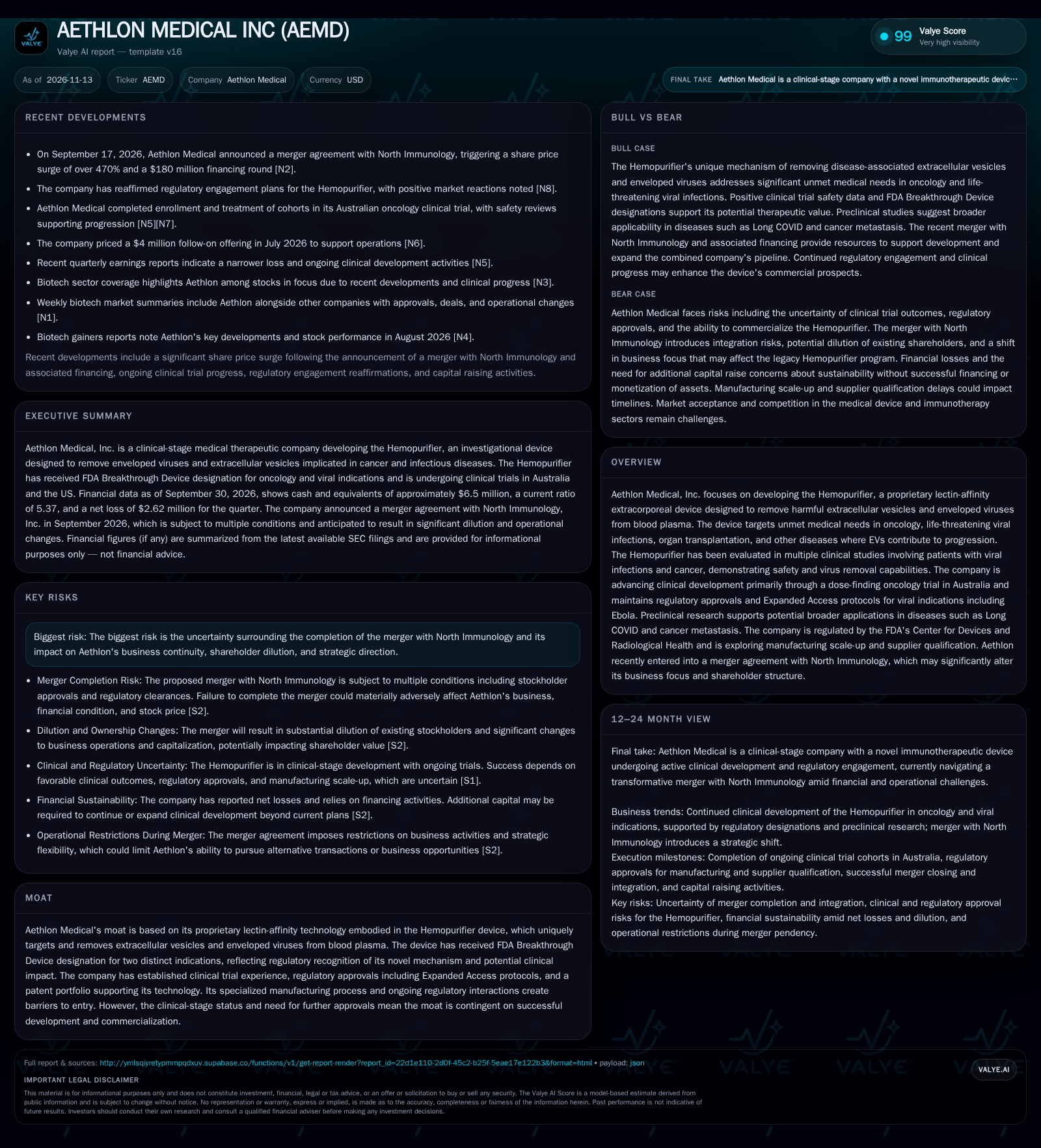
Aethlon Medical’s clinical-stage Hemopurifier device is advancing in oncology and viral indications with ongoing trials and regulatory engagement. The proposed merger with North Immunology introduces both opportunity and risk, likely shifting the company’s focus to North’s pipeline while diluting current shareholders. Aethlon’s value proposition now rests on its ability to demonstrate clinical efficacy, secure regulatory milestones, and manage integration amid financial constraints and shifting priorities. [S1] [S2] [N2]
Aethlon Medical stands at a pivotal juncture. Its flagship Hemopurifier device—an investigational immunotherapy platform for removing pathogenic extracellular vesicles and viruses—has achieved FDA Breakthrough Device designation and advanced into clinical trials targeting both oncology and infectious disease. Yet, the company’s direction is set to change dramatically with a pending merger with North Immunology. This transaction promises access to new pipeline assets and resources but also entails significant dilution and operational overhaul. The company’s future will depend on its ability to generate compelling clinical evidence, navigate regulatory paths, and integrate with North, all while managing cash burn and maintaining investor confidence in a fiercely competitive landscape. [S1] [S2] [N2]
Merger Moves, Clinical Progress, and Capital Constraints Define the Present
Aethlon Medical’s most material recent development is its September 17, 2026, merger agreement with North Immunology, Inc. The deal—structured as a two-step merger—remains contingent on stockholder approvals, regulatory clearances, and Nasdaq listing. If completed, it will result in substantial dilution for existing shareholders and a realignment of business focus toward North’s pipeline, relegating Aethlon’s legacy Hemopurifier program to a secondary role. The company reported cash and liquidity metrics for the period; these figures do not by themselves establish operating runway, investment capacity, financial flexibility, or financing capacity. [S2] [N2]
Clinically, Aethlon continues to advance the Hemopurifier device—a proprietary lectin-affinity extracorporeal platform—through a safety, feasibility, and dose-finding oncology trial in Australia. Enrollment has been completed for two cohorts, with the third cohort underway following independent safety review. No serious device-related adverse events have been reported, supporting a benign safety profile to date [S1].
Financially, as of September 30, 2026, Aethlon reported $6.49 million in cash and equivalents, $6.86 million in current assets, and $1.28 million in current liabilities, yielding a current ratio of 5.37. The net loss for the quarter was $2.62 million, underscoring ongoing cash burn and the continued need for external funding [S2].
Commercialization Pathways and Economic Leverage for Hemopurifier
Aethlon’s business model is predicated on the successful clinical and regulatory advancement of the Hemopurifier. The device’s commercial economics could be attractive if it achieves approval in high-value settings such as advanced/metastatic cancer or treatment-resistant viral infections, where existing therapies are limited and reimbursement potential is high. The FDA’s Breakthrough Device designation for both oncology and viral indications may help accelerate regulatory review and market access, but the path to approval remains dependent on robust clinical data [S1].
Pricing power in these markets—if achieved—would likely be supported by the Hemopurifier’s unique mechanism and the urgent unmet need. However, the business model is fundamentally high-fixed-cost at this stage, with significant R&D, regulatory, and clinical trial expenditures. Variable costs may be manageable if manufacturing is successfully scaled, but this is not yet proven. Until regulatory approval and payer coverage are established, revenue is likely to be minimal and opportunistic (e.g., through Expanded Access protocols) rather than predictable or recurring.
Capital intensity remains a central concern. The company’s cash burn, continued net losses, and recent follow-on offering all point to ongoing reliance on external financing. The pending merger with North Immunology may provide access to new capital and pipeline assets, but will also reshape the company’s economic profile and raise integration costs [S2] [N6].
Hemopurifier’s Distinctive Mechanism Faces a Crowded and Evolving Landscape
The Hemopurifier’s competitive strength lies in its proprietary lectin-affinity technology, enabling the direct removal of extracellular vesicles and enveloped viruses from blood plasma—a mechanism distinct from most antibody-based or cell therapy approaches. This has garnered FDA Breakthrough Device status for two separate indications, signaling regulatory recognition of its novelty and potential clinical impact [S1].
However, the competitive environment in oncology and infectious disease therapies is intense. In cancer, the Hemopurifier could compete with combination immunotherapies, advanced biologics, and emerging cell-based platforms. In viral diseases, direct-acting antivirals, monoclonal antibodies, and supportive care protocols are entrenched, while new antiviral platforms continue to emerge. The device’s extracorporeal nature may create procedural complexity and limit its use to specialized centers, potentially constraining rapid adoption absent compelling efficacy evidence.
Barrier to entry is supported by intellectual property and specialized manufacturing, but the lack of commercial-stage validation leaves the company vulnerable to competitive advances elsewhere. The merger with North Immunology may introduce pipeline synergies or distractions, depending on integration success and the prioritization of assets post-merger.
Clinical Validation and Regulatory Milestones Unlock Platform Value
The most favorable scenario for Aethlon is that ongoing clinical trials—particularly the Australian oncology study—demonstrate not just safety but also clear efficacy signals in patients with solid tumors resistant to anti-PD-1 therapy. Successful completion of these trials, followed by positive regulatory engagement, could support accelerated approval or expanded access, particularly in areas of high unmet need. Breakthrough Device designation may facilitate expedited review and early market entry in select settings [S1].
If the merger with North Immunology is completed efficiently and integration is well-managed, the combined company could benefit from pooled resources, pipeline diversification, and improved access to capital. This would enable continued investment in both the Hemopurifier and North’s assets, potentially driving value creation beyond what either could achieve independently.
Confirmation of this scenario would require: robust clinical data showing statistically and clinically meaningful benefits; clear, positive regulatory feedback (e.g., acceptance of trial endpoints or approval pathway); and evidence that the merged entity is able to access additional funding without excessive dilution or operational disruption.
Incremental Progress Amid Integration and Financial Headwinds
The most plausible near-term trajectory is a period of incremental clinical progress for the Hemopurifier, with additional safety data and possibly early efficacy signals from the Australian trial, but without pivotal results or regulatory approval in the next 12 months. The merger with North Immunology is likely to close, but with substantial dilution for legacy shareholders and a shift in strategic focus to North’s pipeline assets [S2] [N2].
In this scenario, Aethlon continues to support its core clinical programs at a reduced operational tempo, constrained by limited cash resources and the need to manage integration costs. The Hemopurifier remains in clinical-stage limbo, with its future dependent on the merged company’s prioritization of assets and the ongoing ability to raise additional capital. Commercial revenue remains negligible, and the company’s valuation is driven by pipeline optionality rather than near-term cash flows.
Evidence confirming this scenario would include: continued disclosure of clinical enrollment and safety updates without pivotal data; completion but not rapid acceleration of the merger; ongoing net losses and small follow-on financings; and a gradual shift in external communication toward North Immunology’s pipeline.
Trial Stalls, Merger Risk, and Financial Strain Threaten Continuity
An adverse scenario would unfold if the Hemopurifier’s ongoing clinical trials encounter safety signals, dose-limiting toxicities, or a lack of efficacy, leading to enrollment pauses or trial discontinuation. Simultaneously, if the merger with North Immunology fails—due to regulatory, financial, or shareholder hurdles—Aethlon could be left with limited cash, reduced staff, and no clear path to market, raising existential risk [S2].
Financial stress would be exacerbated by continued net losses, inability to secure new financing on acceptable terms, and operational restrictions imposed during the merger process. In this scenario, the company could be forced into further workforce reductions, asset sales, or strategic alternatives that substantially impair shareholder value.
Confirmation of this scenario would include: clinical trial setbacks or negative safety/efficacy reports; public disclosure of merger termination or delays; rapid cash burn without offsetting inflows; and increased discussion of strategic alternatives or going concern risk.
Milestones That Will Determine the Value of Aethlon’s Transition
Progression, enrollment rates, and interim results in the Australian dose-finding oncology trial—particularly any efficacy signals or adverse safety events.
Updates on regulatory engagement with the FDA or Australian authorities, including acceptance of trial endpoints or feedback on approval pathways.
Definitive completion (or failure) of the merger with North Immunology, including shareholder vote outcomes and Nasdaq listing status.
Disclosure of clinical or commercial prioritization for the Hemopurifier program within the merged entity.
Cash burn rate and runway estimates, particularly in light of ongoing clinical spend and merger-related expenses (if disclosed).
Any new follow-on offerings, partnering deals, or non-dilutive funding sources announced to support ongoing operations.
Public statements or filings regarding operational restructuring, workforce reductions, or asset divestitures that could impact continuity or optionality.
Evidence of competitive advances in the same therapeutic areas, such as new approvals or trial results from alternative immunotherapy or antiviral platforms.
Disclaimer: This is research-only, informational analysis and not investment advice. It may include AI-generated interpretation and general industry context. Always verify important details using primary sources.

Comments