
Wilco 63 Corp: SPAC Economics, Liquidity Constraints, and the Search for a Business Combination
Wilco 63 Corp, a Cayman Islands-incorporated SPAC, remains pre-combination with no operating revenues and cash held in trust.
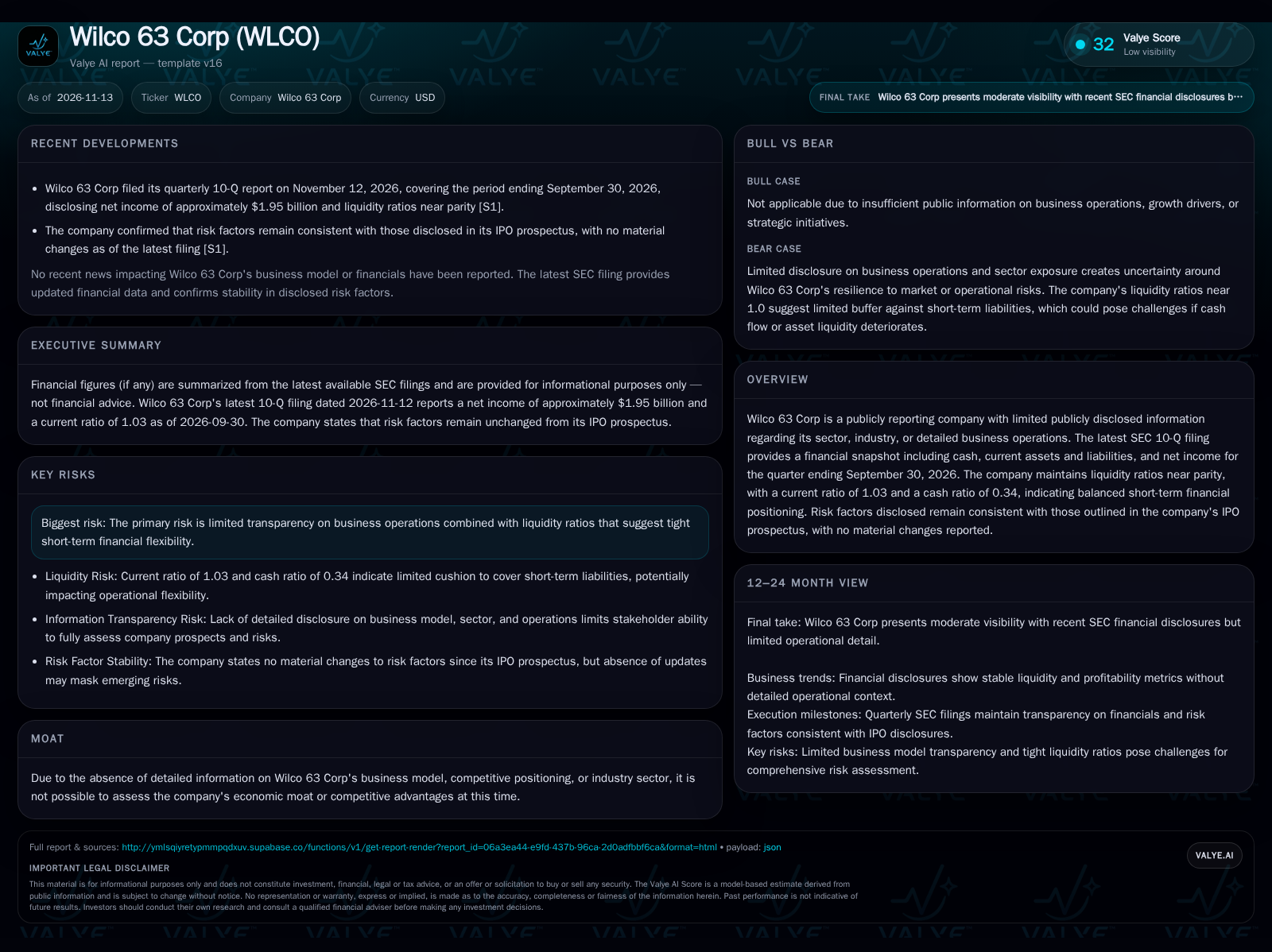
Wilco 63 Corp is a blank check company that has yet to announce a business combination. Its financials reflect interest income from IPO proceeds, current assets marginally above liabilities, and no operational revenues. The lack of a target and reported liquidity position buffer highlight the importance of deal execution and market conditions in determining future value creation. [S1]
Wilco 63 Corp’s status as a pre-combination special purpose acquisition company (SPAC) places it at a crossroads: the clock is ticking to identify and consummate a merger, with IPO proceeds parked in trust driving modest interest income but no underlying business activity. With a current ratio barely above parity and no announced target, Wilco 63’s value proposition is entirely contingent on future deal execution. The SPAC’s financial structure, risk disclosures, and macro environment collectively frame both its opportunity and its vulnerabilities.
Wilco 63 Corp’s Financial Position and Pre-Combination Status Define the Present
As of September 30, 2026, Wilco 63 Corp had not entered into a definitive agreement with any business combination target. The company’s net income of $1.95 million for the quarter was generated exclusively from interest earned on marketable securities held in trust, with no operating revenues reported. Current assets stood at $207.95 million, just above current liabilities of $202.52 million, resulting in a current ratio of 1.03 and a cash ratio of 0.34. These figures indicate that almost all liquidity is tied up in the trust, and the company’s ability to meet short-term obligations is closely balanced. The risk factors disclosed in the latest 10-Q remain unchanged from the IPO prospectus, suggesting no new developments or operational shifts. [S1]
SPAC Economics: Trust Interest, Fee Structures, and the Countdown to De-SPAC
Wilco 63 Corp’s business model follows the typical SPAC structure: capital is raised via an IPO, proceeds are held in trust, and the company seeks a merger with an operating business. Until such a deal is executed, the only revenue source is interest earned on trust assets, which contributed the reported net income. The company incurs ongoing expenses—legal, compliance, and due diligence costs—that are drawn from its working capital outside the trust. The economics for SPAC sponsors and public shareholders hinge on successfully identifying an attractive target and closing a business combination before the SPAC’s deadline (typically 18-24 months from IPO, though the exact timeframe is not specified here). If no deal is completed, funds (net of certain expenses) are returned to shareholders, and the SPAC is liquidated.
Operating leverage is minimal until a target is acquired. The trust structure creates a high fixed-cost environment relative to negligible operating income, with dilution risk from warrants and deferred underwriting fees. The capital structure also includes a significant deferred underwriting fee ($9.8 million) and private placement warrants, both of which are contingent on deal completion and future share price performance. [S1]
The interplay between the trust structure and the SPAC’s operational expenses creates a delicate liquidity management challenge. Since the trust funds are legally restricted and cannot be used for operating expenses, the company must rely on the working capital raised outside the trust to cover ongoing costs. This bifurcation means that even with substantial trust assets, the SPAC’s ability to sustain search and due diligence activities is limited by the size and burn rate of its non-trust funds. Consequently, the timing and efficiency of target identification become critical, as prolonged search phases can deplete working capital, potentially forcing the SPAC to seek extensions or alternative financing, which may dilute shareholder value or increase risk.
SPAC Market Dynamics and the Race for Quality Targets
Wilco 63 Corp operates within the highly competitive SPAC landscape, where dozens of blank check companies are simultaneously seeking merger candidates. The market has seen significant crowding, with increased scrutiny from regulators and public investors regarding deal quality, post-merger performance, and sponsor alignment. The primary competitive pressure is the ability to source, negotiate, and close a value-accretive transaction ahead of peers, as well as to convince target companies and their shareholders that a SPAC merger offers superior outcomes to traditional IPOs or private funding.
Substitutes for Wilco 63’s capital include traditional IPOs, direct listings, private equity, and venture capital. The lack of an identified target, coupled with a tightly reported liquidity position, means Wilco 63 must compete aggressively on deal terms, sponsor reputation, and the perceived value-add of a public listing. In this environment, SPACs with clear sector focus, experienced management, or differentiated sourcing networks may enjoy a relative advantage, but these attributes are not discernible from Wilco 63’s public disclosures.
Successful Business Combination Could Unlock Value Beyond Trust Proceeds
The most favorable scenario for Wilco 63 Corp is the timely identification and consummation of a business combination with a high-growth or undervalued private company. If the SPAC can secure an attractive target, negotiate favorable terms, and execute the de-SPAC process efficiently, shareholders could realize value through share appreciation, warrant conversion, and potential long-term upside in the merged entity.
Confirmation of this scenario would require a definitive merger announcement with credible projections, supportive market reaction, and evidence that redemptions are limited (preserving capital for the post-merger entity). Conversely, failure to identify a target, excessive redemptions, or regulatory delays would challenge the upside case.
Most Plausible Outcome: Deal Execution Pressures Mount as Deadline Approaches
The central scenario for Wilco 63 Corp is that it continues to pursue a business combination, incurring administrative and search costs, while trust assets generate modest interest income. As the SPAC’s deadline approaches, pressure increases to announce a deal; this dynamic can incentivize suboptimal transactions or aggressive deal structuring.
Evidence supporting this scenario would include continued 10-Q disclosures without a merger announcement, incremental drawdown of working capital for expenses, and possible extensions or amendments to the SPAC’s timeline. A base case outcome is a deal at or near the deadline, with significant redemptions and uncertain post-merger trading performance—a pattern observed in many recent SPAC cycles.
No Deal, High Redemptions, or Adverse Market Shifts Could Result in Liquidation
The adverse scenario for Wilco 63 is failure to secure a business combination within the permitted timeframe, leading to liquidation and return of trust proceeds to shareholders, less expenses. This outcome is plausible if market conditions deteriorate, targets become scarce or too expensive, or regulatory or shareholder hurdles prove insurmountable.
Downside confirmation would come from repeated extensions, shareholder votes against proposed combinations, or the filing of liquidation notices. High redemption rates—even if a deal is announced—could also erode the capital base, making the post-merger entity less viable.
Milestones That Will Shape Wilco 63 Corp’s Prospects
Announcement of a definitive business combination agreement, including target sector, valuation, and pro forma financials.
Level of shareholder redemptions at the time of deal approval—a critical indicator of capital retention and investor confidence.
Updates on SPAC extension votes or amendments to the original deal timeline, if disclosed.
Trends in administrative and due diligence expenses, which impact available working capital outside the trust.
Market and regulatory conditions affecting SPAC deal activity, including changes in SEC rules or macro volatility.
Details on warrant structure and potential dilution, especially if deal terms are renegotiated or sweetened.
Any material changes to risk factors or disclosures in subsequent SEC filings.
Disclaimer: This is research-only, informational analysis and not investment advice. It may include AI-generated interpretation and general industry context. Always verify important details using primary sources.

Comments